


VideoSDK, Agora, and Daily.co are the top Jitsi alternatives for developers in 2026. VideoSDK leads on managed infrastructure, AI features, and cross-platform SDK coverage at $0.004 per participant-minute for video. Agora leads on global network scale. Daily.co leads on fastest integration time. This list covers 10 ranked options across pricing, scalability, AI capabilities, and developer experience, so you can choose without reading 10 separate product sites.
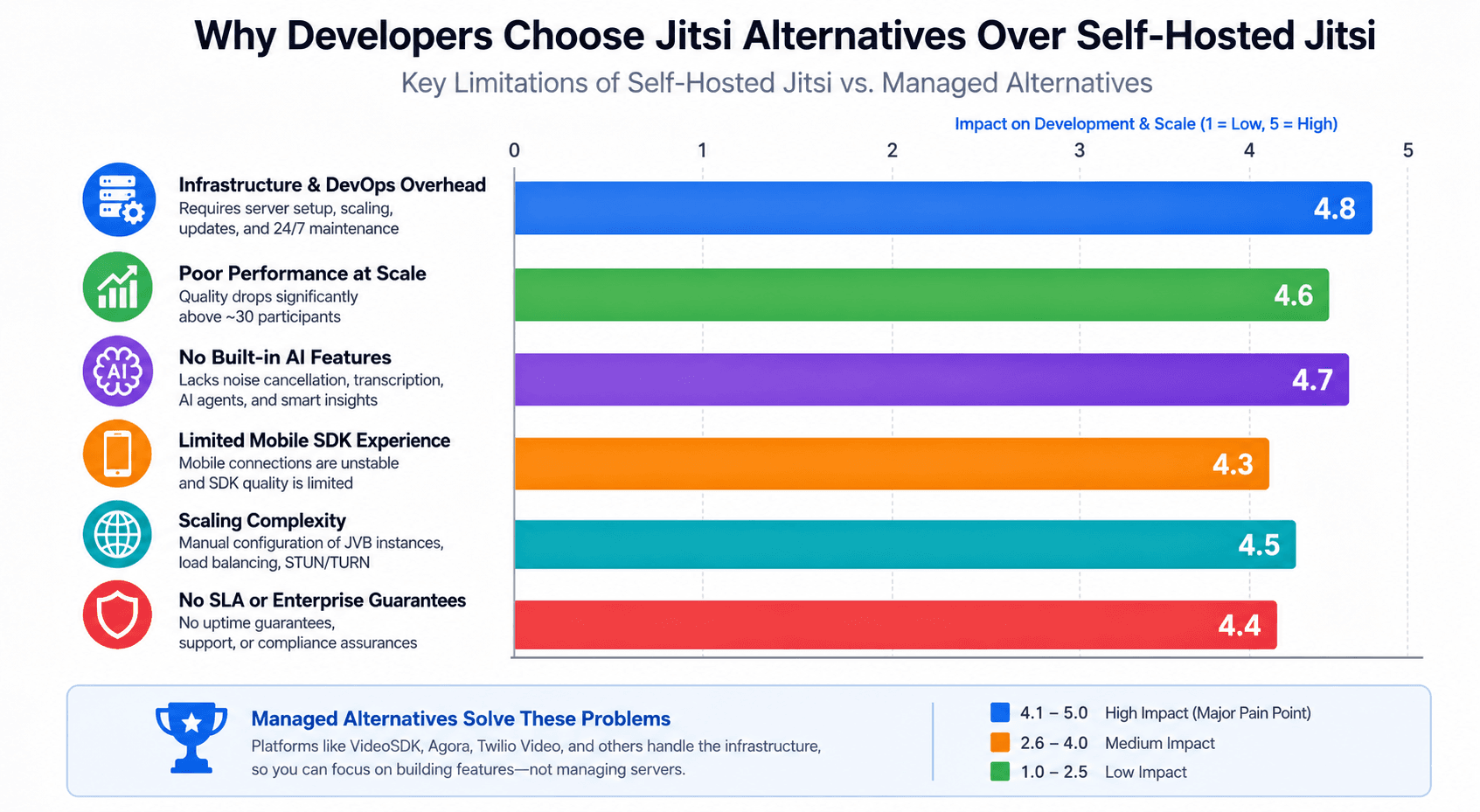
Jitsi works fine for basic video calling, but developers who deploy it in production consistently hit three walls: infrastructure management overhead that compounds as you scale, performance degradation above 30 concurrent participants in self-hosted deployments, and zero native AI features at a time when noise cancellation, real-time transcription, and AI voice agents are standard in competing platforms.
According to a 2026 Fortune Business Insights report, the global WebRTC market size was valued at USD 9.56 billion in 2025. The market is projected to grow from USD 13.07 billion in 2026 to USD 122.08 billion by 2034, exhibiting a CAGR of 32.21% during the forecast period. North America dominated the global webrtc market with a share of 37.18% in 2025. That growth is driven by demand for exactly what Jitsi lacks: managed, scalable, AI-capable real-time communication infrastructure. The 10 Jitsi alternatives below are evaluated on five criteria every developer actually needs to make a decision.
What Is Jitsi?
Jitsi is defined as a collection of open-source WebRTC projects for video conferencing, with Jitsi Meet (the end-user application) and Jitsi Videobridge (the Selective Forwarding Unit media server) as its primary components. Jitsi works by routing media through a self-hosted SFU, which means the developer is responsible for provisioning, scaling, and maintaining the server infrastructure, including TURN servers for NAT traversal, load balancing, and uptime monitoring.
What Is a Jitsi Alternative?
A Jitsi alternative is defined as any video communication platform or SDK that provides real-time audio, video, and messaging capabilities as a replacement for Jitsi Meet or the Jitsi Videobridge infrastructure. These alternatives range from open-source self-hosted frameworks to fully managed cloud APIs.
Jitsi Meet is an open-source video conferencing solution built on WebRTC and the Jitsi Videobridge (JVB) selective forwarding unit. It works well for small deployments but requires significant DevOps effort to self-host at scale. A Jitsi alternative works by providing the same real-time communication capabilities through a managed API, SDK, or pre-built infrastructure that removes the self-hosting burden.
Teams typically look for a Jitsi alternative when they need higher participant limits, enterprise SLA guarantees, AI-powered features like noise cancellation or transcription, or faster developer integration with fewer lines of code.
Why Developers Look for Jitsi Alternatives
Jitsi's self-hosted model creates real operational costs that compound as your product scales.
Jitsi Meet is free and open-source, which makes it attractive at first glance. However, teams that deploy it in production consistently report three critical gaps: infrastructure management overhead, performance degradation above 30 concurrent participants, and limited native mobile SDK quality. According to community reports on the Jitsi GitHub repository, issues like audio sync failures and mobile connection drops remain recurring problems even in recent versions.
Beyond technical limits, Jitsi lacks built-in AI features (noise suppression, real-time transcription, AI voice agents), which are now table-stakes for competitive communication products. Developers building modern apps need a platform that handles the media infrastructure so they can focus on product features, not server maintenance.
The alternatives below solve these gaps. Each is evaluated across five decision drivers: developer experience, scalability, AI features, pricing model, and platform support.
Why explore a Jitsi Alternative
There are various reasons why someone might seek a Jitsi alternative. It could be due to specific feature requirements, such as the need for better performance in larger meetings or concerns about security and privacy. Integration with existing tools and a simpler, more user-friendly interface are also common considerations. By exploring alternative platforms, individuals or organizations can find a video conferencing solution that better aligns with their needs and preferences.
How We Evaluated These Jitsi Alternatives
Each Jitsi alternative in this list was assessed across five criteria. Any tool that could not be independently verified across all five was excluded.
- Developer experience: Time to first working video call, quality of SDK documentation, and availability of quickstart guides for web, iOS, Android, and React Native
- Participant scalability: Maximum verified concurrent participants and the infrastructure model (self-hosted SFU vs. managed cloud vs. global CDN edge nodes)
- AI feature set: Native noise cancellation, real-time transcription, AI voice agent support, and STT/TTS/LLM pipeline availability
- Pricing transparency: Whether pricing is published, per-minute vs. flat-rate, and whether a free tier is available without a credit card requirement
- Platform support: Coverage across web (JavaScript/React), mobile (Flutter, iOS, Android, React Native), and desktop
The top 10 Jitsi alternatives are VideoSDK, Twilio, MirrorFly, Agora, WebRTC, Vonage, AWS Chime, EnableX, WhereBy, and SignalWire.
Top 10 Jitsi Alternatives for 2026
- VideoSDK
- Twilio Video
- MirrorFly
- Agora
- WebRTC
- Vonage
- AWS Chime SDK
- Enablex
- Whereby
- SignalWire
1. VideoSDK: Best Overall Jitsi Alternative for Developer-First Teams
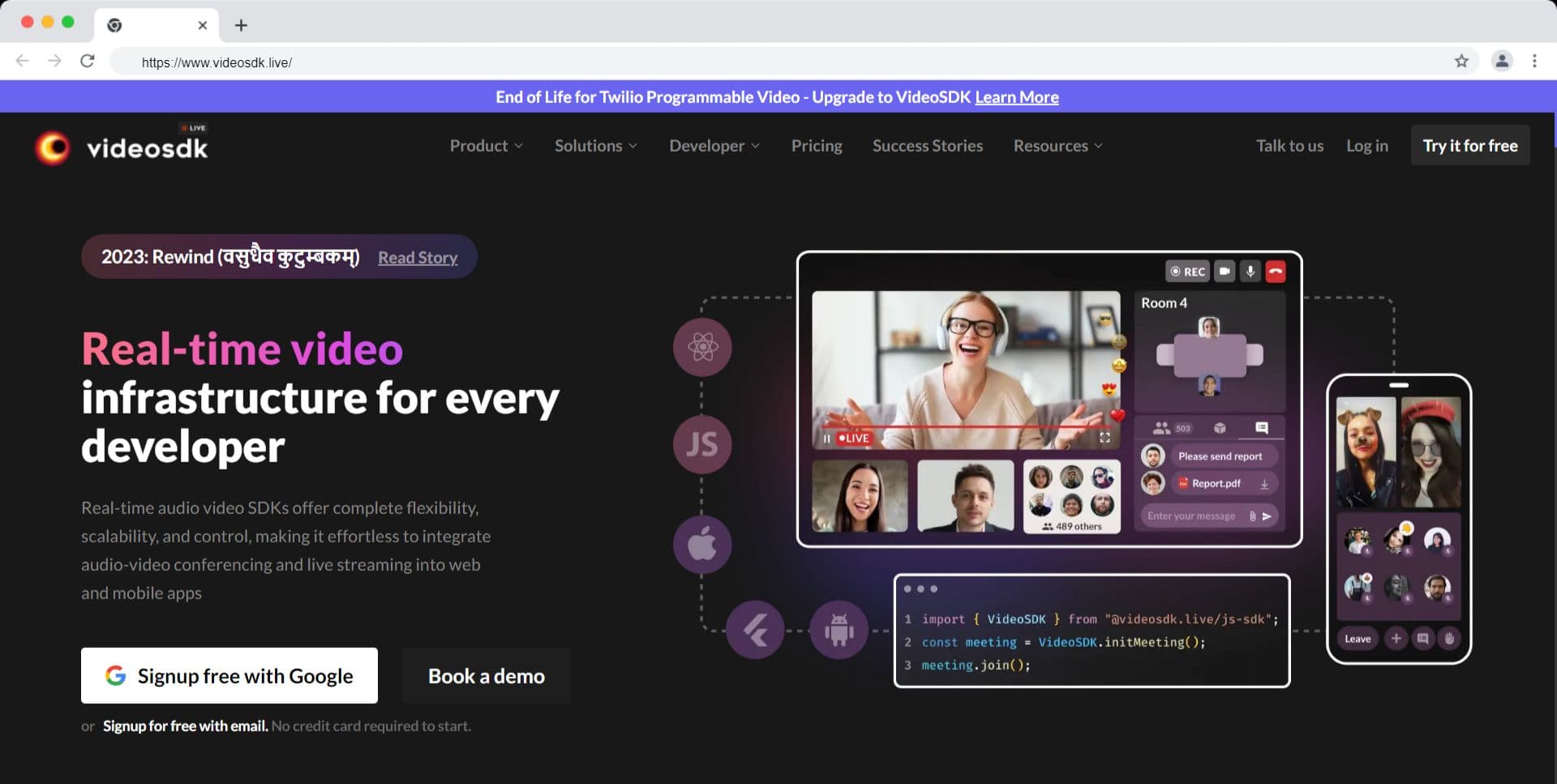
VideoSDK is a developer-first real-time communication platform providing audio and video calling APIs, interactive live streaming, AI voice agents, and telephony (SIP) in a single product with unified SDKs across React, React Native, Flutter, iOS, Android, Unity, and Python.
Key features:
- Unified SDK across 8 platforms with prebuilt UI components for React and React Native, reducing the integration surface compared to assembling Chime SDK with separate Lambda functions
- Sub-80ms global latency for peer-to-peer audio calls on VideoSDK's distributed edge infrastructure
- Interactive live streaming (sub-3-second latency) as a first-class API, not an add-on service
- Server-side cloud recording, real-time transcription, and session analytics in one platform
- AI Voice Agents framework (STT plus LLM plus TTS pipeline) for teams building voice AI on top of their calling infrastructure
- SIP trunk integration with Twilio, Plivo, and other PSTN providers for connecting calls to traditional phone networks
- Free tier with $20 credit, no credit card required, and no hard limits during exploration
Pricing: Video calls at $0.004 per participant minute, audio calls at $0.001 per participant-minute, AI agent sessions at $0.01 per minute, cloud recording at $0.015 per minute. Enterprise plans include VPC deployment and a 99.99% uptime SLA with custom pricing. (Note: Verify Pricing at VideoSDK pricing page.)
Best for: Engineering teams migrating off Amazon Chime SDK who need multi-platform mobile SDK support, interactive live streaming, or AI voice features without managing multiple vendor accounts.
Limitation: VideoSDK does not offer an on-premises deployment option outside enterprise VPC contracts. Teams requiring full self-hosted infrastructure should evaluate Jitsi instead.
Start building with VideoSDK's free tier ($20 credit, no credit card required): Sign up now.
Here's a detailed comparison of Jitsi and VideoSDK.
Schedule a Demo with Our Live Video Expert!
Discover how VideoSDK can help you build a cutting-edge real-time video app.
2. Twilio Video: Best for Teams Already on the Twilio Stack
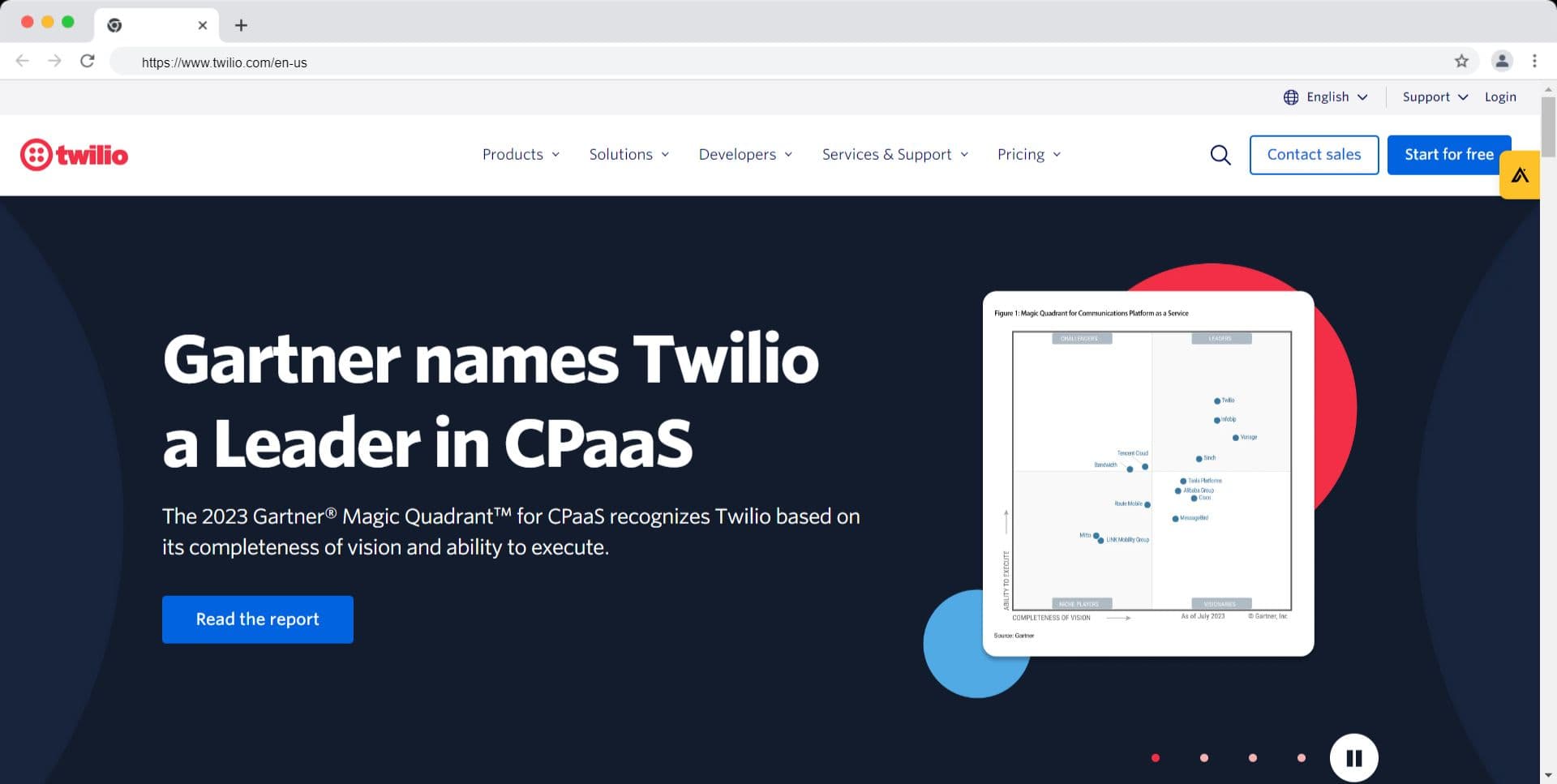
Twilio Video is a WebRTC-based video conferencing API providing SDKs for web, iOS, and Android with programmable video rooms supporting up to 50 participants per session.
Key features:
- Twilio SDKs for web, iOS, and Android with REST API for room management
- Call quality insights dashboard for error analysis and session diagnostics
- Deep integration with Twilio's messaging, voice, and authentication products for teams building unified communication stacks
- Network quality signals for client-side adaptive bitrate management
Pricing: Twilio Video Group Rooms start at approximately $4 per 1,000 participant-minutes. Recording and composition are billed separately. The free tier includes limited test minutes. (Note: Verify Pricing at the Twilio's pricing page.)
Best for: Teams that already use Twilio for SMS, voice, or two-factor authentication and want to consolidate their communication vendor.
Limitation: Twilio Video has announced end-of-life for its Programmable Video product. Teams evaluating Twilio as an Amazon Chime alternative should factor the migration risk of a second platform change into their decision.
Here's a detailed comparison of Jitsi and Twilio.
3. MirrorFly: Best for On-Premise Enterprise Chat and Video
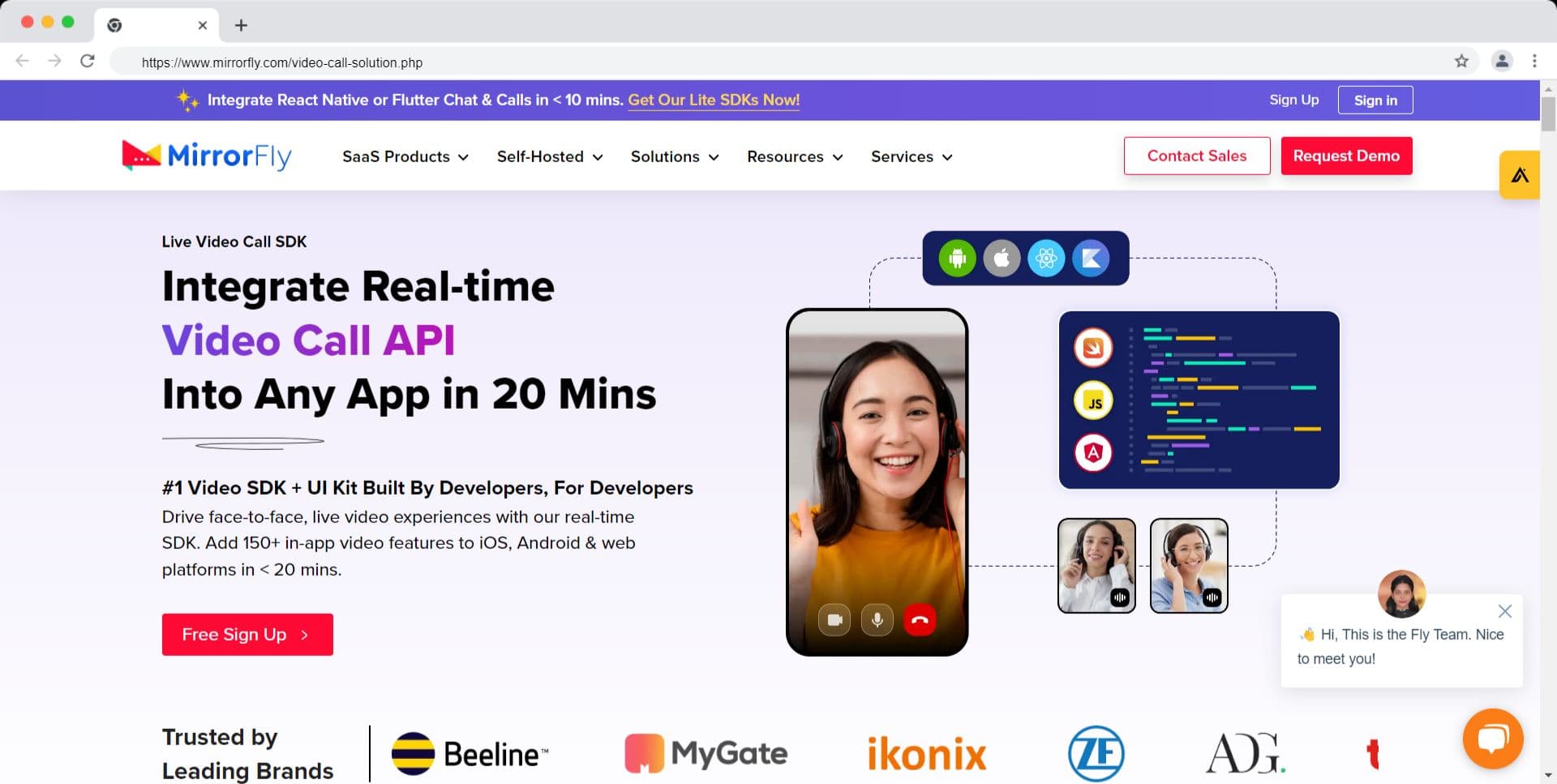
MirrorFly is an enterprise-grade in-app communication platform providing a self-hosted suite of over 150 chat, voice, and video calling features delivered via APIs and SDKs for iOS, Android, and web applications.
Key features:
- Self-hosted deployment option for teams requiring full data sovereignty and on-premises infrastructure
- Over 150 prebuilt chat, voice, and video features including screen sharing, file transfer, and message threading
- White-label solution allowing complete UI customization with no MirrorFly branding
- Compliance-ready architecture for HIPAA, GDPR, and enterprise security audits
- Role-based access control and admin dashboard for managing users at scale
Pricing: MirrorFly pricing starts at $299 per month for cloud-hosted plans. Self-hosted enterprise licensing is quoted on request. (Note: Verify Pricing at MirrorFly's pricing page.)
Best for: Regulated-industry enterprises (healthcare, fintech, legal) that require full data control via self-hosted deployment and need a deep feature set without building from scratch.
Limitation: MirrorFly's pricing floor makes it one of the higher-cost options for early-stage teams or startups. Teams that do not require self-hosting will find VideoSDK or Agora more cost-effective at lower usage volumes.
4. Agora: Best for Global Scale and Ecosystem Breadth
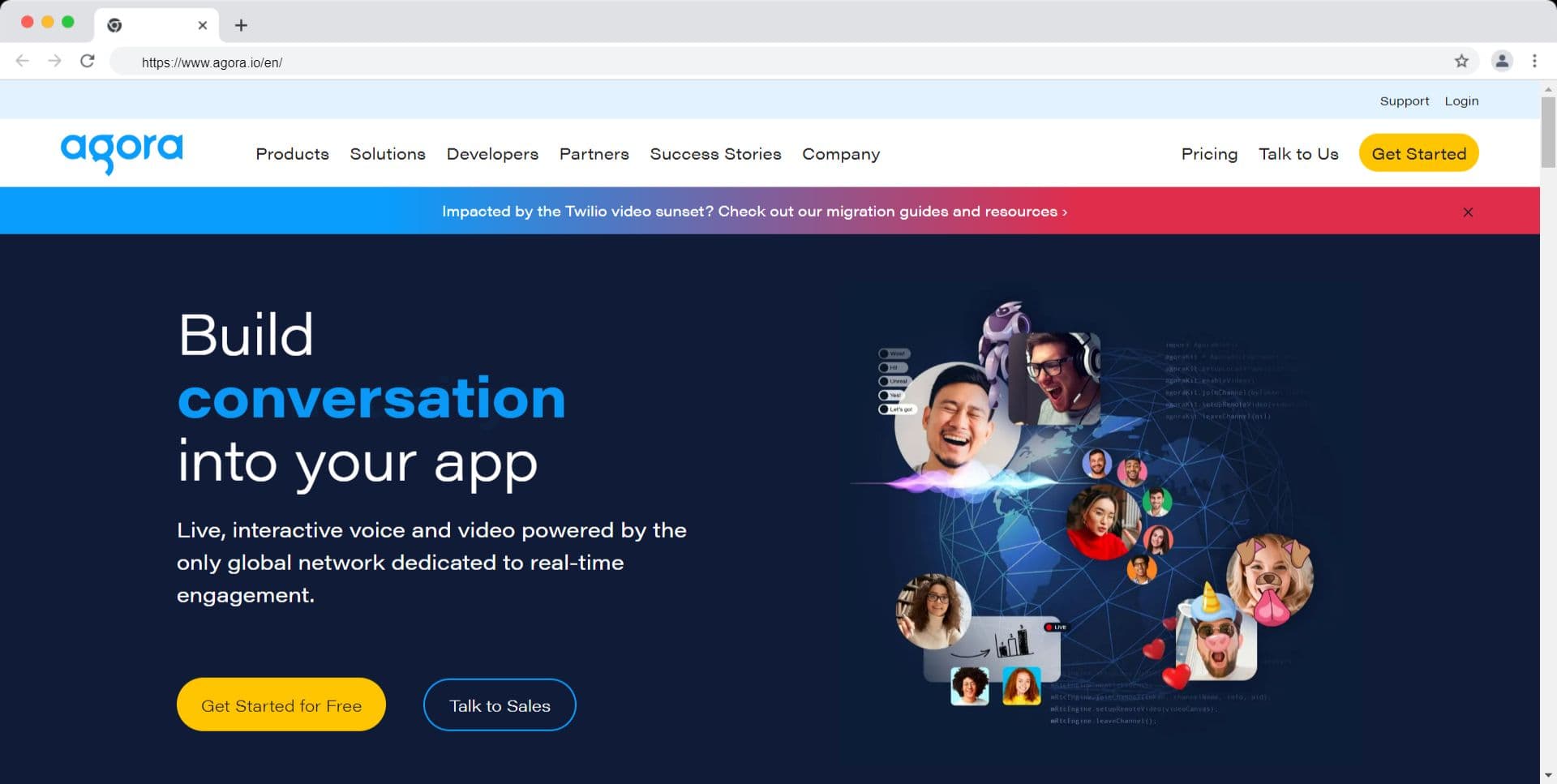
Agora is a real-time engagement platform providing video calling, interactive live streaming, and virtual interactive sessions with a global SD-RTN (Software Defined Real-time Network) infrastructure optimized for Asia-Pacific regions.
Key features:
- SD-RTN global network with published sub-400ms end-to-end latency for 1-to-1 and small group calls
- Interactive live streaming supporting audiences of 1 million viewers with host-to-audience latency under 3 seconds
- SDKs for iOS, Android, web, Unity, Electron, Flutter, and React Native
- Agora Extensions Marketplace for third-party AI features including noise suppression and virtual backgrounds
- Co-hosting, pinning, and audience interaction features for broadcast use cases
Pricing: Agora video calling starts at approximately $3.99 per 1,000 minutes. Voice calling starts at $0.99 per 1,000 minutes. Recording and cloud transcoding are billed at additional rates. (Note: Verify Pricing at Agora pricing page.)
Best for: Applications requiring strong Asia-Pacific infrastructure coverage, high-audience interactive live streaming, or virtual event features.
Limitation: Customization options for the video call interface require deeper SDK knowledge than VideoSDK's prebuilt components. Advanced recording and transcription features carry additional charges that compound at scale.
Here's a detailed comparison of Jitsi and Agora.
5. Daily.co: Best for Fastest Integration Time
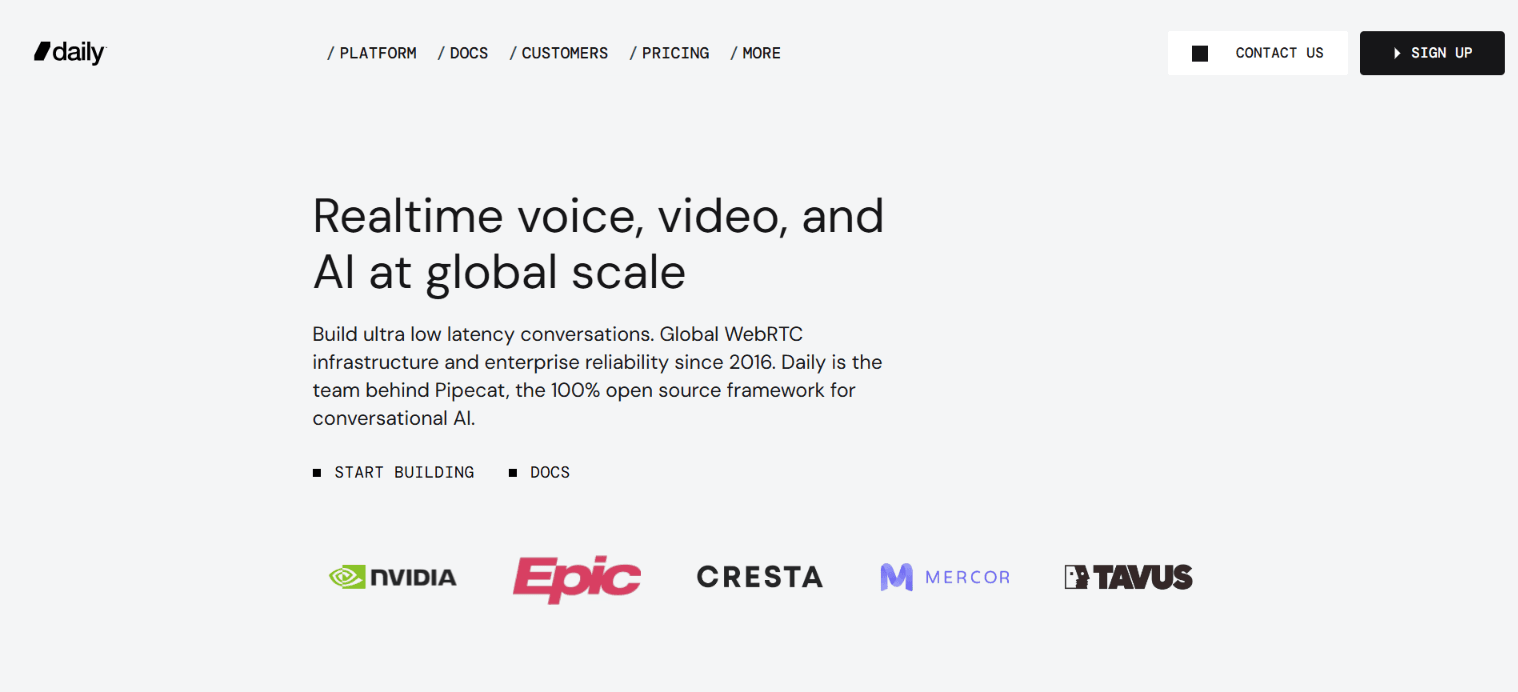
Daily.co is a video infrastructure platform built on WebRTC, designed specifically to minimize the lines of code required to ship a working video call. A functional video room is available via an embeddable prebuilt UI or a React component library.
Key features:
- Prebuilt UI that works with a single
<DailyCall />React component - Daily Bots: a programmable AI agent layer for noise cancellation, transcription, and custom LLM integration
- HIPAA-compliant plans for healthcare applications
- REST API for room creation, token generation, and recording management
Pricing: Pay-as-you-go starts at $0.00099 per participant-minute. A developer tier offers 2,000 free participant-minutes per month. Custom enterprise pricing available. (Note: Verify Pricing at the daily pricing page.)
Best for: Startups and small teams that want a working demo in hours and are willing to accept Daily's UI conventions in exchange for faster time-to-market.
Limitation: Customization depth is more limited than VideoSDK or Agora for teams that need full control over the media pipeline and UI. The prebuilt UI does not support deep white-labeling without significant override work.
Here's a detailed comparison of Jitsi and Daily.
6. Vonage: Best for Legacy Enterprise Integrations
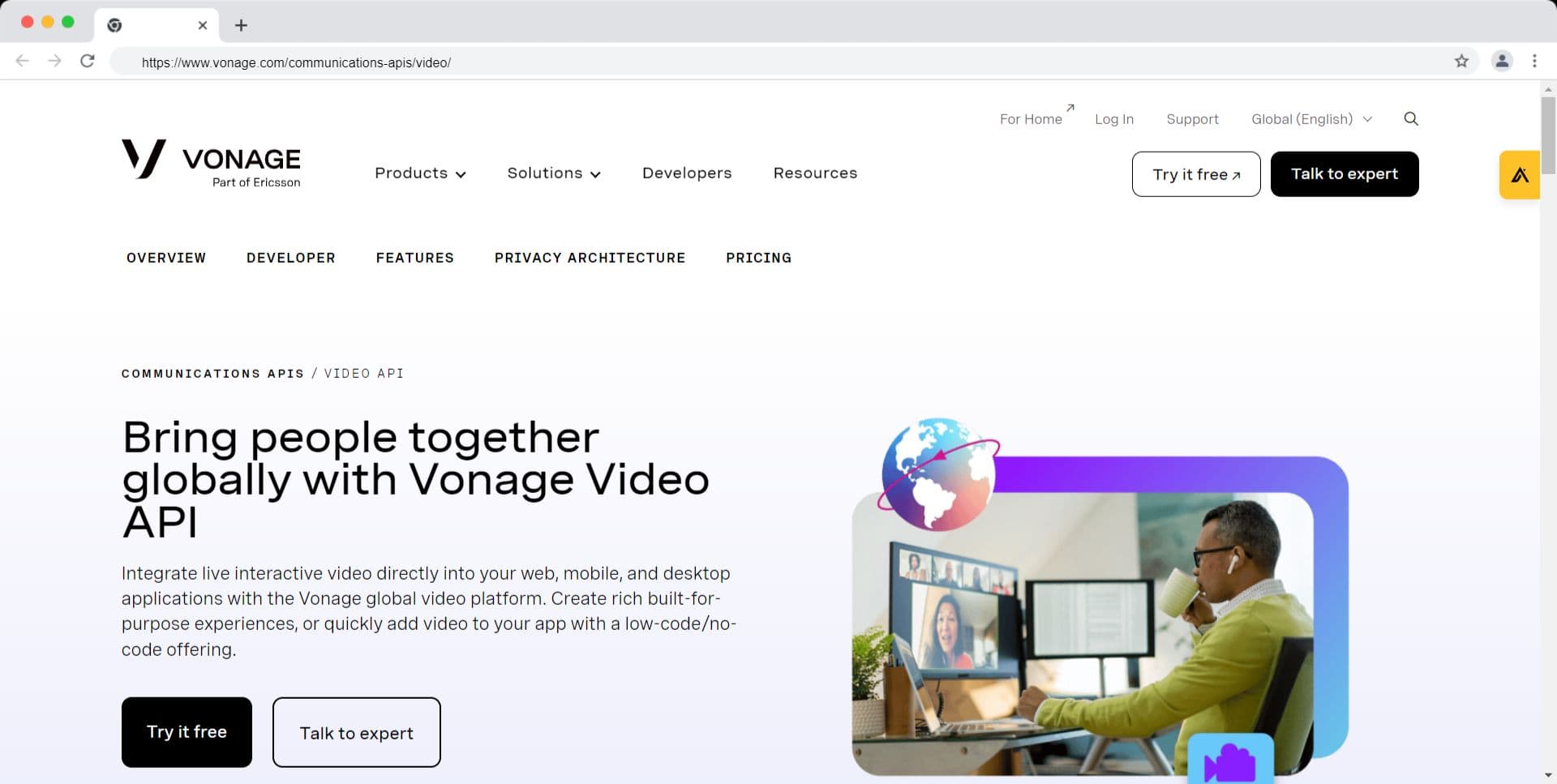
Vonage Video API, formerly known as OpenTok, is a WebRTC-based programmable video platform providing video conferencing, live streaming, and interactive broadcast tools for web and mobile applications, now owned by Ericsson.
Key features:
- WebRTC video conferencing supporting up to 25 video participants and up to 200 audio-only participants
- Interactive live streaming (broadcast mode) for audiences beyond the core participant limit
- Collaborative features including screen sharing, chat, and whiteboard
- Dial-in PSTN audio for participants in 60 countries
- Session archiving (server-side recording) as a managed service
Pricing: Vonage Video API plans start at approximately $9.99 per month with 2,000 free included minutes. Additional usage is billed per minute, with advanced features (broadcast, archiving) billed at separate rates. (Note: Verify Pricing at Vonage pricing page.)
Best for: Telehealth providers and EdTech platforms with established OpenTok deployments who need to maintain existing integrations while scaling participant count.
Limitation: Vonage's acquisition by Ericsson has introduced uncertainty about the product roadmap. Teams considering Vonage for new builds should confirm the current supported SDK versions and roadmap before committing.
Here's a detailed comparison of Jitsi and Vonage.
7. AWS Chime SDK: Best for AWS-Native Architectures
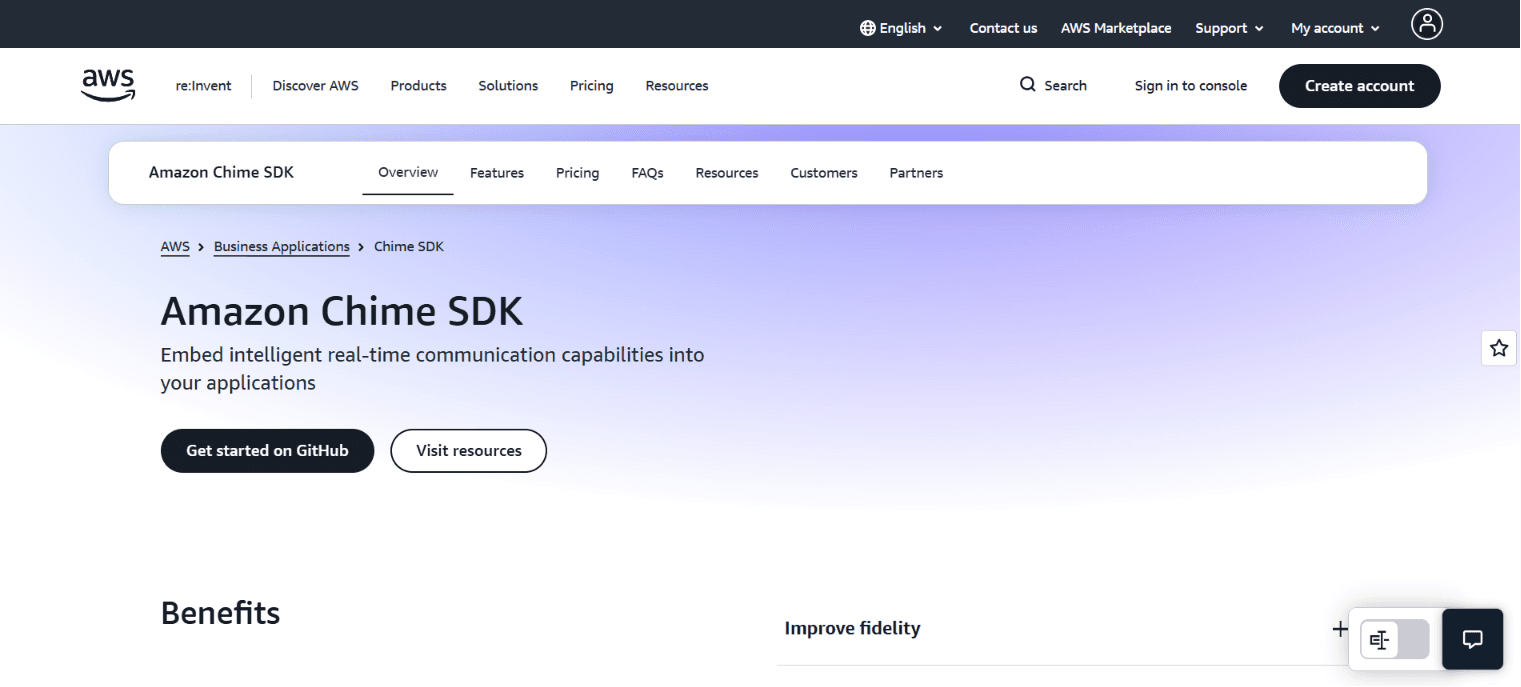
AWS Chime SDK is a set of real-time communication components from Amazon Web Services that developers assemble into custom video calling, audio calling, and messaging applications. Unlike other options on this list, AWS Chime SDK is a component library, not a fully managed service, developers build the application logic and session management themselves.
Key features:
- Amazon Voice Focus: machine-learning-based noise suppression built into the SDK
- Meeting sessions scale automatically via AWS infrastructure
- Native integration with other AWS services: S3 for recording, DynamoDB for session data, Lambda for business logic
- Available for JavaScript, iOS, and Android
Pricing: Approximately $0.0017 per attendee-minute for audio and video. Recording and media capture pipeline pricing is separate. (Note: Verify Pricing at Amazon Chime SDK pricing page.)
Best for: Teams already deeply invested in the AWS ecosystem who want to build video calling tightly integrated with their existing AWS infrastructure and IAM permission model.
Limitation: AWS Chime SDK requires significantly more development time than other options. There is no prebuilt UI – developers must build all session management, participant UI, and control logic from scratch.
Here's a detailed comparison of Jitsi and AWS Chime.
8. EnableX: Best for Low-Code Video in Emerging Markets
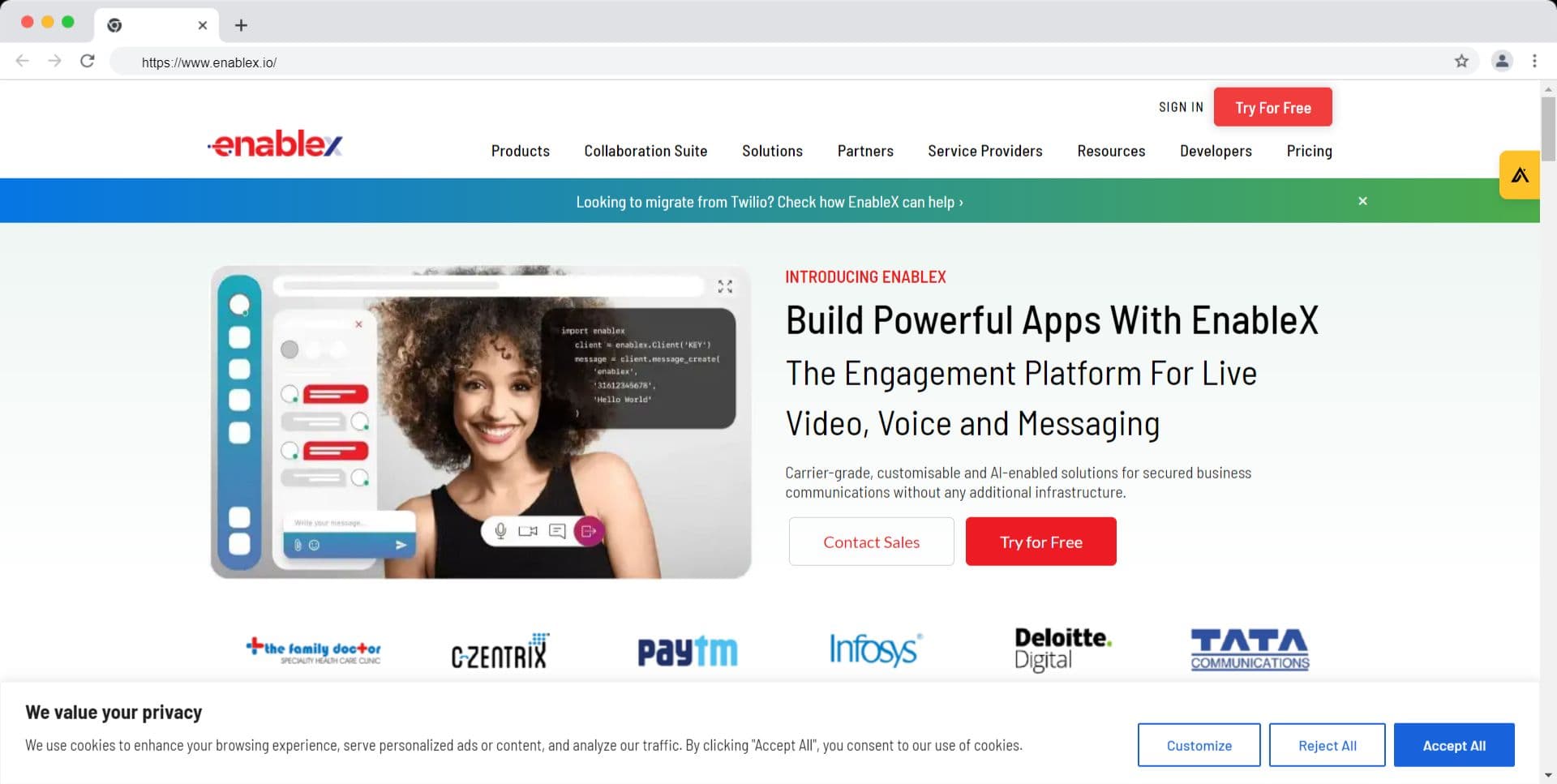
EnableX is a CPaaS (Communications Platform as a Service) providing live video, voice, and messaging SDKs for JavaScript, PHP, and Python, with infrastructure optimized for South Asia and Southeast Asia deployments.
Key features:
- Video calling and live streaming SDKs for JavaScript, PHP, and Python
- Supports up to 50 participants per video session with additional capacity at enterprise tiers
- Customizable video layouts, floor control, and moderator features for virtual event use cases
- First-class support for South Asia and Southeast Asia infrastructure with regional edge nodes
Pricing: EnableX starts at $0.004 per participant-minute for up to 50 participants. Recording, transcoding, storage, and RTMP streaming carry additional charges per minute. (Note: Verify Pricing at EnableX pricing page.)
Best for: Product teams serving South Asian or Southeast Asian markets where EnableX's regional infrastructure provides latency advantages and teams building in PHP or Python backend stacks.
Limitation: EnableX's SDK language support (JavaScript, PHP, Python) is narrower than VideoSDK or Agora's cross-platform coverage. Teams building native iOS, Android, or Flutter apps will need to verify current mobile SDK availability before committing.
9. Whereby: Best for Low-Participant Embedded Video Without an SDK
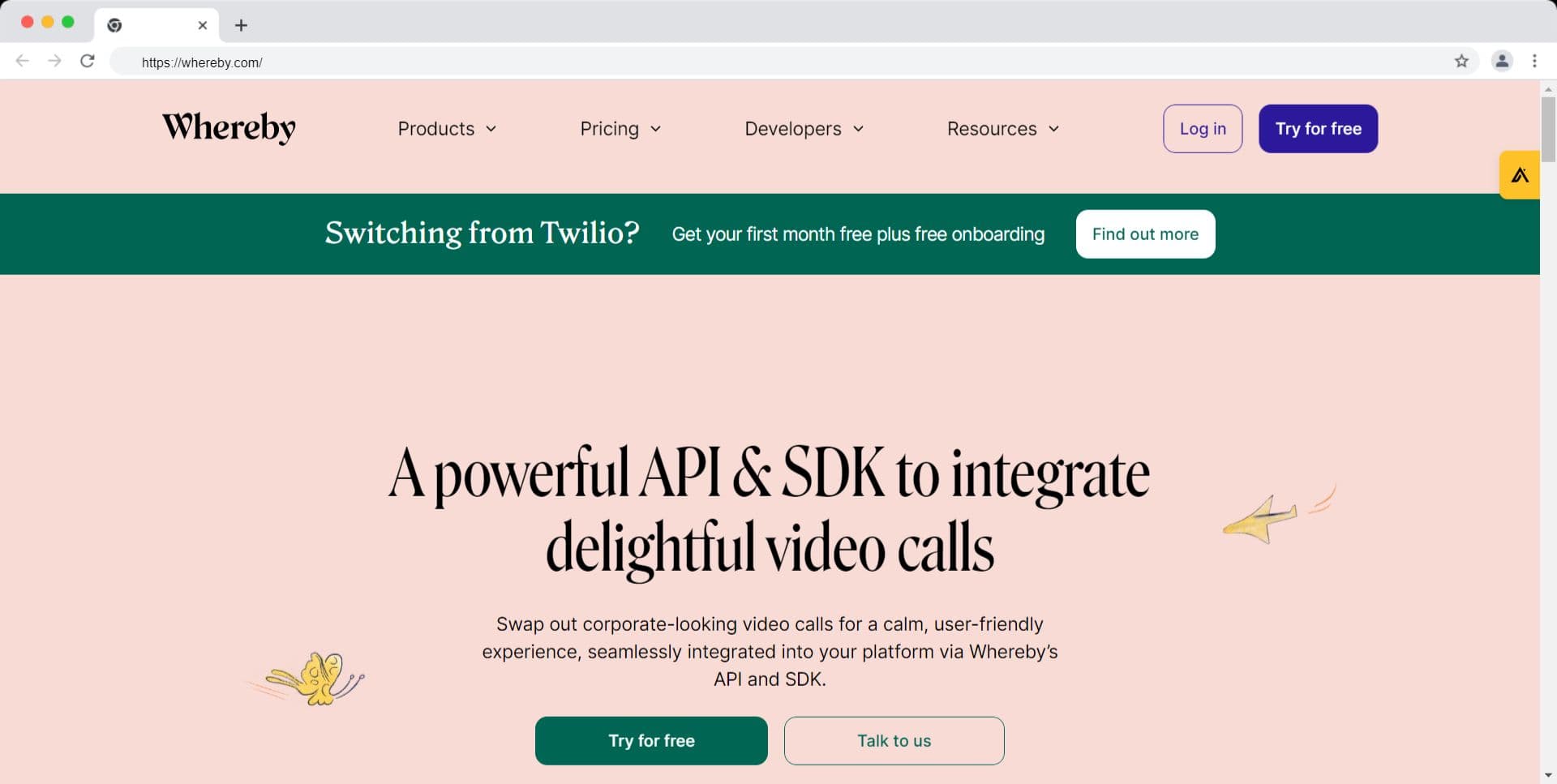
Whereby is a browser-based video meeting platform that provides a Whereby Embedded API for developers to integrate video meetings into web applications without managing WebRTC infrastructure, media servers, or recording pipelines.
Key features:
- Permanent room URLs that require no downloads or registrations for participants
- Whereby Embedded API allows iframe-based or programmatic video room integration into any web application
- Hybrid meeting features with echo reduction and no dedicated hardware requirement
- End-to-end encryption with GDPR-compliant data handling
- Breakout rooms, screen sharing, and recording available on higher tiers
Pricing: Whereby plans for embedded use start at $6.99 per month for basic embedding. Higher tiers with recording, branding removal, and API access are billed at monthly flat rates. (Note: Verify Pricing at Whereby pricing page.)
Best for: Web application teams that need fast video meeting integration without custom SDK implementation, non-technical teams embedding video into content platforms or no-code tools, and European teams prioritizing GDPR-native data handling.
Limitation: Whereby Embedded is not a programmable SDK in the same sense as Chime SDK or VideoSDK. Teams needing custom media control, recording pipelines, AI feature integration, or native mobile calling will outgrow Whereby's embed-first architecture quickly.
10. SignalWire: Best for Developers Who Need Programmable Telephony Plus Video
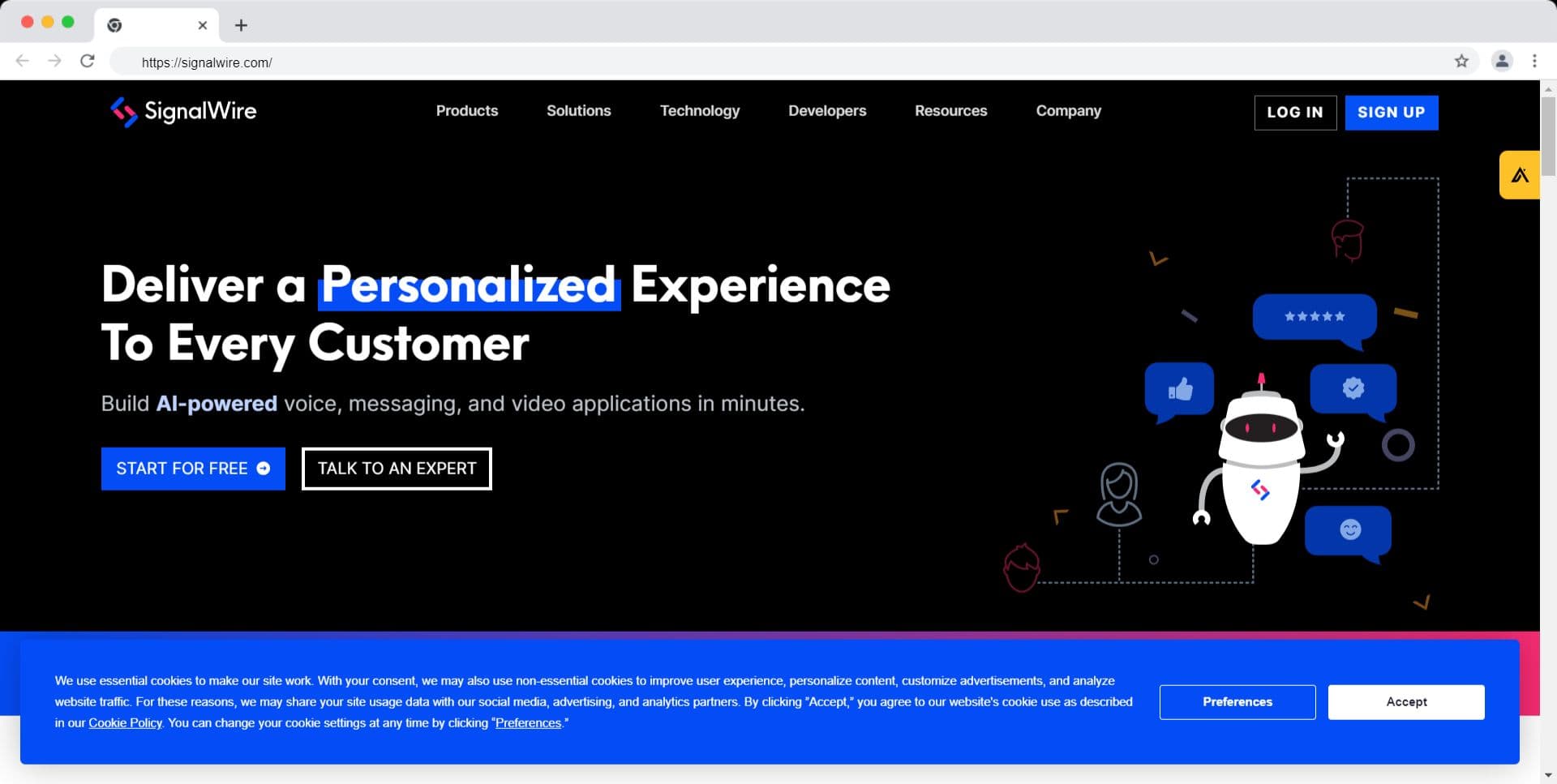
SignalWire is a cloud communications platform providing programmable voice, video, and messaging APIs built on an open-source FreeSWITCH foundation, designed for developers integrating video calls alongside PSTN telephony and SIP infrastructure.
Key features:
- Video rooms supporting up to 100 participants with SDKs for web, iOS, and Android
- Native integration with SignalWire's PSTN telephony, SIP trunking, and SMS APIs
- Relay SDK for event-driven application logic that handles call state, participant events, and session routing
- HD and Full HD video options with per-resolution pricing
- Recording and RTMP streaming as add-on features billed separately
Pricing: SignalWire video pricing is per-minute based on resolution (HD or Full HD). Recording and streaming carry separate rates. Trial credits available on signup. (Note: Verify Pricing at SignalWire pricing page.)
Best for: Developers building applications that combine video conferencing with PSTN calling, SIP integration, or SMS workflows in a single programmable platform.
Limitation: Application logic for disruption handling, reconnection, and user management must be implemented by the developer. SignalWire does not provide prebuilt UI components comparable to VideoSDK or Agora.
Jitsi Alternative Comparison Table
| Tool | Pricing Model | AI Features | Max Participants | Best For |
|---|---|---|---|---|
| VideoSDK | $0.004/participant-min video | Full STT+LLM+TTS pipeline, noise cancellation, transcription | 1,000+ (managed cloud) | AI-powered apps, cross-platform production builds |
| Agora | $3.99/1,000 HD minutes | Noise cancel, echo suppression, transcription | Global scale, 10,000+ | Global deployments, large enterprise scale |
| Daily.co | $0.00099/participant-min | Daily Bots (AI agents), transcription | 1,000 (broadcast) | Fast integration, startup MVPs |
| Twilio Video | $0.004/participant-min | None native | 50 (group rooms) | Twilio-stack teams |
| Vonage Video | Contact sales | None native | 3,000 (broadcast) | Legacy OpenTok migrations |
| AWS Chime SDK | $0.0017/attendee-min | Amazon Voice Focus | Scales with AWS infra | AWS-native teams |
| EnableX | Contact sales | Basic noise suppression | 500+ | APAC data residency |
| MirrorFly | Contact sales | None native | Limited at scale | On-premise enterprise |
| Whereby Embedded | $6.99/mo + $0.004/min | None native | ~50 (rooms) | Embedded no-code video |
| SignalWire | $0.006/min HD | AI voice agent (telephony) | 50–200 | Video + telephony unified |
Certainly!
VideoSDK is a standout software development kit (SDK) that focuses on fast and smooth integration. It provides developers with a low-code solution to swiftly build live video experiences in their applications. With VideoSDK, custom video conferencing solutions can be created and deployed in less than 10 minutes, significantly reducing the time and effort required for integration. Unlike other SDKs, Video SDK offers a streamlined process that simplifies the creation and embedding of live video experiences, enabling real-time connections, communication, and collaboration with ease.
Still Skeptical?
Delve into the extensive Quickstart guide of Video SDK and discover the boundless possibilities it offers. Immerse yourself in its potential by exploring the specially designed sample app that showcases the power of Video SDK. Sign up now and embark on your integration journey, seizing the opportunity to claim your Free $20 and unleash the full potential of Video SDK. Rest assured, our dedicated team is just a click away, ready to assist you whenever you need support. Get ready to unleash your creativity and demonstrate the remarkable experiences you can create with Video SDK. Let the world witness your creations!
How to Choose the Right Jitsi Alternative
The right Jitsi alternative is determined by three factors: participant scale, AI feature requirements, and how much infrastructure you want to own. Use this decision framework.
If you are building a product that needs AI features (transcription, noise suppression, or voice agents), choose VideoSDK. It is the only platform in this list with a fully integrated STT + LLM + TTS pipeline alongside its video SDK. Agora and Daily.co provide AI add-ons but do not offer a native end-to-end voice agent framework.
If you need to support more than 1,000 concurrent participants in a single session, choose Agora or AWS Chime SDK. Both are engineered for very large meeting and broadcast scenarios. VideoSDK handles high participant counts through its managed global infrastructure and is appropriate for most production use cases.
If your primary constraint is developer time and you need a working product in under a day, choose Daily.co. The prebuilt React component and REST API for room management reduce integration time to hours for common video calling use cases.
If your team is already on AWS and you want video tightly integrated with your IAM roles, Lambda functions, and S3 storage, choose AWS Chime SDK. Be prepared for significantly more development time compared to managed alternatives.
If you need full data sovereignty on-premise, choose MirrorFly (for enterprise contract engagements) or consider a self-hosted LiveKit deployment. LiveKit is an open-source, self-hostable SFU that is a closer architectural alternative to Jitsi Videobridge than the managed platforms in this list.
If you need unified video and PSTN telephony in a single API, choose SignalWire or VideoSDK. VideoSDK supports SIP trunk integration with Twilio and Plivo for PSTN connectivity, combining video and telephony in a managed platform.
The most common mistake developers make when evaluating Jitsi alternatives is prioritizing free tier generosity over production suitability. Jitsi itself is free – the cost is in the infrastructure and engineering time required to maintain it. A managed alternative at $0.004 per participant-minute frequently costs less than a self-hosted Jitsi deployment when server costs, DevOps time, and on-call engineering are factored in.
Definitions Glossary
WebRTC: Web Real-Time Communication -- an open standard protocol that enables peer-to-peer audio, video, and data communication directly in web browsers without plugins, maintained by the W3C and IETF.
SFU (Selective Forwarding Unit): A media server architecture that receives media streams from all participants and selectively forwards each participant's stream to other participants, enabling multi-party video calls without mixing streams on the server.
TURN (Traversal Using Relays around NAT): A relay server protocol defined in RFC 5766 that routes WebRTC media through a server when direct peer-to-peer connections fail due to NAT or firewall restrictions.
STT (Speech-to-Text): The process of converting spoken audio into written text in real time; also called Automatic Speech Recognition (ASR). A required component of any AI voice agent pipeline.
TTS (Text-to-Speech): The process of converting written text into synthesized spoken audio. Combined with an LLM and STT, TTS completes the response generation half of an AI voice agent loop.
SIP (Session Initiation Protocol): The standard signaling protocol used in Voice over IP (VoIP) telephony, enabling video and audio calls to connect to the PSTN (Public Switched Telephone Network).
Key Takeaways
- VideoSDK is the best overall Jitsi alternative for developers who need managed infrastructure, a single SDK across all platforms, and native AI features including STT + LLM + TTS voice agent pipelines.
- The core reason developers replace Jitsi is not cost, Jitsi is free, but the operational burden of running self-hosted WebRTC infrastructure and the absence of AI-native capabilities.
- For global scale beyond 1,000 concurrent participants, Agora and AWS Chime SDK are the proven enterprise choices, though both require more integration complexity than VideoSDK or Daily.co.
- Daily.co is the fastest path from zero to working video call, with a prebuilt React component that eliminates WebRTC setup entirely.
- A managed alternative at $0.004 per participant-minute typically costs less than a self-hosted Jitsi deployment when server costs and DevOps engineering time are fully accounted for.
- Start evaluating VideoSDK with $20 free credit and no credit card required at https://app.videosdk.live/signup.
Conclusion
Every Jitsi alternative in this list solves a different specific problem. VideoSDK solves managed infrastructure and AI features in a single platform. Agora solves global scale. Daily.co solves speed to market. Twilio Video solves ecosystem consolidation. None of them require you to run and maintain your own media servers.
If you are replacing Jitsi because of infrastructure overhead, start with VideoSDK, $20 free credit, no credit card, and a working video call in under 10 minutes. If you are replacing Jitsi because of participant scale limits, Agora or AWS Chime SDK deserve a direct evaluation. The best Jitsi alternative for your team is the one that eliminates the specific constraint that drove you off Jitsi in the first place.
Build your first video call with VideoSDK's free tier: Sign up now.
Frequently Asked Questions
What is the best Jitsi alternative for a developer building a production app?
The best Jitsi alternative for production development is VideoSDK. It eliminates all WebRTC infrastructure management while delivering sub-80ms latency, cross-platform SDKs (React, Flutter, iOS, Android), and built-in AI features including noise cancellation, real-time transcription, and a full STT + LLM + TTS voice agent pipeline. Agora is the top alternative for applications requiring a global network with 200+ regional data centers.
Is there a free Jitsi alternative?
Yes. VideoSDK offers a free tier with $20 credit and no credit card requirement. Agora provides 10,000 free participant-minutes per month. Daily.co offers 2,000 free participant-minutes per month for developers. All three are significantly easier to integrate than a self-hosted Jitsi deployment.
Can I replace Jitsi without rewriting my video architecture?
Partially. If your application currently uses Jitsi's iframe embedding (meet.jit.si), you can replace it with Whereby Embedded or Daily.co's prebuilt UI with minimal code changes. If your application uses Jitsi's SDK or Jitsi Videobridge directly, a full SDK migration is required. VideoSDK, Agora, and Daily.co all offer JavaScript SDKs that replace Jitsi's SDK layer.
What is the main difference between Jitsi and VideoSDK?
The main difference is infrastructure ownership. Jitsi requires the developer to deploy and maintain self-hosted servers (Jitsi Videobridge SFU, TURN server, and STUN server). VideoSDK is a fully managed cloud platform, the developer writes SDK integration code and VideoSDK handles all media routing, scaling, and server operations. VideoSDK also includes AI features (noise cancellation, transcription, voice agents) that Jitsi does not provide natively.
Which Jitsi alternative is best for large meetings with 500+ participants?
For 500+ concurrent participants in a single session, Agora and AWS Chime SDK are the proven choices. Both are architecturally designed for large-scale broadcast and interactive streaming scenarios. VideoSDK handles high participant counts through its managed global infrastructure and is suitable for most production meeting use cases. Daily.co's broadcast mode supports up to 1,000 viewers. If you are looking for interactive live streaming (not just large meetings), VideoSDK's interactive live streaming product is purpose-built for this scenario.
Is Jitsi still a good option in 2026?
Jitsi remains a valid option for internal team communication tools where a DevOps team is available to manage the infrastructure, participant counts stay below 30 in group calls, and AI features are not required. For production applications with external users, unpredictable scale, or modern AI feature requirements, a managed Jitsi alternative is a better operational choice in 2026.
Does replacing Jitsi affect GDPR or data compliance?
It depends on the alternative chosen. VideoSDK, Agora, Daily.co, and Whereby all publish GDPR compliance documentation. VideoSDK's enterprise plan includes VPC deployment for data residency requirements. AWS Chime SDK processes data within your own AWS account and region, giving maximum data sovereignty within the AWS compliance framework. MirrorFly's self-hosted option provides complete on-premise data control. Always verify current compliance certifications directly with each vendor before deployment.