


Video KYC for NBFCs (also called VKYC) is the Video based Customer Identification Process (V-CIP). It is set out in paragraphs 26 and 27 of the Reserve Bank of India (Non-Banking Financial Companies - Know Your Customer) Directions, 2025 (RBI/DOR/2025-26/361, dated 28 November 2025). A trained NBFC official verifies the customer on a live, recorded video call. RBI treats a compliant V-CIP "on par with face-to-face CIP". V-CIP is optional for an NBFC.
A fintech or lending service provider may run the app, but the NBFC stays the regulated entity. It may not outsource KYC decisions (para 13). As para 27(1)(v) puts it, "the ultimate responsibility of any customer identification rests with the NBFC".
Building a V-CIP flow for your NBFC?
VideoSDK gives you the video layer: a waiting lobby for admission control, recording to your own cloud storage, and signed webhooks you can verify. A new account comes with a $20 credit.
What are the RBI KYC guidelines for NBFCs?
The RBI KYC guidelines for NBFCs are the NBFC KYC Directions, 2025 (RBI/DOR/2025-26/361). These are the paragraphs a video KYC project touches:
| Topic | Paragraph |
|---|---|
| KYC decisions cannot be outsourced | 13 |
| Aadhaar OTP e-KYC limits | 25 |
| V-CIP uses | 26 |
| V-CIP infrastructure, procedure and records | 27 |
| V-CIP as the first option for remote onboarding | 44(1) |
| Record keeping and retention | 47 |
| CKYCR upload and retrieval | 63 |
Which NBFCs do the video KYC rules cover?
Para 3 applies the Directions "to all categories of Non-Banking Financial Company ... for all layers, unless specified otherwise", with one exception: "NBFCs not having any customer interface". The Directions do not define that phrase.
| Entity | KYC rules it follows | Where RBI says so |
|---|---|---|
| NBFCs in the base, middle, upper and top layers | NBFC KYC Directions, 2025 | Para 3 of the NBFC KYC Directions |
| Housing finance companies, NBFC-MFIs and NBFC-P2P platforms | NBFC KYC Directions, 2025 (HFCs and NBFC-P2P platforms: where not contradictory to their own Directions; NBFC-MFIs: listed as directions they must follow) | HFC Directions para 5 item (23); NBFC-MFI Directions para 41(2); NBFC-P2P Directions para 4(11) |
| Asset reconstruction companies | Their own ARC KYC Directions, 2025 (V-CIP in paras 25 and 26) | ARC KYC Directions, para 3 |
Banks, small finance banks, co-operative banks and AIFIs each have their own KYC Directions. For the cross-entity view, see our guide to RBI video KYC guidelines and the V-CIP rules; for a bank-side build, see video KYC for co-operative banks and video banking software and RBI rules.
Para 73 repeals the existing KYC directions, instructions and guidelines for NBFCs. VideoSDK's reading: an SOP, vendor contract or audit checklist that still cites the 2016 KYC Master Direction needs new references, because V-CIP is now in paras 26 and 27.
Is video KYC mandatory for NBFCs?
No, video KYC is not compulsory for NBFCs. Para 26 says the NBFC "may undertake V-CIP", and para 27 applies to "the NBFC opting to undertake V-CIP". Video KYC is one of the routes, alongside in-person KYC, digital KYC (para 24) and Aadhaar OTP e-KYC with limits (para 25). Our guide to the types of KYC in India compares every route and its limits.
There is one rule that makes V-CIP matter once you build it. Para 44(1): "If the NBFC has introduced the process of V-CIP, it shall provide the same as the first option to the customer for remote onboarding."
When an NBFC uses V-CIP
Para 26 lists the uses, numbered as RBI prints them:
- Customer due diligence for new individual customers, the proprietor of a proprietorship firm, and authorised signatories and beneficial owners of legal entity customers (26(1)).
- For a proprietorship firm, the NBFC also obtains the "equivalent e-document of the activity proofs" under paras 31 and 32 (26(2)).
- Converting accounts opened with Aadhaar OTP based e-KYC in non-face-to-face mode (26(3)).
- "Updation / Periodic updation of KYC for eligible customers" (26(4)). The Directions do not define "eligible customers".
Why V-CIP matters for loans opened on OTP e-KYC
Para 25 limits borrowal accounts opened with Aadhaar OTP e-KYC without meeting the customer. The NBFC may sanction term loans only, and the total must "not exceed ₹60,000 in a year" (25(5)). The account may not "operate for more than one year" unless the NBFC completes identification under para 23 or V-CIP under paras 26 and 27 (25(6)). After a year without completed CDD, there can be "no further debits" (25(7)). VideoSDK's reading for lenders: a customer onboarded on OTP e-KYC for a small loan can move to full KYC through V-CIP without a branch visit.
RBI video KYC guidelines for NBFCs, clause by clause
The table follows paras 27 and 63. The "What to build" column is VideoSDK's reading of how each clause turns into product and engineering work; it is not RBI text, so have your compliance team confirm the mapping against your own policy.
| Para | What RBI requires | What to build |
|---|---|---|
| 27(1)(i), premises and network | House the technology infrastructure on the NBFC's own premises; the V-CIP connection "shall necessarily originate from its own secured network domain" | Agent consoles reachable only from the NBFC network (VPN or allow-listed IPs) |
| 27(1)(i), cloud route | Cloud model: rules on data ownership, transfer and no retention at the provider (see the vendor section below) | Recordings written to the NBFC's own bucket, or copied there and deleted at the provider |
| 27(1)(ii) | "end-to-end encryption of data between customer device and the hosting point"; consent recorded "in an auditable and alteration-proof manner" | Encrypted transport to your application; an append-only consent log |
| 27(1)(iii), (iv) | Block "connection from IP addresses outside India or from spoofed IP addresses"; recordings carry "the live GPS co-ordinates (geo tagging) of the customer" and a date and time stamp | IP geolocation and VPN or proxy checks before the call; location captured during the call and drawn into the recording |
| 27(1)(v) | "face liveness / spoof detection as well as face matching technology with high degree of accuracy"; gestures such as blinking "not mandatory" | A liveness or spoof check and a face match against the document photo, with a manual review path |
| 27(1)(vii) to (ix) | Report forged identity "as a cyber event"; vulnerability assessment, penetration testing and a security audit by CERT-In empanelled auditors before go-live and periodically; test the application and APIs before live use | A fraud case log; a CERT-In empanelled audit of the full stack including vendor components; failure tests |
| 27(2)(i) to (iv) | A written SOP; calls run only by officials "specially trained for this purpose"; "in case of call drop / disconnection, fresh session shall be initiated"; vary the questions; reject on "any prompting at the customer end" | Role-based access; a dropped call voids the attempt; a randomised question set; a reject reason code |
| 27(2)(v) to (ix) | Check negative lists; record audio and video and capture a photograph; take identity from Aadhaar OTP e-KYC, offline Aadhaar, CKYCR or an equivalent e-document; redact the Aadhaar number; Aadhaar XML or Secure QR "not older than three working days" | Lookups before the call; masking before storage; a timestamp on every identity fetch that blocks stale data |
| 27(2)(x) to (xiii) | Confirm current address and the "economic and financial profile"; capture the PAN card on camera unless e-PAN is given and verify it with the issuing authority; printed copies of e-documents are not valid | Address, work and income questions in the script; PAN capture and verification; reject printouts |
| 27(2)(xiv) | Accounts opened through V-CIP become operational "only after subjecting them to concurrent audit" | A hold state on the account until the concurrent auditor clears it |
| 27(3)(i), (ii) | Store "the entire data and recordings of V-CIP in a system / system located in India" with a date and time stamp; keep the activity log with the official's credentials | Storage in India with searchable metadata; an activity log tied to the official's login |
| 63(1) | Upload KYC records to CKYCR "within 10 days of commencement of an account-based relationship" | Track each upload against its 10-day deadline |
RBI does not use the word deepfake: para 27(1)(v) asks for liveness or spoof detection and face matching, and says gestures such as blinking are not mandatory. For methods, see what liveness detection is and how it works.
For your auditors: para 27(1)(i) still cites the "minimum baseline cyber security and resilience framework for NBFCs", while RBI issued the NBFC Cybersecurity, Technology: Risk, Resilience and Assurance Framework Directions, 2026 on 31 July 2026. Ask your compliance team which framework will be tested.
Can an NBFC use a cloud or video KYC vendor?
Yes, but the NBFC must own the data and the vendor must keep none. Para 27(1)(i) decides what a V-CIP platform or video SDK provider may do:
- The NBFC owns the data. In a cloud model, "ownership of data in such model rests with the NBFC only".
- The data moves to the NBFC at once. All data "including video recording is transferred to the NBFC's exclusively owned / leased server(s) including cloud server, if any, immediately after the V-CIP process is completed".
- The vendor keeps nothing. "the cloud service provider or third-party technology provider assisting the V-CIP shall retain no data".
Two other rules apply to the vendor relationship:
- Para 13: "The NBFC shall ensure that it does not outsource the decision-making functions of determining compliance with KYC norms." The vendor can run the video; the NBFC official decides.
- The NBFC Managing Risks in Outsourcing Directions, para 74, require an IT outsourcing agreement to include, as applicable, access by the NBFC to "all data, books, records, information logs, alerts" and "storage of data only in India".
Ask any vendor in writing where session data sits during and after the call, and how deletion is confirmed.
How is video KYC done for an NBFC loan?
For an NBFC loan, video KYC is done in eight steps: consent, identity data, pre-call checks, the recorded V-CIP call, verification, secure storage, concurrent audit and the CKYCR upload. The upload is due within 10 days of the account-based relationship starting. VideoSDK's reading: your credit policy decides whether sanction waits for the upload.
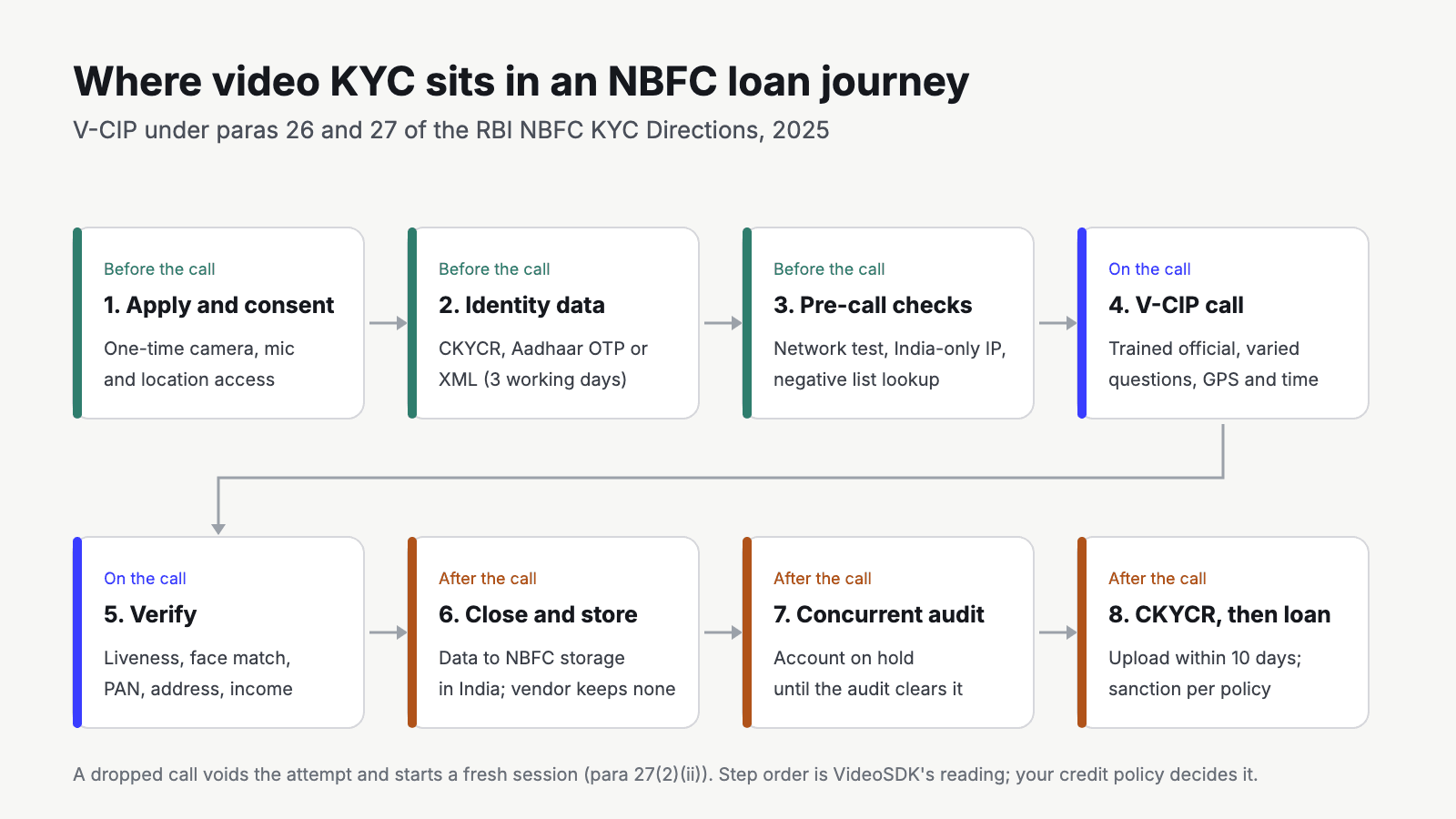
On the call, a trained official compares the customer's face with the photo on the identity document. The official sees the PAN card on camera and confirms the address and the "economic and financial profile" (27(2)(vi), (x) to (xiii)). For loans sourced through an app, para 13(1) of the Credit Facilities Directions allows "a one-time access" to camera, microphone and location for onboarding and KYC only, with the borrower's explicit consent.
If you also run a credit interview on video, see what Video PD is and how lenders run it. A combined KYC and PD call must still satisfy para 27 for the KYC part.
How to build video KYC for an NBFC with VideoSDK
VideoSDK sells video infrastructure, so read this section as a vendor's description of its own product and check it against the linked docs. VideoSDK provides the video layer: rooms, recording, webhooks and image capture. Your application supplies the KYC logic: identity APIs, the question script, case management and the audit trail. Ask VideoSDK in writing where recordings kept on its own storage are held and for how long, or record straight to your own bucket in India. The table maps the V-CIP needs to features documented on VideoSDK video KYC docs.
| V-CIP need | VideoSDK feature | Note |
|---|---|---|
| One-to-one call with an official, admission control | Rooms, tokens with ask_join for the customer, waiting lobby | Admission is driven by the permissions in the tokens your backend issues |
| Recording that starts with the session; the room closes if recording cannot recover | autoStartConfig.recording with onFailure: close-room on room creation | The docs say close-room closes the room "so the session does not continue unrecorded" |
| Recordings in your own storage, encrypted | Recording storage config for AWS S3, Azure Blob or GCP Cloud Storage; recording encryption with your RSA public key | Encryption and transcription cannot be enabled together on one API key |
| GPS on the recording | Customer location sent over PubSub and drawn by a custom recording template | The template shows the coordinates your app publishes; add the date and time in the same template |
| PAN and face stills | captureImage() on the customer side, file transfer to the official over PubSub | Files go to VideoSDK's temporary file storage; save them to your own system during the call |
| OCR and face spoof detection | VideoSDK OCR and Face Spoof Detection docs | Both docs pages say Enterprise plan only |
| Block connections from outside India (para 27(1)(iii)) | Geo IP Restriction (allow or deny by IP location) | The docs page says Enterprise plan; see the pricing page for plans. Spoofed IPs are not described there, so handle them in your own network layer |
Para 27(1)(ii) asks for end-to-end encryption of data between the customer device and your V-CIP hosting point, and para 27(2)(vi) asks for a recording. Agree with your security team how both are met before you commit to an architecture.
Create one room per V-CIP attempt
Each attempt gets its own room, and the room starts recording when the session starts. If recording fails and cannot recover within waitTime (30 seconds here), onFailure: close-room closes the room, so the call cannot carry on unrecorded beyond that window. With session-end-and-deactivate, VideoSDK's docs say only one session can be taken per room. After a session ends, your app creates a new room for the next attempt and marks the old one void. duration is in minutes.
// Server side (tested on Node 26). Creates one room per V-CIP attempt.
// The room records from the moment the session starts, closes itself if
// recording fails, and cannot be reused after the session ends.
export async function createVcipRoom({ serverToken, webhookUrl, templateUrl }) {
  const res = await fetch("https://api.videosdk.live/v2/rooms", {
    method: "POST",
    headers: { Authorization: serverToken, "Content-Type": "application/json" },
    body: JSON.stringify({
      webhook: {
        endPoint: webhookUrl,
        events: ["session-*", "participant-*", "recording-*"],
      },
      // One session per room (docs): after a session ends, create a new
      // room for the next attempt, the fresh session of para 27(2)(ii).
      autoCloseConfig: { type: "session-end-and-deactivate", duration: 60 },
      autoStartConfig: {
        recording: {
          templateUrl, // your hosted template that shows the GPS watermark
          config: { mode: "video-and-audio", quality: "high", orientation: "landscape" },
          onFailure: { action: "close-room", waitTime: 30 },
        },
      },
    }),
  });
  if (!res.ok) throw new Error(`Room not created: ${res.status} ${await res.text()}`);
  const room = await res.json();
  return room.roomId;
}
Tested: the room was created, and GET /v2/rooms/{roomId} showed the stored close, recording and failure settings; a bad token returned "Room not created: 401". Not tested: a live recording, because it starts a billed recording, and the geo-tag template, which you host.
For audit events, verify every webhook with the videosdk-signature header as described in the webhook verification docs, and hand each finished recording to your own transfer job. For para 27(2)(ii), treat a dropped call as a void attempt and create a new room for the next one.
Technical requirements for a video KYC API integration
To integrate a video KYC API with your existing systems, an NBFC needs six pieces in place:
- A backend that creates rooms and issues short-lived tokens per participant (never ship an API secret in the app), plus a webhook endpoint with signature checks and an audit store.
- Your own storage bucket in India for recordings and stills, with encryption and a retention policy that meets para 47(2).
- Identity integrations: Aadhaar OTP e-KYC or offline Aadhaar, CKYCR download, DigiLocker, PAN verification.
- An agent console for trained officials only, reachable from the NBFC network.
- A case system that records consent, questions asked, decisions, reject reasons and concurrent audit status.
- Integration with your loan origination, loan management and core systems, so the account stays on hold until the concurrent audit clears it and the CKYCR upload is tracked against its 10-day deadline.
To compare video KYC API providers, see our video KYC API comparison. If you are deciding between a full V-CIP platform and your own build, our build vs buy guide for video KYC infrastructure covers the trade-offs.
To see the managed product, visit the VideoSDK video KYC solution page. To scope a V-CIP build for your NBFC, talk to our team.
Frequently asked questions
How long must an NBFC keep V-CIP recordings?
We found no separate V-CIP retention period in paras 27(3) or 47. Para 27(3)(i) also says the record-management instructions in the Directions apply to V-CIP, and that V-CIP data and recordings are stored in a system located in India. VideoSDK's reading: a recording is an identification record, so para 47(2) applies and it is kept at least five years after the business relationship ends.
What will be asked in an NBFC video KYC call?
In an NBFC video KYC call, the official confirms identity details, asks you to show your PAN card on camera (unless you gave an e-PAN), checks your face against your documents and confirms your current address. It also asks about your economic and financial profile, such as your work and income. The questions vary from call to call, as RBI requires (27(2)(iii)). The call is recorded with your location and the time.
Next steps
For banks and other regulated entities, read our guide to video KYC rules across RBI's ten KYC Directions, and for the basics, what V-CIP means and how it works.
To try the room sample in your own project, create a VideoSDK account; a new account comes with a $20 credit. For India-only connections, identity APIs or plan questions, contact our team.