


VCIP full form is Video-based Customer Identification Process, written V-CIP in the Reserve Bank of India's rules. It is the regulated form of video KYC: a specially trained official of a bank or NBFC identifies the customer over a live, consented and recorded video call. The RBI treats a compliant V-CIP on par with face-to-face identification.
The definition sits in paragraph 5(2)(xvi) of the RBI's Commercial Banks KYC Directions, 2025 (RBI/DOR/2025-26/169). The RBI issued ten entity-wise KYC Directions on 28 November 2025, and paragraph 80 of the Commercial Banks text repeals the 2016 KYC Master Direction, which first allowed V-CIP on 9 January 2020.
This page is for teams at banks, NBFCs and fintechs who run or build video KYC. It covers what each word of V-CIP means, which regulator uses which name, how the call runs from the bank's side, and how V-CIP compares with Aadhaar OTP e-KYC and DigiLocker. It summarises the RBI text and is not legal advice.
Key takeaways
- VCIP full form is Video-based Customer Identification Process; the RBI writes it V-CIP and defines it in para 5(2)(xvi) of its KYC Directions, 2025.
- A V-CIP is full customer due diligence over a live, consented, recorded video call run by a specially trained official, and the RBI treats a compliant one on par with face-to-face identification.
- V-CIP is optional, but a bank that offers it must make it the first option for remote onboarding and meet every minimum standard in para 27.
- Aadhaar OTP e-KYC without a video call gives a limited account. DigiLocker onboarding without a video call keeps the customer high-risk until a V-CIP or face-to-face check. A compliant V-CIP counts as face-to-face identification, and the account goes live after a concurrent audit.
- IRDAI (VBIP), SEBI (VIPV) and PFRDA (VCIP for NPS) each set their own video identification rules.
What does VCIP stand for?
VCIP stands for Video-based Customer Identification Process. The RBI text writes it "Video based Customer Identification Process (V-CIP)"; bank portals and vendors also write VCIP, vCIP or V CIP. All four spellings name the same process, and each word in the name carries a rule.
| Word | What it means in the RBI text |
|---|---|
| Video-based | A live audio-visual interaction with the customer, based on the customer's informed consent (para 5(2)(xvi)). A recorded selfie or an uploaded photo is not V-CIP. |
| Customer | Individual customers, proprietors of proprietorship firms, and the authorised signatories and beneficial owners of company or other legal-entity customers (para 26(1)). |
| Identification | "Customer identification" means undertaking customer due diligence, or CDD (para 5(2)(vi)). In V-CIP that covers identity, PAN, address and the customer's financial profile (27(2)(vi) to (xi)), not only a face check. |
| Process | A clear workflow and standard operating procedure, run by trained officials, with a recording, an activity log and a concurrent audit (para 27). |
The last two words carry most of the weight. V-CIP is the full due diligence process carried out over video, and paragraph 27 sets a fixed list of minimum standards for it.
What is the full form of V CIP in banking?
The full form of V CIP in banking is Video-based Customer Identification Process at every bank, because the term comes from the RBI's KYC Directions, not from the bank. The full form of VCIP at Axis Bank, SBI or any other RBI-regulated bank is the same. Banks often call the same service video KYC, VKYC or V-KYC on their account-opening pages.
What is VCIP in KYC?
In KYC, VCIP is one of the RBI's routes for completing customer due diligence without a branch visit. The Commercial Banks KYC Directions define it as "an alternative method by which an authorised official of the bank conducts customer identification with facial recognition and customer due diligence" (para 5(2)(xvi)). The same definition says a V-CIP that meets the prescribed standards is "on par with face-to-face CIP".
Paragraph 26 lets a bank use V-CIP for three jobs:
- Customer due diligence when onboarding new individual customers, proprietors, authorised signatories and beneficial owners.
- Converting accounts opened through Aadhaar OTP based e-KYC in non-face-to-face mode.
- Updation and periodic updation of KYC for eligible customers.
V-CIP is optional: paragraph 26 says the bank "may undertake V-CIP". Two rules apply once a bank offers it. Every session must meet the minimum standards in paragraph 27, and V-CIP must be the first option the bank offers for remote onboarding (para 44(1)). The other nine KYC Directions carry the same V-CIP minimum standards. NBFCs, payments banks and all India financial institutions use paragraphs 26 and 27, as commercial banks do; small finance banks use 27 and 28; local area banks, regional rural banks, co-operative banks and asset reconstruction companies use 25 and 26. Our guide to the RBI video KYC guidelines maps each one.
V-CIP, VBIP, VIPV and VKYC: the names Indian regulators and banks use
Video KYC is the everyday name. Each financial regulator that allows it uses its own term and writes its own rules, so the name tells you which rulebook applies.
| Name | Full form | Regulator and source | Who uses it |
|---|---|---|---|
| V-CIP | Video-based Customer Identification Process | RBI, KYC Directions, 2025 (ten entity-wise Directions, 28 November 2025) | Banks, NBFCs, co-operative banks, payments banks, all India financial institutions, asset reconstruction companies |
| VCIP for NPS | Video based Customer Identification Process | PFRDA circular PFRDA/2020/46/SUP-CRA/18, 6 October 2020 | Intermediaries registered with PFRDA, for National Pension System onboarding, exit and service requests |
| VBIP | Video Based Identification Process | IRDAI Master Guidelines on AML/CFT, 2022, Annexure II | Insurers, as an optional KYC route |
| VIPV | Video in Person Verification | SEBI circular SEBI/HO/MIRSD/DOP/CIR/P/2020/73, 24 April 2020 | Stockbrokers and other SEBI-registered intermediaries |
| VKYC, video KYC | Video Know Your Customer | Common name, not a legal term | Bank and fintech apps, customer help pages |
The processes look alike, but the clauses differ. IRDAI requires the call to start from the insurer's own domain, and SEBI's VIPV sits inside the in-person verification rules for investors, so work from the rule for your licence. Our guides cover IRDAI VBIP for insurers and SEBI video KYC for stockbrokers.
Lenders also run a different video call before sanctioning a loan: Video PD, the credit officer's personal discussion with the applicant. It tests repayment capacity, not identity; see what Video PD is and how lenders run it.
How does VCIP video KYC work, step by step?
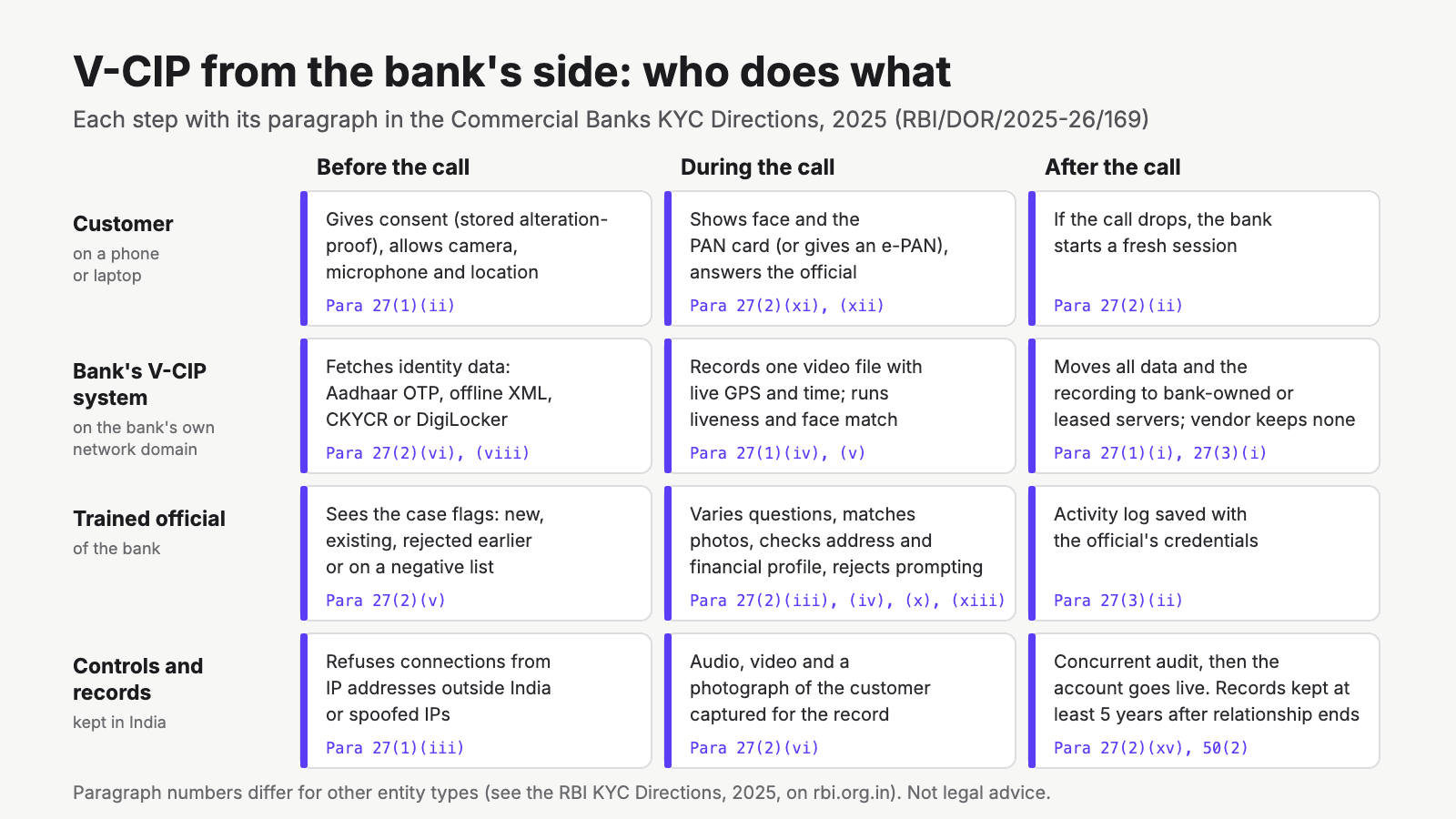
The VCIP journey is the sequence every V-CIP session follows: consent and identity data before the call, a live recorded call with a trained official, then storage and a concurrent audit before the account opens. Bank help pages describe it from the customer's chair. From the regulated entity's side, a V-CIP session has three stages and three actors (the customer, the bank's V-CIP system and a trained official), with controls and records behind them. Paragraph numbers below are from the Commercial Banks KYC Directions.
Before the call
- Consent and connection. The customer consents, and the bank records that consent "in an auditable and alteration-proof manner" (27(1)(ii)). The V-CIP connection must originate from the bank's own secured network domain (27(1)(i)), and the system must be able to refuse connections from IP addresses outside India or spoofed IP addresses (27(1)(iii)).
- Identity data. The bank fetches identity data from one of four sources: Aadhaar OTP e-KYC, offline verification of Aadhaar, CKYCR records, or an equivalent e-document such as a DigiLocker document (27(2)(vi)). An Aadhaar XML file or Secure QR code must be no older than three working days (27(2)(viii)), and the Aadhaar number must be redacted or blacked out (27(2)(vii)).
- Case checks. The bank's workflow factors in whether the person is a new or existing customer, was rejected earlier, or appears on a negative list (27(2)(v)).
During the call
- A trained official runs the call. V-CIP is "operated only by officials of the bank specially trained for this purpose" (27(2)(i)). The bank may use appropriate artificial intelligence (AI) technology to strengthen the process (27(1)(vi)), but a flow with no official on the call is not V-CIP. The official records audio and video and captures a photograph of the customer (27(2)(vi)). The recording carries live GPS co-ordinates and a date and time stamp (27(1)(iv)).
- Liveness and face match. The application checks face liveness or spoofing and matches faces (27(1)(v)). Blinking, smiling or other gestures are not mandatory for the liveness check, and the bank must consider the customer's special needs. The official confirms that the photos in the Aadhaar or other officially valid document and the PAN match the person on camera (27(2)(xiii)).
- PAN and profile. The customer shows the PAN card and the bank captures a clear image of it, unless the customer gives an e-PAN; the bank then verifies PAN with the issuing authority (27(2)(xi)). A printed copy of an e-document, including an e-PAN, is not valid (27(2)(xii)). If the current address differs from the document, the bank captures records of it, and the bank confirms the customer's economic and financial profile (27(2)(x)).
- Live questions. The official varies the sequence or type of questions to show the call is not pre-recorded (27(2)(iii)), and rejects the account opening if anyone is seen prompting the customer (27(2)(iv)).
After the call
- Storage and audit trail. All data and recordings are stored in systems located in India (27(3)(i)), and any cloud or technology provider assisting the V-CIP "shall retain no data" once the data moves to the bank's own servers (27(1)(i)). The activity log keeps the credentials of the official who ran the call (27(3)(ii)).
- Concurrent audit. The account becomes operational only after a concurrent audit of the V-CIP (27(2)(xv)).
Call drops have their own rule. A pause or disruption must not create multiple video files, and a call drop or disconnection means a fresh session (27(2)(ii)).
If the process cannot finish in one go, the video step must happen within three working days of fetching the identity data (27(2)(ix)).
Banks may also run assisted V-CIP, where a Business Correspondent helps the customer at the customer's end (27(2)(xiv)); this clause appears in the seven bank Directions, not in the NBFC, AIFI or ARC texts.
If you run V-CIP at an NBFC, our guide to video KYC for NBFCs maps each clause of the NBFC Direction to what to build and what to keep as audit evidence.
What is mandatory during a VCIP session?
During a VCIP session, a trained official of the bank must run a live, recorded audio and video call. The recording must carry the customer's GPS position and the date and time, and the customer must show the PAN card on camera or provide an e-PAN. The customer also needs:
- A phone or computer with a working camera and microphone, and location access switched on.
- Aadhaar details for OTP or offline verification, a CKYCR KYC identifier, or DigiLocker documents, depending on what the bank uses.
- To connect from an Indian IP address, without a VPN. The bank's system must be able to refuse connections from outside India and from spoofed IPs.
- To answer the official's questions themselves. The bank must reject the account opening if it sees prompting at the customer's end; in assisted V-CIP, a bank's Business Correspondent may help with the process.
The clause-by-clause RBI guide linked earlier lists every standard, with what each rule asks of the software.
V-CIP vs Aadhaar OTP e-KYC vs DigiLocker
These three are often listed as alternatives, but the RBI text treats them differently. Aadhaar OTP e-KYC and DigiLocker are ways to obtain identity data; V-CIP is a way to complete due diligence on a live call, and it can use either of them as its data source. The table compares the three as onboarding routes under the Commercial Banks KYC Directions.
| Point | V-CIP | Aadhaar OTP e-KYC, non-face-to-face | DigiLocker or other e-documents, no video call |
|---|---|---|---|
| Paragraph | 26 and 27 | 25 | 44, with the e-document definition in 5(1)(x) |
| Live official on video | Yes, a specially trained official | No | No |
| RBI standing | On par with face-to-face identification | Limited account until full due diligence | Non-face-to-face onboarding with enhanced due diligence |
| Limits | None beyond the V-CIP standards | Deposit balance up to ₹1 lakh, credits up to ₹2 lakh a financial year, term loans up to ₹60,000 a year (para 25(3)) | Customer is high-risk until verified face to face or through V-CIP |
| Conditions | Concurrent audit before the account is operational | Full due diligence within one year (para 25(6)) | First transaction must be a credit from the customer's KYC-compliant bank account; address confirmed by positive confirmation |
| Where DigiLocker fits | Can be the identity source and the PAN check | Not the identity source | The identity source itself |
For product design, the deciding row is RBI standing. V-CIP is the only one of the three that the RBI puts on par with a branch visit. Aadhaar OTP e-KYC suits fast, low-limit sign-ups, and those accounts can later be converted through V-CIP (para 26(2)). If the bank uses Aadhaar details in that V-CIP, it must follow the V-CIP process in full, including a fresh Aadhaar OTP authentication (para 25(6)). DigiLocker without video opens the account but keeps the customer under enhanced monitoring until a V-CIP or face-to-face check.
Digital KYC (para 24) is a fourth route and is easy to confuse with V-CIP. In digital KYC, an authorised officer captures a live photo of the customer and the document, with the latitude and longitude of the place, through the bank's own application. The customer visits the official or the official visits the customer (para 24(3)). There is no video call.
What a V-CIP application needs from its video layer
A regulated entity owns its V-CIP application, its officials' workflow and every decision. A team building that application usually splits it into three layers: the workflow and case system (queue, negative lists, decision, audit), the identity services (Aadhaar, CKYCR, PAN, liveness, face match), and the video layer that carries the call. The video layer usually provides a waiting room from which the official admits the customer, and one recording per session with the GPS position and time. It also delivers that recording to the bank's storage in India, blocks connections from outside India, and captures still images of the face and the PAN card.
The table maps those needs to the features in VideoSDK's video KYC guide for the React SDK.
| What the V-CIP call needs | VideoSDK feature in the docs | Note |
|---|---|---|
| Official admits the customer | Waiting lobby: customer token with ask_join, official calls allow() on onEntryRequested | |
| One recording per session, with live GPS and time | Meeting (composite) recording with the geo-tag recording template; the app publishes coordinates on the GEO_TAG PubSub topic | The watermark shows the coordinates your app supplies, so it is not independent proof of location |
| Stop if the recording fails | onFailure with close-room on start recording | |
| Recording in the bank's own storage | Delivery to your AWS S3, Azure Blob or GCP bucket, set per API key; optional recording encryption with your RSA public key | Recording encryption and transcription cannot run together on one API key |
| Block IP addresses outside India (27(1)(iii)) | Geo IP Restriction with the INDIA region | Enterprise plan |
| Keep media on servers in India | Geo Fencing with the INDIA region | Enterprise plan |
| Face and PAN images | captureImage() on the customer's camera, sent to the official over PubSub | |
| Face match, spoof detection, OCR, number of faces | Identity Verification APIs | Enterprise plan |
| Call drop handling | onMeetingStateChanged with RECONNECTING and DISCONNECTED states | A drop still means a fresh session under 27(2)(ii) |
Several V-CIP duties stay with the bank whatever video provider it uses. They include hosting and network decisions under 27(1)(i), the trained officials and the standard operating procedure, and Aadhaar, CKYCR and PAN verification. The bank also owns the decision on each case, the concurrent audit and the CERT-In empanelled security tests in 27(1)(viii).
Para 27(1)(ii) also asks for end-to-end encryption between the customer's device and the V-CIP hosting point; check with any provider how its encryption and recording work together before you sign off. The clause-by-clause RBI guide covers that clause, with code samples for geo-tagging, recording and the activity log.
Glossary
- Customer due diligence (CDD) is identifying and verifying the customer and the beneficial owner using reliable and independent sources of identification; the RBI defines customer identification as undertaking CDD.
- CKYCR (Central KYC Records Registry) is the registry that receives, stores and returns customers' KYC records in digital form. A V-CIP can use CKYCR records fetched with the customer's KYC identifier.
- An equivalent e-document is an electronic document issued with a valid digital signature by the issuing authority, including documents in the customer's DigiLocker account. A printout of one is not valid in V-CIP.
- Offline verification of Aadhaar is verifying identity from an Aadhaar XML file or Secure QR code without online authentication. For V-CIP, the file must be no more than three working days old.
- Concurrent audit is an audit of each V-CIP case before the account becomes operational, to confirm the process was followed.
Frequently asked questions
What is video KYC?
Video KYC is identity verification over a live video call between a customer and an official of a bank or other regulated entity. In RBI-regulated finance its legal name is V-CIP, the Video-based Customer Identification Process. The official records the call, checks the customer's face against identity documents, sees the PAN card and confirms the customer's details, so the customer does not need to visit a branch.
What is the difference between KYC and video KYC?
KYC is the whole duty to identify and verify customers, done in person, through Aadhaar e-KYC, digital KYC or other routes. Video KYC is one of those routes: the same due diligence carried out on a live, recorded video call with a trained official. Under the RBI's KYC Directions, a compliant video KYC counts the same as a face-to-face check.
Is video KYC compulsory?
No, video KYC is not compulsory for customers or banks. The RBI says a bank "may undertake V-CIP", and customers can use other KYC routes the bank offers, including a branch visit. A bank that offers V-CIP must present it as the first option for remote onboarding, and accounts opened through Aadhaar OTP e-KYC need full KYC, for example by V-CIP, within one year.
What happens if video KYC is not done?
If you skip video KYC, the bank completes KYC through another route it offers, such as a branch visit, because V-CIP is optional. The exception is an account opened through Aadhaar OTP e-KYC in non-face-to-face mode: it stays within the e-KYC limits and cannot operate beyond one year unless the bank completes full due diligence under paragraph 23 (for example at a branch) or through V-CIP. A deposit account is then closed; a loan account allows no further debits.
Can I complete video KYC without PAN card?
No, not in an RBI V-CIP. The bank must capture a clear image of the PAN card you show during the call, unless you provide an e-PAN, and it verifies the PAN with the issuing authority, including through DigiLocker. A printed copy of an e-PAN is not valid. Customers without a PAN should ask the bank which other KYC route applies.
What happens if a video KYC call disconnects?
If a video KYC call drops or disconnects, the RBI requires the bank to start a fresh session. A pause or disruption does not force a fresh session as long as it does not create multiple video files. If the bank already fetched the identity data, the new video session must happen within three working days of that fetch.
Can I do video KYC from outside India?
Usually not for an RBI-regulated account. The bank's V-CIP system must be able to prevent connections from IP addresses outside India or spoofed IP addresses, and the recording must carry the customer's live GPS co-ordinates. A VPN can trigger the same block. Customers abroad, such as non-resident Indians, should ask the bank about its other KYC routes for their account type.
Why was my video KYC rejected?
Common causes map to the RBI's V-CIP rules. Someone was seen prompting you, or the PAN card was missing or shown as a printout. Other causes: an Aadhaar XML or QR file more than three working days old, photos that did not match the person on camera, a location or Indian IP address the bank could not confirm, or video not clear enough to identify you beyond doubt (27(1)(iv)).
What are the RBI guidelines for V-CIP?
The RBI guidelines for V-CIP are paragraphs 26 and 27 of the KYC Directions, 2025 for commercial banks. The same numbers apply to NBFCs, payments banks and all India financial institutions; small finance banks use 27 and 28, and the other Directions use 25 and 26. They cover infrastructure on the bank's own premises and network, encryption, IP blocking, geo-tagged recordings, liveness and face matching, trained officials, PAN checks, storage in India and a concurrent audit. Our RBI video KYC guidelines page walks through each clause.
Does VideoSDK provide liveness detection for video KYC?
Yes, on the Enterprise plan: VideoSDK's Identity Verification APIs include Face Spoof Detection, Face Match, OCR and Number of Face Detection. They return results, such as a spoof flag or a match, that the bank's workflow uses; our guide to liveness detection in Android and iOS video KYC apps shows the integration. The decision on each case, the official's liveness judgement under the RBI rules, and Aadhaar and PAN verification stay with the bank and its identity providers.
If you are building the video layer for a V-CIP application, start with the video KYC guide in the VideoSDK docs and test a call, recording and geo-tag flow on your own account. Sign up for VideoSDK: a new account comes with a $20 credit. For the Enterprise identity and geo controls, talk to the VideoSDK team.