


An AI voice agent for customer support is a real-time, speech-driven system that handles inbound and outbound customer calls by transcribing speech, reasoning over it with an LLM, and responding with synthesized voice. VideoSDK provides an open-source Python AI Agent SDK that connects STT, LLM, and TTS providers into a single low-latency pipeline deployable on cloud or self-hosted infrastructure. To get started, explore the VideoSDK AI Agents documentation and follow the quickstart guide for your deployment target.
The average customer waits over 12 minutes on hold before reaching a live agent, and nearly 60 percent of callers abandon the queue before that happens. That gap is why engineering teams are racing to deploy an AI voice agent for customer support that can answer, resolve, and escalate calls in real time without forcing customers through a rigid touch-tone menu. Developers evaluating this space need to understand the full pipeline from voice activity detection through speech-to-text, LLM reasoning, and text-to-speech, plus how to wire those components into existing CRM and ticketing systems. This guide breaks down the architecture, compares the major provider stacks, walks through the build path from no-code to custom SDK integration, and covers the performance, cost, and compliance considerations that determine whether your voice agent ships to production or stalls in a pilot.
What Is an AI Voice Agent for Customer Support?
An AI voice agent for customer support is defined as a software system that conducts real-time, two-way voice conversations with callers to resolve support queries, deflect routine tickets, and escalate complex issues to human agents when necessary. Unlike traditional Interactive Voice Response (IVR) systems that rely on static decision trees and keypad input, an AI voice agent processes natural speech, understands intent, and generates contextually relevant spoken responses.
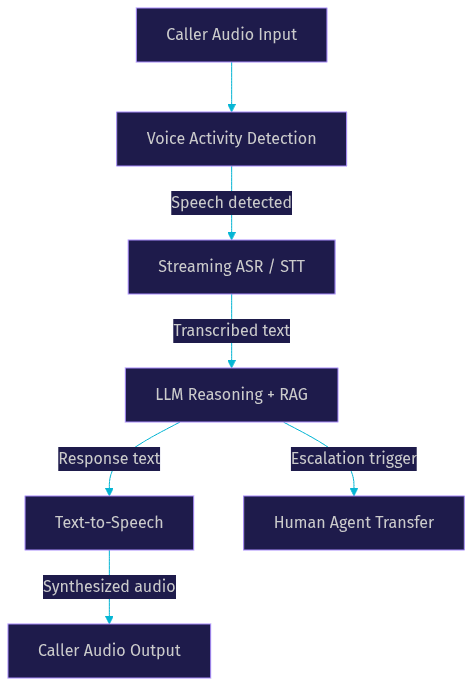
The core pipeline works by continuously listening for speech through Voice Activity Detection (VAD), converting the caller's audio into text via Automatic Speech Recognition (ASR), passing that text to a Large Language Model (LLM) for reasoning and response generation, and then converting the response back into natural-sounding speech using Text-to-Speech (TTS). This entire cycle must complete in under 300 milliseconds to feel conversational. VideoSDK provides this capability through its AI Voice Agent SDK, which orchestrates the full pipeline inside a VideoSDK room and supports both web-based and telephony-based caller connections.
Core Components of a Production-Ready Voice Agent
A production-ready AI voice agent for customer support is not a single API call. It is a coordinated pipeline of four specialized components, each with its own latency budget, failure modes, and integration requirements. Getting any one of these wrong degrades the entire caller experience.
Voice Activity Detection and Turn Management
Voice Activity Detection (VAD) is the gatekeeper of the entire pipeline. It determines when the caller has started speaking, when they have paused, and when the agent should respond. In support scenarios, inaccurate VAD causes the agent to interrupt callers mid-sentence or wait too long before replying, both of which feel broken. A well-tuned VAD model distinguishes between a breath, a brief pause, and an actual end of speech, and it must do so on noisy phone lines where background audio is unpredictable. VideoSDK's agent pipeline includes built-in turn detection with configurable sensitivity thresholds so developers can adjust the balance between responsiveness and interruption avoidance.
Real-Time Speech-to-Text (ASR)
The ASR layer converts the caller's audio stream into text that the LLM can reason over. For customer support, accuracy matters more than speed alone. If the transcription mishears an account number or a product name, the entire conversation derails. Multilingual support is increasingly essential as companies serve global customer bases. Providers like Deepgram and OpenAI Whisper offer streaming ASR with word-error-rates below 10 percent on clean audio, but performance drops on noisy cellular connections. VideoSDK's agent SDK supports pluggable STT providers, so you can select the one that performs best for your language coverage and latency budget.
Conversational Reasoning Engine (LLM)
The LLM is the brain of the voice agent. It takes the transcribed user input, retrieves relevant context from CRM data or knowledge bases, and generates a response that addresses the caller's intent. For support use cases, prompt design is critical: the model must stay on topic, refuse to promise things outside policy, and know when to escalate. Context window management is a real engineering challenge because long calls accumulate tokens quickly. VideoSDK's Conversational Graph provides a deterministic alternative to pure LLM-driven flow control, letting developers define conversation steps as a directed graph while the LLM handles only natural language generation.
Text-to-Speech and Voice Branding
The TTS layer converts the LLM's text response into spoken audio. Naturalness is non-negotiable for customer trust: a robotic voice signals cheap automation and erodes confidence. Providers like ElevenLabs and Cartesia Sonic deliver near-human quality with sub-200-millisecond generation latency. Custom voice cloning lets companies match the TTS voice to their brand identity. VideoSDK's agent SDK supports multiple TTS providers with built-in caching, so repeated phrases like greetings and confirmations generate instantly without reprocessing.
Integration Points with Customer-Support Systems
A voice agent that only talks to callers but cannot access customer data or update tickets is a glorified chatbot with a microphone. Production support agents need deep integration with the systems your human agents already use.
CRM and Ticketing
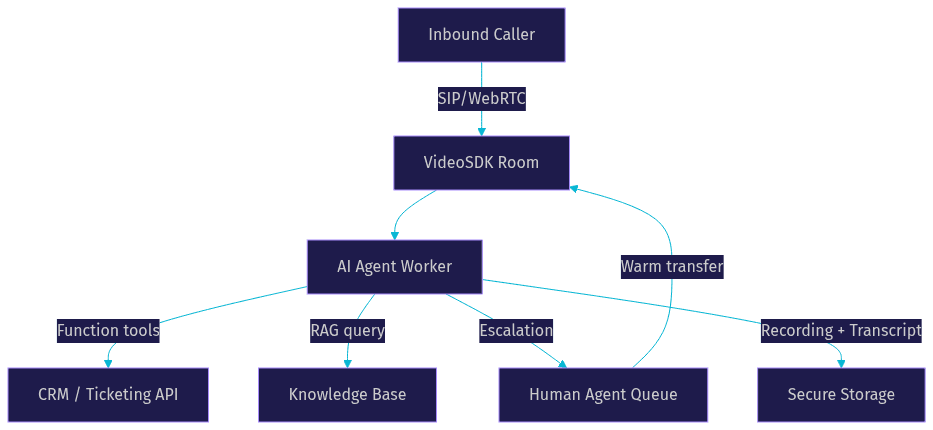
The voice agent must pull customer context at the start of a call. When a caller identifies themselves, the agent queries the CRM to retrieve account status, recent orders, open tickets, and support history. This context feeds into the LLM prompt so the agent can personalize responses. After resolving an issue, the agent writes a summary back to the ticketing system. VideoSDK's agent SDK supports function tools that let the LLM trigger external API calls, so your agent can read from and write to Salesforce, Zendesk, HubSpot, or any CRM with a REST API.
Knowledge-Base Retrieval
Retrieval-Augmented Generation (RAG) is what separates a generic AI voice assistant for support from one that gives accurate, company-specific answers. The agent searches your knowledge base for relevant articles, policies, or product documentation and includes that context in the LLM prompt. This keeps answers grounded in current information rather than the LLM's training data, which may be outdated or irrelevant to your specific products. VideoSDK's agent pipeline supports RAG integration through custom pipeline hooks, letting developers inject retrieved context before the LLM generates a response.
Escalation and Human-in-the-Loop
No AI voice agent resolves every call. The system must recognize when it cannot help and transfer the caller to a human agent with full context. Warm transfer is the gold standard: the voice agent briefs the human agent on the call so far, then bridges the caller over without making them repeat everything. VideoSDK's telephony integration supports call transfer and warm transfer natively, and the Conversational Graph's human-in-the-loop feature lets the agent pause and wait for external input before continuing.
Security, Compliance, and Data Governance
Customer support calls often involve sensitive data: account numbers, payment details, personal identifiers. Your voice agent stack must comply with PCI-DSS for payment data, SOC 2 for operational security, and GDPR for European customer data. This means encrypting audio streams in transit, controlling data retention policies for recordings and transcripts, and ensuring your LLM and ASR providers do not retain or train on your customer data. VideoSDK provides end-to-end encryption for media streams and configurable recording retention.
Choosing the Right Provider Stack
Selecting the right combination of ASR, LLM, and TTS providers is the most consequential architectural decision you will make. Each provider has distinct strengths in latency, language coverage, pricing, and integration complexity. The right choice depends on your support volume, language requirements, and budget constraints.
For real-time multimodal models, OpenAI Realtime API, Google Gemini Live, and AWS Nova Sonic each offer end-to-end voice pipelines that handle ASR, reasoning, and TTS in a single streaming connection. These are the fastest to integrate but offer less granular control over individual pipeline stages. For composable architectures, pairing a specialized ASR provider like Deepgram with a dedicated LLM and a high-quality TTS provider like ElevenLabs gives you more control over each stage and often better performance on specific languages or accents.
| Provider | Latency (median) | Language Support | Pricing Model | Best For |
|---|---|---|---|---|
| OpenAI Realtime | ~300 ms | 30+ languages | Per-minute audio | Fast prototyping, broad language coverage |
| Google Gemini Live | ~250 ms | 40+ languages | Per-request + audio | Google Cloud ecosystem users |
| AWS Nova Sonic | ~350 ms | 20+ languages | Per-minute usage | AWS-native deployments |
| Deepgram (ASR) + ElevenLabs (TTS) | ~200 ms combined | 30+ languages | Per-minute ASR + per-char TTS | Maximum control and voice quality |
| VideoSDK Agent SDK (composable) | Sub-300 ms | Depends on providers | Provider costs + VideoSDK | Custom pipelines, telephony integration |
[LINKABLE ASSET — comparison table]
The table above highlights a key tradeoff: end-to-end models are simpler to integrate but lock you into one provider's quality across all stages. A composable stack using VideoSDK's agent SDK lets you swap Deepgram for OpenAI Whisper if your language mix changes, or switch from ElevenLabs to Cartesia Sonic if you need faster TTS generation. That flexibility matters in production where provider outages and pricing changes are inevitable.
Building the Agent: A No-Code vs. Custom Development Path
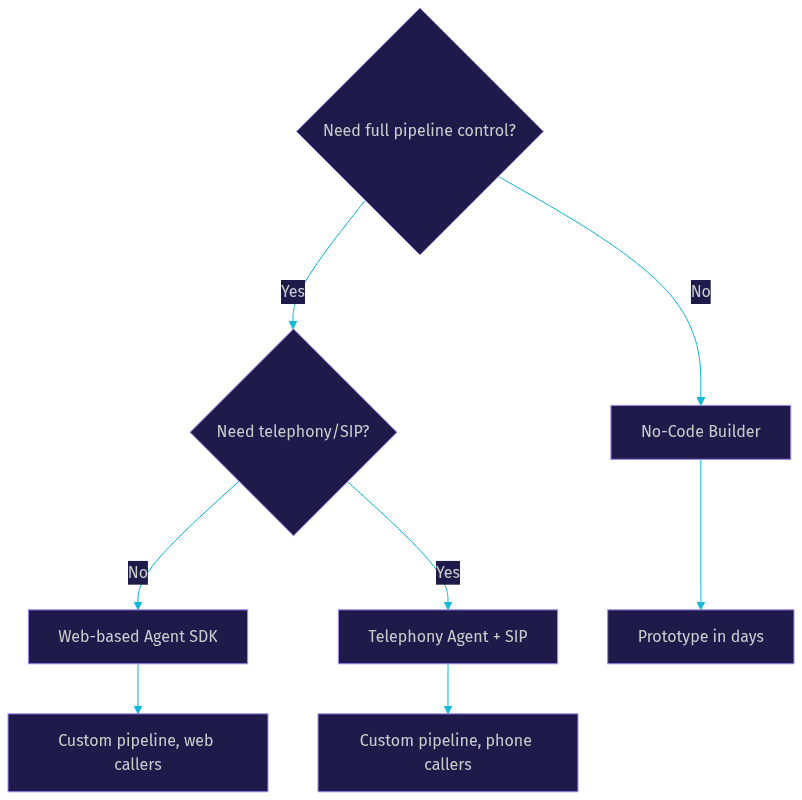
Once you have chosen your provider stack, the next decision is how to build and deploy the agent. There are two primary paths, and the right one depends on your team's engineering capacity, customization requirements, and timeline.
No-Code Builder Overview
Several platforms now offer no-code voice agent builders where you describe the agent's behavior in natural language, connect a phone number, and deploy without writing any code. These platforms handle VAD, ASR, LLM, and TTS configuration behind the scenes and provide visual editors for conversation flows. They are excellent for prototyping, internal tools, or simple support bots that handle a narrow set of intents. The tradeoff is limited control over the pipeline: you cannot swap individual providers, implement custom RAG logic, or integrate with niche internal systems without hitting the platform's boundaries. For teams that need to ship a basic voice-enabled customer service bot in days rather than weeks, no-code is a valid starting point.
Custom SDK Integration with VideoSDK
For teams that need full control over the pipeline, custom development with VideoSDK's AI Voice Agent SDK is the production-grade path. The SDK is Python-based and connects your chosen STT, LLM, and TTS providers into a single agent worker that runs inside a VideoSDK room. Callers connect via web, mobile, or traditional phone lines through SIP integration.
The first step in any VideoSDK integration is authentication. You must generate a VideoSDK token server-side using your API key and secret, then pass that token to the agent worker and to any client-side SDK that joins the room. Never expose your API secret on the client side. The VideoSDK authentication guide covers token generation in detail for each supported platform.
After authentication, you configure the agent pipeline by selecting your STT provider, LLM provider, and TTS provider. The SDK handles the streaming connections between these components, manages turn detection, and routes audio between the caller and the agent. You can add function tools so the LLM can call external APIs for CRM lookups or ticket updates, and you can use the Conversational Graph to define deterministic conversation flows for structured processes like account verification or payment collection.
For telephony-based support, VideoSDK's SIP integration lets you connect inbound phone calls directly to the agent. You configure routing rules to direct calls to the agent worker, and the agent handles the conversation. If escalation is needed, the agent can perform a warm transfer to a human agent's extension while passing along the call context.
Performance and Cost Considerations
Performance and cost are tightly coupled in voice agent architecture. Every millisecond of latency and every cent per minute directly affects both user experience and unit economics.
The industry target for conversational voice AI is a round-trip latency under 300 milliseconds from the end of the caller's speech to the beginning of the agent's response. Breaking that down, streaming ASR typically contributes 100 to 150 milliseconds, LLM first-token generation adds 50 to 150 milliseconds depending on the model and provider, and TTS first-audio generation adds another 50 to 100 milliseconds. VideoSDK's agent SDK is optimized for this budget with streaming pipelines that overlap transcription and generation rather than running them sequentially.
On the cost side, a composable stack bills per component. Streaming ASR from Deepgram costs roughly $0.0043 per minute of audio. TTS from ElevenLabs varies by plan but typically runs $0.18 per 1,000 characters, which translates to approximately $0.01 to $0.02 per minute of generated speech. LLM costs depend on the model: GPT-4o mini is significantly cheaper per token than GPT-4o, and for many support queries the smaller model is sufficient. A realistic blended cost for a composable voice agent is $0.03 to $0.06 per minute of call time. For a support center handling 10,000 minutes per month, that is $300 to $600 in provider costs, plus VideoSDK infrastructure costs.
Word-error-rate (WER) is the other critical metric. According to Artificial Analysis's Speech Arena benchmark, top streaming ASR providers achieve WER between 7 and 12 percent on conversational audio. Your actual WER will vary based on call quality, accent distribution, and domain vocabulary. Testing on real call recordings from your support center is essential before going live.
Real-World Success Stories
A fintech company deployed a self-hosted AI voice agent for customer support using VideoSDK's Python SDK with Deepgram for ASR and ElevenLabs for TTS. The agent handles 24/7 account balance queries, transaction history requests, and card activation calls. By running the agent worker on their own Kubernetes cluster, they maintained full control over data residency and compliance with financial regulations. The agent now handles 70 percent of inbound calls without human intervention, reducing average wait time from 8 minutes to under 30 seconds.
An e-commerce brand serving customers across Latin America built a multilingual voice agent using VideoSDK's agent SDK with Google Gemini for reasoning and Cartesia Sonic for TTS. The agent detects the caller's language from their first utterance and switches the entire pipeline to Spanish, Portuguese, or English accordingly. After three months in production, the brand reported a 65 percent first-call resolution rate for order status, return initiation, and shipping inquiries, with customer satisfaction scores matching their human agent baseline.
Best Practices and Common Pitfalls
Building a voice agent that works in a demo is straightforward. Building one that handles real customer calls reliably is hard. Here are the practical lessons that separate production deployments from abandoned pilots.
Monitor VAD accuracy continuously. False positives cause the agent to respond to background noise, and false negatives cause it to miss short utterances like "yes" or "no." Tune sensitivity per deployment and review edge cases from call recordings regularly.
Keep context window size in check. Long support calls can generate thousands of tokens of transcript history. Implement summarization or context truncation strategies so the LLM prompt stays within token limits without losing critical conversation context. VideoSDK's agent SDK includes context management features for this purpose.
Test on noisy cellular networks. Lab conditions with clean audio do not represent real call quality. Run load tests with simulated poor-bandwidth conditions and verify that your ASR provider degrades gracefully.
Plan for token expiry. VideoSDK tokens have a configurable TTL. If a call lasts longer than the token's lifetime, the connection drops. Set token expiration generously for support calls, which can run 15 to 30 minutes.
Ensure GDPR-compliant data handling. Configure recording and transcript retention policies explicitly. If you use a third-party LLM provider, confirm their data processing agreement prohibits training on your customer interactions. VideoSDK provides configurable retention and end-to-end encryption to support compliance requirements.
Definitions Glossary
Voice Activity Detection (VAD): A signal processing technique that detects the presence or absence of human speech in an audio stream, used to determine when a caller starts and stops speaking so the AI agent knows when to respond.
Automatic Speech Recognition (ASR): The process of converting spoken audio into text in real time, enabling the LLM to reason over the caller's words. Also referred to as Speech-to-Text (STT).
Agent Worker: The Python process that runs a VideoSDK AI agent and manages its session lifecycle inside a VideoSDK room, coordinating the STT, LLM, and TTS pipeline.
Conversational Graph: VideoSDK's deterministic flow engine that defines conversation steps as a directed graph with nodes, transitions, and state, giving developers control over branching logic while the LLM handles natural language generation.
Warm Transfer: A call transfer method where the AI agent briefs the human agent on the conversation context before bridging the caller, so the customer does not have to repeat their issue.
Retrieval-Augmented Generation (RAG): A technique where the agent retrieves relevant documents from a knowledge base and includes them in the LLM prompt to ground responses in current, company-specific information.
Key Takeaways
- An AI voice agent for customer support replaces rigid IVR menus with real-time, natural speech conversations powered by a VAD, ASR, LLM, and TTS pipeline that must complete in under 300 milliseconds.
- Provider selection is the most consequential architectural decision: end-to-end models like OpenAI Realtime offer speed of integration, while composable stacks using VideoSDK's agent SDK give you control over each pipeline stage and the ability to swap providers as needs change.
- Integration with CRM, ticketing, and knowledge-base systems is what separates a functional voice agent from one that actually resolves support queries, and VideoSDK's function tools and RAG hooks make these integrations straightforward.
- Cost per minute for a composable voice agent typically ranges from $0.03 to $0.06, making AI call center automation economically viable even at high call volumes.
- VideoSDK's Conversational Graph enables deterministic conversation flows for compliance-driven support processes, ensuring every step happens in order regardless of LLM behavior.
Conclusion
Building an AI voice agent for customer support is one of the highest-impact projects a development team can take on in 2026. The technology is mature enough for production, the economics work at scale, and the developer tooling has reached a point where a small team can ship a production-grade voice agent in weeks rather than quarters. VideoSDK's open-source Python AI Agent SDK, combined with its telephony integration and Conversational Graph, gives you the building blocks to assemble a composable pipeline that fits your exact support workflow. Whether you start with a no-code prototype or go straight to a custom SDK integration, the key is to test on real calls, monitor your latency and WER metrics, and iterate based on what your customers actually experience. Ready to build? Sign up at app.videosdk.live/login, explore the AI Agents documentation, or join the VideoSDK Discord community to connect with other developers building voice agents. What are you building with VideoSDK? Drop a comment below, I would love to hear what kind of AI voice agent use case you are working on.
Free $20 Balance for AI Voice Agents & Video Calls
FAQ