


The best LLM for a voice agent depends on your primary constraint: use OpenAI GPT-4o or Grok Voice Think Fast for sub-second latency, Google Gemini for multilingual support, and Anthropic Claude for high-precision tool calling. VideoSDK provides the real-time infrastructure to connect these LLMs to your users via WebRTC and SIP, handling the media transport so your AI pipeline can focus on conversation quality.
In 2026, demand for natural voice agents has surged as businesses deploy AI for telephony, customer support, and interactive applications. The underlying large language model (LLM) dictates the conversation's fluidity, reasoning capability, and latency. Choosing the best LLM for voice agent applications requires evaluating full-duplex speech-to-speech models, real-time generation, and tool-calling capabilities. VideoSDK simplifies this deployment by providing the real-time communication layer that bridges your chosen LLM to end-users over WebRTC or traditional SIP networks.
What Is an LLM for Voice Agent?
An LLM for a voice agent is a model optimized for real-time spoken conversations. Unlike traditional pipelines that chain speech-to-text, text-based LLMs, and text-to-speech, modern voice agent LLMs often process full-duplex speech-to-speech directly. This architecture reduces latency significantly, allowing the model to handle turn-taking, interruptions, and natural pauses without waiting for complete transcription cycles. VideoSDK integrates with these advanced pipelines through its AI Voice Agent SDK, enabling developers to build responsive voice applications.
Key Evaluation Criteria
Latency & Real-Time Responsiveness
Latency is the most critical metric for voice agents. Sub-second first-audio response times are necessary to maintain natural conversation flow. High latency causes awkward pauses and user frustration, making real-time responsiveness a non-negotiable criterion.
Speech Recognition & Generation Accuracy
Accuracy involves both understanding the user (measured by Word Error Rate, or WER) and generating natural-sounding speech. Benchmarks like Artificial Analysis Speech Arena provide objective metrics for evaluating how well a model handles conversational audio.
Tool-Calling & Reasoning Capabilities
Voice agents often need to interact with external APIs, such as checking order status or booking appointments. The best LLM for voice agent deployments must support native tool-calling, allowing it to reason through a task and invoke functions mid-conversation.
Multilingual & Code-Switching Support
Global applications require models that handle multiple languages and code-switching seamlessly. The ability to understand a user mixing languages in a single sentence is a strong differentiator for modern voice LLMs.
Cost & Inference Efficiency
Pricing models vary, often calculated per minute or per token. Inference efficiency dictates the hardware requirements. Balancing cost with performance is essential for scaling voice-first applications without breaking the budget.
Integration Flexibility
A model is only useful if it integrates easily with your existing stack. Look for SDKs, API formats, and native support for telephony and SIP. VideoSDK offers robust telephony integration to bridge AI agents with traditional phone networks.
Top Contenders for the Best LLM for Voice Agent
OpenAI GPT-4o
OpenAI GPT-4o offers real-time voice capabilities with low latency and robust tool-calling. It processes audio natively, reducing the delay seen in chained pipelines. Pricing is structured around audio input and output minutes, making it a premium but powerful choice for high-quality voice agents.
Google Gemini Voice
Google Gemini excels in multilingual support and integrates tightly with Google Cloud infrastructure. It offers strong reasoning capabilities and handles diverse accents well. Developers already invested in the Google ecosystem will find it a natural fit for global customer support applications.
Anthropic Claude Voice
Anthropic Claude is known for its safety-focused responses and precise tool-calling. While often used in text-to-speech pipelines, its reasoning capabilities make it a strong backend for complex voice agents that require strict adherence to business rules and safe conversational boundaries.
Inworld Real-Time Voice
Inworld Real-Time Voice is designed specifically for sub-second latency in interactive applications. It ranks highly on voice agent benchmarks for responsiveness and is highly compatible with AI-driven gaming and interactive character experiences.
Grok Voice Think Fast 2.0
Grok Voice Think Fast 2.0 focuses on low first-audio latency, achieving high scores on the tau-voice benchmark. It is suitable for applications where immediate acknowledgment of the user's speech is critical to the experience.
NemotronLabs VoiceChat
NemotronLabs VoiceChat provides an open-weight alternative with native tool-calling. It performs well on benchmark tests and offers developers the flexibility to self-host, reducing long-term inference costs for budget-conscious teams.
StepAudio 3 Realtime
StepAudio 3 Realtime features a think-while-speaking architecture, allowing it to process context dynamically as the conversation unfolds. This approach gives it leadership in complex, multi-turn benchmark scenarios.
Smallest.ai Lightning V3
Smallest.ai Lightning V3 specializes in instruction-following text-to-speech and dynamic language-switching. It is an excellent choice for applications requiring rapid, natural-sounding responses across different languages.
Comparison Table & Decision Flow
[LINKABLE ASSET — comparison table]
| Model | Latency | Multilingual | Tool-Calling | Cost Efficiency | Best For |
|---|---|---|---|---|---|
| OpenAI GPT-4o | Very Low | High | Excellent | Medium | Premium real-time voice |
| Google Gemini | Low | Excellent | Good | Medium | Global support |
| Anthropic Claude | Medium | Medium | Excellent | Medium | Complex reasoning |
| Inworld | Very Low | Medium | Good | High | Interactive characters |
| Grok Voice | Very Low | Medium | Good | Medium | Immediate acknowledgment |
| NemotronLabs | Medium | Medium | Excellent | High | Self-hosted tool use |
| StepAudio 3 | Low | High | Good | Medium | Multi-turn conversations |
| Smallest.ai | Low | Excellent | Medium | High | Language-switching TTS |
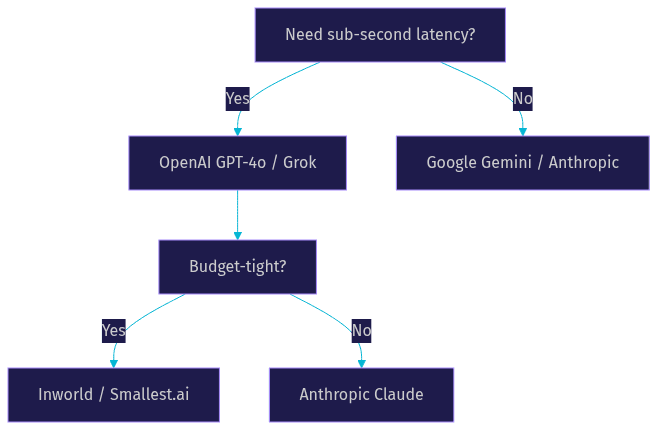
Choosing the right model requires mapping your priorities to the model's strengths. The following diagram illustrates a basic decision flow based on latency requirements and budget constraints.
Choosing the Right Model for Your Use Case
Low-Latency Telephony
For traditional phone calls, sub-second latency is critical to avoid users talking over the agent. OpenAI GPT-4o and Grok Voice Think Fast 2.0 excel here. Pair them with VideoSDK's SIP integration to connect the AI agent directly to inbound and outbound phone calls.
Multilingual Customer Support
If your user base spans multiple regions, Google Gemini and Smallest.ai Lightning V3 are top choices. They handle code-switching and diverse accents better than most, ensuring accurate comprehension across global deployments.
High-Precision Tool Use
When the voice agent must execute complex API calls, such as processing a payment or modifying a booking, Anthropic Claude and NemotronLabs VoiceChat offer the most reliable tool-calling capabilities. They reason through function parameters accurately.
Budget-Constrained Projects
For startups and high-volume deployments, inference cost is a major factor. Inworld and Smallest.ai provide excellent performance per dollar. NemotronLabs offers an open-weight model for teams capable of self-hosting to eliminate per-minute API costs.
Practical Implementation Tips
Setting up a voice agent requires secure token authentication. Always generate your VideoSDK tokens server-side using your API key and secret, then pass them to the client SDK. Never expose your API secret on the frontend. Handle interruptions by configuring your pipeline's turn detection to immediately stop the text-to-speech output when the user begins speaking. Monitor latency by tracking the time between user speech endpoint detection and the first byte of agent audio. VideoSDK's pipeline observability tools provide real-time metrics to help you identify bottlenecks in your STT, LLM, or TTS components.
Future Trends in Voice-Agent LLMs
The future of voice agents points toward end-to-end multimodal models that process audio, video, and text simultaneously without intermediate translation steps. On-device inference is also gaining traction, promising zero-latency processing for edge cases. Emerging benchmark suites, like Artificial Analysis's Speech Arena, are setting standardized metrics for evaluating these real-time systems. As models evolve, VideoSDK continues to integrate the latest providers, ensuring developers can swap LLMs without rewriting their transport layer.
Definitions Glossary
Full-Duplex Voice AI: A communication system that allows simultaneous two-way audio transmission, enabling users to interrupt the AI agent naturally.
Speech-to-Speech Model: An AI architecture that directly converts input audio to output audio, bypassing the traditional text intermediate step to reduce latency.
Turn Detection: The mechanism an AI voice agent uses to determine when a user has finished speaking and it is time to generate a response.
Tau-Voice Benchmark: A standardized evaluation metric used to measure the responsiveness and conversational fluidity of real-time voice AI models.
SIP Integration: The bridge between traditional telephony networks and modern WebRTC infrastructure, allowing AI agents to make and receive phone calls.
Key Takeaways
- The best LLM for voice agent applications depends on your primary constraint: latency, multilingual support, or tool-calling precision.
- OpenAI GPT-4o and Grok Voice lead in sub-second latency, while Google Gemini excels in multilingual scenarios.
- Anthropic Claude and NemotronLabs provide the most reliable tool-calling for complex API interactions.
- VideoSDK provides the real-time infrastructure to connect these LLMs to users via WebRTC and SIP, handling media transport and observability.
- Always generate authentication tokens server-side and monitor latency between speech endpoint detection and first audio output.
Conclusion
Choosing the best LLM for voice agent development is a conditional decision. Use OpenAI GPT-4o or Grok for low-latency telephony, Google Gemini for multilingual support, and Anthropic Claude for complex tool use. VideoSDK bridges the gap between your chosen model and your users, providing the WebRTC and SIP infrastructure needed for production-ready voice agents. Explore the VideoSDK AI Agents documentation to start building. What are you building with VideoSDK? Drop a comment below.
Free $20 Balance for AI Voice Agents & Video Calls
FAQ