


A large language model (LLM) is a neural network trained on massive text datasets to predict and generate human language. Built on the transformer architecture, LLMs power tools like ChatGPT, Claude, and Gemini. Developers integrate them through APIs for chatbots, summarization, code assistance, and increasingly for real-time voice and video applications with platforms like VideoSDK.
Large language models have moved from research labs to the center of the software industry in under four years. Every major platform announcement, from AI coding assistants to real-time voice agents, now rests on the same underlying technology. If you build software in 2026, you will almost certainly integrate an LLM into something you ship.
So what is a LLM, exactly? At its core, it is a statistical model of language, trained on a significant fraction of the public internet, that predicts the next token in a sequence with surprising accuracy. That simple objective, scaled up, produces systems that write essays, translate documents, answer questions, and generate working code.
This article covers the full picture: the formal definition, how tokenization and transformer attention actually work, what training at scale involves, the capabilities and limitations you should plan around, how models are evaluated, and where the field is heading. By the end, you will understand LLMs well enough to reason about integration decisions, not just use them blindly.
What Is a Large Language Model (LLM)?
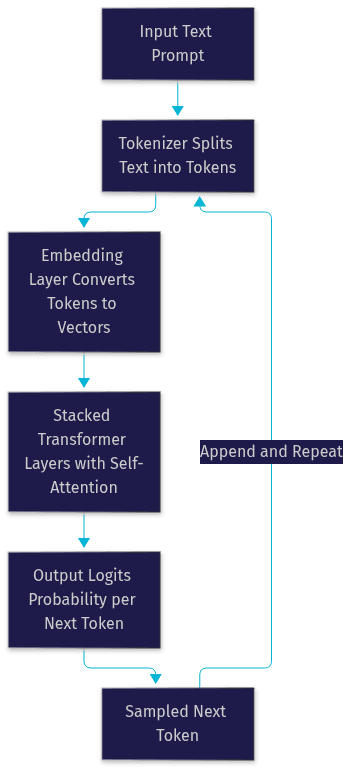
A large language model is defined as a deep neural network, typically with billions of parameters, trained on vast text corpora to predict the next token in a sequence. An LLM works by converting input text into numerical representations, processing those representations through stacked transformer layers, and producing a probability distribution over possible next tokens. Generation is simply repeated prediction: sample a token, append it, predict again.
Three components define the category. First, the neural network itself: a parameterized function whose weights are learned during training. Second, the transformer architecture, introduced in the 2017 paper "Attention Is All You Need" by Vaswani et al., which replaced recurrence with attention and made parallel training feasible. Third, scale: models like GPT-3 at 175 billion parameters and newer frontier models reportedly exceeding a trillion parameters exist because language modeling quality improves predictably with more data, parameters, and compute.
The term "foundation model" is often used interchangeably. It emphasizes that one pre-trained LLM serves as the base for many downstream tasks, from classification to conversation, without training a new model from scratch.
Here is the high-level architecture every LLM shares:
How Do LLMs Work?
An LLM works by chaining three stages: tokenization, transformer-based computation, and next-token prediction. Understanding each stage explains both why LLMs are powerful and why they fail in characteristic ways.
Tokenization and Embedding
Models do not read words. A tokenizer splits text into sub-word units called tokens, mapped from a fixed vocabulary built before training. Common English words become single tokens; rarer words split into pieces. Each token is then converted into a vector embedding, a list of numbers that positions it in a high-dimensional space where similar meanings sit near each other. Everything downstream operates on these vectors, never on raw text.
Transformer Mechanics
The transformer's core innovation is self-attention: every token can attend to every other token in the sequence, regardless of distance. For each token, the model computes attention weights against all others, then blends their information proportionally. Multi-head attention runs several of these operations in parallel, letting the model track different relationships simultaneously, such as syntax in one head and coreference in another. Positional encoding injects word order, since attention alone has no notion of sequence.

Pre-training and Fine-tuning
Pre-training uses self-supervised learning: the model predicts the next token on internet-scale text, with no human labels required. Fine-tuning then adapts the pre-trained model to narrower behavior, such as following instructions or refusing harmful requests, using curated datasets and techniques like reinforcement learning from human feedback.
Training a LLM: Data, Compute, and Scale
Training a frontier LLM is one of the largest engineering projects humans run. The training pipeline ingests trillions of tokens, cleans and deduplicates them, and cycles through them repeatedly on accelerator clusters.
Data comes primarily from large web crawls like Common Crawl, plus books, code repositories, Wikipedia, and licensed sources. Raw crawl data is filtered aggressively: deduplication, quality classifiers, and toxicity filters remove a large fraction before training ever starts.
Compute is measured in floating-point operations. Training runs consume thousands of GPUs or TPUs for weeks or months, with costs running from millions to over a hundred million dollars for frontier models. This is why only a handful of organizations pre-train from scratch, while everyone else fine-tunes or prompts existing models.
Parameter counts illustrate the scaling trend. GPT-2 had 1.5 billion parameters, GPT-3 reached 175 billion, and recent frontier models are reported to exceed a trillion when counting sparse mixture-of-experts configurations. Empirical scaling laws, documented in the Kaplan et al. 2020 paper from OpenAI, showed that model loss falls predictably as parameters, data, and compute grow together, which is what justified the investment.

Key Capabilities of LLMs
Modern LLMs handle a remarkably broad task surface from a single model. Text generation and summarization are table stakes. Translation works across dozens of languages without task-specific training. Question answering, document analysis, and structured data extraction all work through prompting alone.
For developers, code assistance is the headline capability. Models like GPT-4o, Claude, and Gemini write, explain, and debug code across most mainstream languages, and coding benchmarks like HumanEval have become a standard yardstick for model releases.
The same models now drive conversational interfaces everywhere: ChatGPT from OpenAI, Claude from Anthropic, and Gemini from Google. Beyond chat, LLMs sit inside search engines, enterprise knowledge tools, customer support pipelines, and increasingly real-time voice agents, where the LLM forms the reasoning layer between speech-to-text and text-to-speech systems.
Zero-shot learning is the property that makes all of this practical: a sufficiently trained LLM performs tasks it was never explicitly trained for, just from instructions in the prompt.
Limitations and Risks of LLMs
Every LLM deployment inherits three structural risks, and pretending otherwise is how projects fail in production.
First, hallucination. Because the model's only job is plausible next-token prediction, it can generate fluent, confident statements that are factually wrong. Grounding responses in retrieved documents, a pattern known as retrieval-augmented generation, mitigates but does not eliminate this.
Second, bias. Training data reflects the internet, including its stereotypes and skews. Models can reproduce or amplify those patterns in outputs, which is why alignment training and evaluation for fairness are standard practice, not optional extras.
Third, security. Prompt injection, where malicious text in a document or web page manipulates the model into ignoring its instructions, is the top vulnerability class for LLM applications that process untrusted input. Treating all model-visible external content as untrusted data is the emerging best practice.
There is also an environmental dimension: training and inference at scale consume significant energy, and responsible teams factor inference efficiency into architecture decisions.
How Are LLMs Evaluated?
LLM evaluation is an active research area because the models are general-purpose and the tasks are open-ended. Benchmarks cluster into a few families: reasoning tests like MMLU and GPQA, factual accuracy probes, alignment and safety evaluations, and domain-specific suites like HumanEval for code.
Classic metrics still play a role. Perplexity measures how well a model predicts held-out text, useful during pre-training but poorly correlated with usefulness. BLEU and ROUGE score generated text against references for translation and summarization tasks. Leaderboards like LMSYS Chatbot Arena, which ranks models from millions of blind human preference votes, and Artificial Analysis, which benchmarks quality, speed, and price together, have become the references developers actually consult when choosing a model.
One caution: benchmark scores can be gamed through contamination, where test data leaks into training corpora. Trust independent, human-preference-based rankings more than self-reported numbers.
Practical Uses and Integration of LLMs
Most teams consume LLMs through hosted APIs from OpenAI, Anthropic, Google, and others, paying per token of input and output. This keeps integration simple: you send a prompt, receive a completion, and never manage inference infrastructure.
Three integration patterns dominate. Prompt engineering tunes instructions and examples in the prompt itself, the cheapest and fastest lever. Fine-tuning adapts weights to your domain, now affordable for many teams thanks to parameter-efficient methods like LoRA. Retrieval-augmented generation connects the model to your own documents so answers are grounded in real data.
Typical integration points include web app backends, customer support chatbots, enterprise search and knowledge tools, and code assistants. A fast-growing pattern is real-time voice: an LLM sits between a speech-to-text engine and a text-to-speech engine to form a conversational voice agent. Platforms like VideoSDK's AI Agents provide the real-time media infrastructure for exactly this, connecting LLM, STT, and TTS providers into live audio and video sessions with sub-second latency.
Future Directions for LLMs
Three trajectories define where LLMs are going in 2026 and beyond.
Multimodality is the first. Frontier models now process images, audio, and video alongside text, and real-time multimodal APIs like the OpenAI Realtime API, Google Gemini Live, and AWS Nova Sonic are turning LLMs into live conversational systems rather than text boxes.
Efficiency is the second. Parameter-efficient fine-tuning techniques like LoRA and adapter layers let teams customize large models on modest hardware, while quantization and distillation shrink inference costs. The open-weight ecosystem, led by Meta's Llama family and Mistral's releases, keeps pressure on pricing across the board.
Controllability and safety are the third. Research on steering generation, formal evaluation of alignment, and regulation like the EU AI Act are pushing providers toward auditable, testable model behavior. For builders, the practical takeaway is that LLM capabilities will keep expanding while the engineering discipline around them, evaluation, guardrails, monitoring, matures in parallel.
Definitions Glossary
LLM (Large Language Model): A neural network with billions of parameters trained on massive text corpora to predict and generate language, serving as the foundation for tools like ChatGPT and Claude.
Token: The sub-word unit an LLM actually processes; text is split into tokens from a fixed vocabulary before being converted to vector embeddings.
Transformer: The neural architecture introduced in 2017 that uses self-attention instead of recurrence, enabling parallel training and powering every modern LLM.
Self-attention: The mechanism that lets every token weigh and blend information from every other token in the sequence, capturing long-range relationships in text.
Foundation model: A single pre-trained model adapted to many downstream tasks through prompting or fine-tuning instead of task-specific training from scratch.
Hallucination: The generation of fluent but factually incorrect content, caused by the model's next-token prediction objective rather than any notion of truth.
Key Takeaways
- A large language model is a transformer-based neural network trained on internet-scale text to predict the next token, and that single objective scaled up produces general-purpose language capability.
- Tokenization, self-attention, and pre-training followed by alignment fine-tuning are the three mechanisms that make LLMs work.
- Training frontier models costs millions to over a hundred million dollars, which is why most teams integrate existing models via APIs, prompt engineering, or efficient fine-tuning rather than training their own.
- Hallucination, bias, and prompt injection are structural risks that require grounding, evaluation, and treating external content as untrusted in any production LLM application.
- LLMs are increasingly embedded in real-time experiences, including voice agents where platforms like VideoSDK connect LLMs with speech-to-text and text-to-speech inside live audio and video sessions.
Conclusion
Understanding what a LLM is, a scaled next-token predictor built on transformer attention, gives you the mental model needed to build with it well. You now know how tokenization and attention work, why training at scale costs what it does, where the failure modes of hallucination, bias, and prompt injection come from, and how to evaluate and integrate models responsibly.
The next step is practical. Experiment with a hosted LLM API, try an open-weight model, or explore real-time voice agents with VideoSDK's AI Agent documentation and the VideoSDK GitHub repository. You can start free at app.videosdk.live/login.
What are you building with LLMs? Drop a comment, I'd love to hear what kind of LLM-powered use case you are working on.
Free $20 Balance for AI Voice Agents & Video Calls
FAQ