


WebRTC P2P (peer-to-peer) is a real-time communication architecture where browsers exchange media and data directly without routing traffic through a central server. It leverages standard protocols like ICE, DTLS, and SCTP to establish secure, low-latency connections. Developers use WebRTC P2P to build chat apps, file sharing tools, and multiplayer games with minimal infrastructure overhead.
The web is shifting from a purely client-server model to one where browsers can talk directly to each other. This surge in peer-to-peer (p2p) communication is largely driven by WebRTC, an open standard that enables true browser-to-browser connections. For developers building latency-sensitive applications, relying on a central server to relay every packet is often a bottleneck. WebRTC p2p solves this by allowing clients to exchange data directly, reducing latency and server costs. Whether you are building a simple chat application, a file-sharing utility, or a real-time multiplayer game, understanding how WebRTC p2p works is essential. In this guide, we will break down the core components, architecture, and best practices for establishing robust peer-to-peer connections in 2026.
What Is WebRTC P2P?
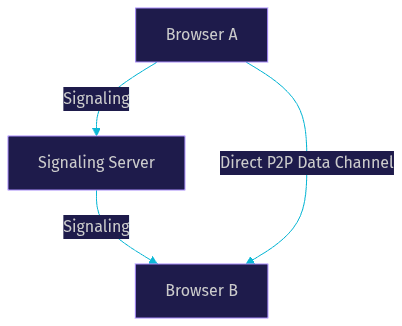
WebRTC is defined as a set of open standards and APIs that enable real-time media and data exchange directly between browsers. In a traditional client-server model, if two users want to send messages to each other, the data travels from User A to a central server, and then from the server to User B. The webrtc p2p model eliminates the middleman for the actual data transfer. Once the connection is established, media streams and data channels flow directly between the two peers.
This direct browser-to-browser communication is critical for latency-sensitive apps like video calling and online gaming. By removing the server hop, WebRTC p2p significantly reduces round-trip time. It also decreases infrastructure costs because the server is only needed for the initial signaling phase, not for relaying continuous traffic. VideoSDK provides robust real-time communication capabilities that abstract away the complexities of WebRTC, allowing developers to embed video calling and interactive live streaming without managing the underlying p2p mechanics directly.
Core Components of a WebRTC P2P Connection
A successful webrtc p2p connection relies on several underlying protocols working together. Understanding these components is crucial for debugging and optimizing your application.
SDP (Session Description Protocol)
SDP is a text-based format used to describe the media and data capabilities of a peer. When a WebRTC connection is initiated, the peers exchange SDP offers and answers. This description includes information about the codecs supported, the bandwidth limits, and the presence of data channels. Think of SDP as the negotiation phase where both browsers agree on what kind of data they will share and how they will encode it.
ICE (Interactive Connectivity Establishment)
ICE is the framework used to connect peers across different networks. Most devices sit behind NAT (Network Address Translation) routers, meaning their local IP address is different from their public one. ICE gathers all possible candidate IP addresses and ports a peer can use to connect. This includes host candidates (local network), server reflexive candidates (public address discovered via STUN), and relay candidates (TURN server). The ICE framework then tests these candidates to find the most efficient path.
DTLS (Datagram Transport Layer Security)
Security is mandatory in WebRTC. DTLS is the protocol used to secure the data channel. It provides encryption for all data flowing between peers, ensuring that even if packets are intercepted on a public network, they cannot be read. DTLS operates over UDP and is a derivative of TLS, the standard encryption used on the web.
SCTP (Stream Control Transmission Protocol)
While WebRTC media streams use SRTP (Secure Real-time Transport Protocol), the data channel uses SCTP over DTLS. SCTP allows developers to choose between reliable, ordered message delivery (like TCP) and unreliable, unordered delivery (like UDP). This flexibility is what makes the webrtc p2p data channel so powerful for different use cases.
Establishing a WebRTC P2P Connection
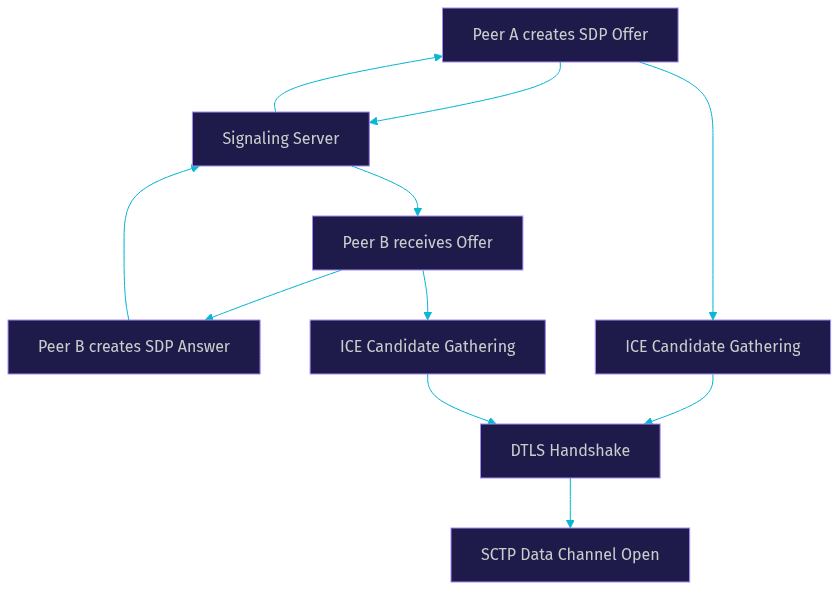
The process of establishing a webrtc p2p connection involves a series of well-defined steps. This phase is often called signaling, though signaling itself is not part of the WebRTC standard.
Signaling Phase
Signaling is the out-of-band exchange of metadata needed to set up the WebRTC connection. This includes exchanging the SDP offers and answers, as well as ICE candidates. Developers must implement their own signaling mechanism, typically using WebSockets, a REST API, or even serverless methods like QR codes or manual copy-paste for local testing. The signaling server only acts as a relay for this initial setup phase and does not handle the actual media or data traffic.
ICE Gathering and Candidate Exchange
Once the signaling channel is open, each peer begins ICE gathering. The browsers query STUN servers to discover their public-facing IP addresses. These candidates are sent over the signaling channel to the other peer. The peers then perform connectivity checks to see which candidate pair can successfully connect.
Offer/Answer Negotiation
One peer takes the role of the offerer and creates an SDP offer describing its intended media and data configuration. This offer is sent to the answerer via the signaling channel. The answerer generates an SDP answer, accepting the offer and potentially adjusting parameters, which is sent back to the offerer.
Connection Finalization
Once both peers have a matching set of ICE candidates and the SDP negotiation is complete, the browsers attempt to establish a direct connection. The DTLS handshake occurs to set up encryption keys. Once DTLS is complete, the SCTP association is established, and the data channel becomes usable for sending and receiving data directly.
Common Architectures and Use Cases
The webrtc p2p data channel is versatile, supporting a wide range of applications.
Browser-to-Browser Chat
A simple text chat is the most common starting point. Text messages are serialized and sent over the data channel. Because the connection is direct, message latency is extremely low, making the chat feel instantaneous.
File Sharing
WebRTC data channels can transmit binary data, making them ideal for peer-to-peer file sharing. A file is chunked into smaller binary blobs and sent over the channel. This allows users to share large files directly without uploading them to a third-party cloud storage provider.
Video and Audio Calls
While data channels are great for text and files, WebRTC is most famous for media streams. Video and audio tracks are captured from the device's camera and microphone, encoded, and sent directly to the peer. This is the foundation of most modern video calling applications.
Multiplayer Gaming
Real-time multiplayer games require constant state synchronization. The unreliable, unordered mode of the SCTP data channel is perfect for sending frequent game state updates where dropping a few packets is preferable to waiting for retransmission.
Overcoming NAT and Firewall Challenges
Connecting two browsers directly is not always straightforward due to NAT and firewalls.
STUN Servers
STUN (Session Traversal Utilities for NAT) servers help a browser discover its public IP address and port. The browser sends a request to the STUN server, which responds with the public address it sees. This address is added to the ICE candidates.
TURN Relays
Sometimes, a direct connection is impossible due to restrictive firewalls or symmetric NAT. In these cases, TURN (Traversal Using Relays around NAT) servers act as a relay. The data is sent to the TURN server, which forwards it to the peer. This breaks the pure p2p model but ensures connectivity. TURN should be a fallback, as it introduces latency and server bandwidth costs.
WebRTC Direct (SDP Munging)
In decentralized web ecosystems like libp2p, WebRTC Direct offers a shortcut. It embeds connection information directly into a multiaddr, bypassing the need for a traditional signaling server. This approach, sometimes called SDP munging, allows for more serverless p2p architectures.
Security and Encryption in WebRTC P2P
Security is built into the core of WebRTC. All webrtc p2p connections are encrypted by default. DTLS secures the data channel, while SRTP secures the media streams. This means that even if traffic traverses public networks or unsecured Wi-Fi, the data remains confidential. For applications requiring end-to-end encryption where the signaling server should not have access to keys, developers can implement additional layers, such as a Noise handshake protocol common in libp2p networks. This ensures that only the intended peers can decrypt the media and data.
Performance Considerations
Optimizing a webrtc p2p connection requires attention to latency and bandwidth. Latency sources include the ICE candidate gathering time and the initial DTLS handshake. Once connected, the choice between reliable and unreliable SCTP modes impacts performance. For real-time state updates, unreliable mode avoids head-of-line blocking. Developers should measure round-trip time by sending periodic ping messages over the data channel. Adjusting packet size is also critical; smaller packets reduce fragmentation but increase overhead, while larger packets improve throughput but risk congestion.
Best Practices and Gotchas
Building a robust webrtc p2p application comes with common pitfalls. Always choose a reliable signaling method, as a dropped signaling message can prevent the connection from forming. Handle ICE candidate timeouts gracefully by implementing ICE restarts if the initial gathering fails. Test your application across different browsers, as WebRTC API implementations can vary. Be aware of mobile data restrictions; mobile networks often have aggressive NATs that require TURN fallbacks. Finally, manage connection states carefully to avoid memory leaks when peers disconnect.
Future Trends for WebRTC P2P
The landscape of webrtc p2p is evolving. Emerging standards like WebTransport and QUIC-based data channels promise lower latency and better congestion control. Mesh-network extensions and decentralized protocols like libp2p are making it easier to build serverless p2p applications. As the web moves towards a more decentralized architecture, WebRTC will remain a foundational technology for direct browser communication.
Definitions Glossary
WebRTC P2P: A communication architecture where browsers exchange media and data directly without a central server relaying the traffic.
SDP (Session Description Protocol): A text-based format used to describe the media and data capabilities of a peer during the WebRTC negotiation phase.
ICE (Interactive Connectivity Establishment): A framework used to discover and connect peers across different networks, handling NAT traversal.
DTLS (Datagram Transport Layer Security): A protocol that provides encryption for WebRTC data channels over UDP.
SCTP (Stream Control Transmission Protocol): A transport protocol used over DTLS to provide reliable or unreliable message delivery for WebRTC data channels.
Key Takeaways
- WebRTC P2P enables direct browser-to-browser communication, reducing latency and server costs.
- A successful connection relies on SDP for negotiation, ICE for NAT traversal, and DTLS/SCTP for secure data transport.
- Common use cases include chat, file sharing, video calls, and multiplayer gaming.
- STUN and TURN servers are essential for overcoming restrictive NATs and firewalls.
- All WebRTC P2P connections are encrypted by default using DTLS and SRTP.
Conclusion
WebRTC P2P remains a powerful tool for developers building real-time, latency-sensitive applications. By enabling direct browser-to-browser communication, it reduces infrastructure costs and improves performance. Understanding the core components, from ICE gathering to SCTP data channels, is essential for debugging and optimizing your connections. As you plan your next project, explore libraries like libp2p, simple-peer, or the native WebRTC API. For a more managed approach that handles the complexities of WebRTC for you, check out the VideoSDK documentation. What are you building with WebRTC? Drop a comment below, I'd love to hear about your p2p use case.
Free $20 Balance for AI Voice Agents & Video Calls
FAQ