


eKYC blockchain identity verification combines digital customer onboarding with distributed ledger records that make identity attestations tamper-resistant and reusable across institutions. Blockchain stores cryptographic proofs and consent events instead of raw PII in a single database. Banks, fintechs, and compliance teams use this model to cut repeat KYC, strengthen audit trails, and meet AML regulations faster.
A customer who completes KYC at one neobank and repeats the same document upload at a second lender within the same month experiences friction that costs both institutions money and erodes trust. eKYC blockchain identity verification addresses that duplication by letting verified identity attestations travel between authorized parties without copying sensitive documents into every new centralized silo. This article defines eKYC, explains how blockchain strengthens identity verification, maps regulatory requirements, compares platform approaches, and covers the production trade-offs that separate a compliant rollout from a pilot that never scales.
What is eKYC?
eKYC is defined as a digital process for verifying a customer's identity remotely using electronic documents, biometric checks, and database validation to satisfy regulatory Know Your Customer requirements without an in-person branch visit.
eKYC works by capturing government-issued identity documents, running automated authenticity checks through OCR and fraud detection engines, matching the applicant's live biometric sample against the document photo, and recording the verification outcome in a compliance audit trail that regulators can inspect.
Traditional physical KYC requires the customer to visit a branch or agent location for face-to-face verification with paper documents. eKYC replaces that visit with a digital workflow that completes in minutes on a smartphone or web browser. The Financial Action Task Force (FATF) recognizes digital identity systems as tools for meeting anti-money laundering obligations when they meet reliability, independence, and auditability standards outlined in FATF Guidance on Digital Identity.
Electronic Know Your Customer differs from Video KYC, though teams often combine them. Standard eKYC may rely on document upload and passive biometric matching. Video KYC adds a live agent or automated video session where the verifier confirms liveness, asks dynamic questions, and records the interaction for regulatory evidence. For regulated remote onboarding in India, the Reserve Bank of India's Video Customer Identification Process (V-CIP) framework requires live interaction during certain account-opening flows.
In practice, compliance teams that treat eKYC as a one-time document scan without ongoing monitoring discover that synthetic identity fraud still enters downstream transaction monitoring. eKYC is the front door. Blockchain identity verification is the infrastructure that determines how long verified credentials remain trustworthy and portable.
This section established the definitional boundary between eKYC, physical KYC, and video-assisted verification.
How Blockchain Enhances eKYC?
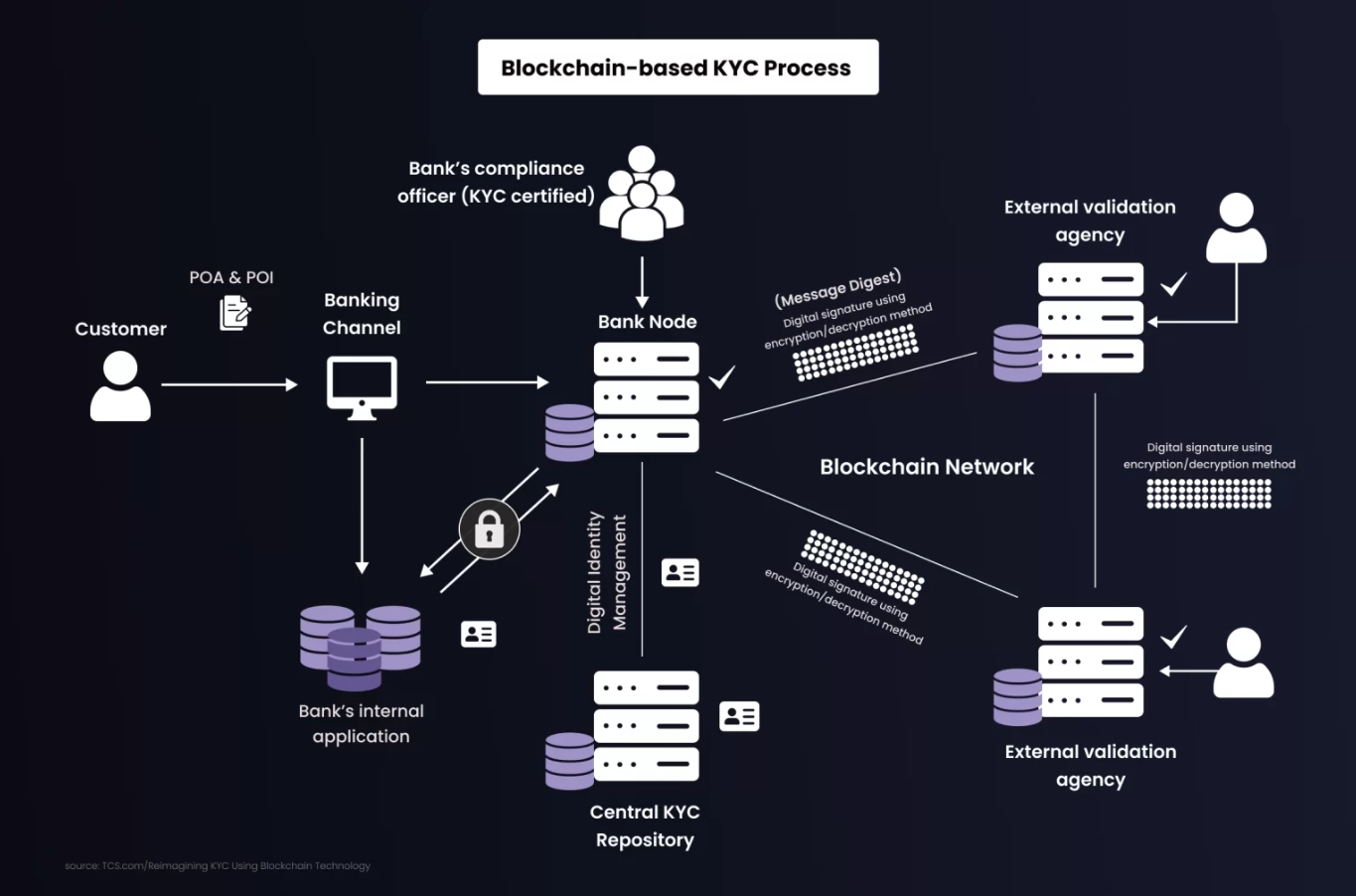
Source: Reimagining KYC Using Blockchain Technology
Blockchain enhances eKYC by replacing centralized identity data silos with tamper-evident, cryptographically signed attestations that authorized institutions verify without re-collecting raw customer documents.
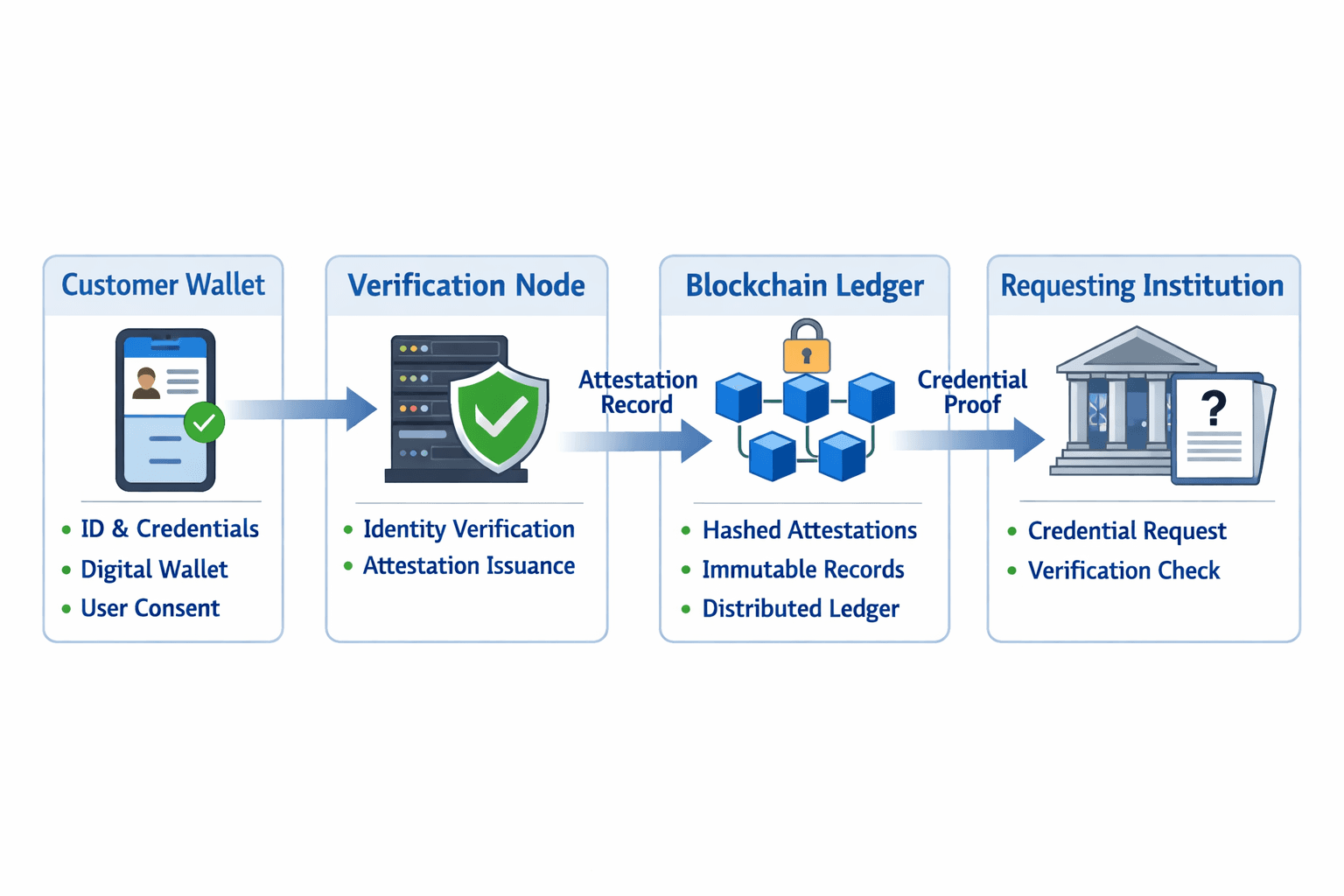
In a traditional eKYC model, each bank stores a full copy of the customer's passport scan, address proof, and biometric template in its own database. A breach at one institution exposes all stored PII. Blockchain-based eKYC stores hashed identity proofs and verification events on a distributed ledger. When a second institution needs to onboard the same customer, it requests a signed attestation from the verifying party rather than duplicating sensitive files.
Immutable Audit Trails
Each verification event, consent grant, and credential revocation is written as a ledger transaction with a timestamp and digital signature. Regulators auditing AML compliance can trace exactly when identity was verified, which entity performed the check, and what consent the customer granted. The World Bank's ID4D initiative documents how digital ID systems with strong audit trails support financial inclusion while meeting integrity requirements [EXTERNAL LINK: World Bank ID4D Digital Identity principles].
Smart Contract Compliance Automation
Smart contracts encode compliance rules as executable logic on the blockchain. A smart contract can enforce that only credentials verified within the last twelve months pass onboarding gates, or that customers from high-risk jurisdictions trigger enhanced due diligence workflows automatically. This reduces manual compliance review for routine cases while preserving human oversight for exceptions.
Reusable Digital Identity
Banks using blockchain for KYC can issue portable credentials that customers present to insurance providers, payment apps, and lending platforms. HSBC piloted blockchain-based KYC sharing with fintech partners through Tradle's TrustChain network, demonstrating how a verified customer record travels between institutions without repeat document submission. The pilot reduced duplicate verification steps for participating entities, though production adoption requires consortium agreement on governance and liability.
Decentralized Identity and User Control
Self-sovereign identity models place credentials in the customer's digital wallet. The customer shares only the minimum attributes a service provider needs (name and age, not full address history) through selective disclosure. This aligns with GDPR data minimization principles and gives users revocation control when a device is compromised.
Blockchain does not replace the verification act itself. It changes how verification results are stored, shared, and audited. The actual identity check still requires document validation, liveness detection, and database screening. That is where video KYC platforms and biometric engines do the heavy work before any attestation reaches the ledger.
This section covered how blockchain strengthens auditability, compliance automation, credential reuse, and user-controlled identity sharing in eKYC workflows.
What to Look for in an eKYC Platform
An eKYC platform must combine reliable identity verification, regulatory audit trails, and integration paths that match your jurisdiction's compliance rules before blockchain credential sharing adds any value.
Verification Accuracy and Liveness Controls
The platform must defeat presentation attacks during biometric capture. ISO/IEC 30107-3 defines Presentation Attack Detection standards that separate bona fide live captures from spoof artifacts. Your vendor should publish false accept rate and false reject rate metrics or reference third-party evaluations such as NIST FRVT PAD results.
Regulatory Coverage
Confirm the platform supports your target markets. India V-CIP, EU eIDAS assurance levels, US Bank Secrecy Act customer identification program rules, and Singapore MAS notice requirements each impose different evidence standards. A platform certified for one jurisdiction does not automatically satisfy another.
API Integration and Developer Experience
Engineering teams need REST APIs, webhooks, and SDKs for mobile capture flows. Time-to-integration directly affects onboarding conversion. Platforms with pre-built UI components and sandbox environments reduce pilot timelines from months to weeks.
Video Session Infrastructure
For regulated video KYC, the platform must deliver sub-second latency, encrypted media transport, session recording with tamper-evident storage, and agent queue management. Packet loss and jitter during a live verification call cause false rejections and abandoned applications.
Blockchain Readiness
If you plan distributed credential sharing, confirm the platform exports standardized verifiable credentials (W3C Verifiable Credentials format) and integrates with your chosen ledger or identity network. Not every eKYC vendor supports blockchain attestation export natively.
In practice, product teams that select an eKYC vendor based on pricing alone report costly re-platforming when liveness accuracy fails regulatory review or video infrastructure cannot scale past initial pilot volume.
This section listed the verification, compliance, integration, video, and blockchain criteria that determine eKYC platform fit.
Future Trends and Innovations in eKYC
Decentralized Identity Solutions
One of the most promising trends in eKYC is the rise of decentralized identity solutions, where individuals control their own digital identities powered by the blockchain. It allows users to store their identity information securely on their devices and share it with service providers only when necessary. This approach reduces the dependency on centralized databases and gives users greater control over their personal information.
AI and Biometrics in Blockchain eKYC
The integration of AI and biometrics into blockchain-based eKYC processes is set to further enhance identity verification. AI can analyze patterns and detect anomalies in real-time, improving the accuracy of verification processes.
Biometrics, such as facial recognition and fingerprint scanning, add a layer of security, ensuring that only the rightful owner of the identity can access services. Together, AI, biometrics, and blockchain initiate a powerful trio that can transform the future of eKYC.
Moreover, as regulatory requirements become more stringent, businesses will need to adapt their eKYC processes to ensure compliance. This may involve the adoption of more sophisticated verification methods and the implementation of real-time monitoring systems.
Looking ahead, the future of eKYC is likely to be characterized by greater collaboration between businesses, regulatory bodies, and technology providers. By working together, these stakeholders can create a more secure and efficient identity verification ecosystem that benefits everyone involved.
Conclusion
As we look towards the future, the integration of AI, biometrics, and decentralized identity solutions will continue to push the boundaries of what's possible in eKYC, making identity verification not only more secure but also more user-centric.
Blockchain technology holds the potential to address many of the inherent challenges in traditional eKYC processes. By providing a decentralized, secure, and efficient way to manage identity verification, blockchain can enhance user experience, reduce operational costs, and improve compliance.
Frequently Asked Questions
What is eKYC?
eKYC is Electronic Know Your Customer, a digital process for verifying customer identity remotely using electronic documents, biometric matching, and database validation. eKYC replaces in-person branch visits with smartphone or web-based onboarding that completes in minutes while satisfying regulatory anti-money laundering requirements.
How does blockchain enhance eKYC?
Blockchain enhances eKYC by storing tamper-evident verification attestations and consent records on a distributed ledger instead of duplicating raw identity documents in every institution's centralized database. Authorized parties verify credentials cryptographically without re-collecting sensitive PII, and regulators audit the complete verification history through immutable ledger timestamps.
What is the difference between eKYC and traditional KYC?
The difference between eKYC and traditional KYC is the verification channel. Traditional KYC requires in-person visits with physical documents and manual review. eKYC digitizes document capture, biometric checks, and database screening into an automated remote workflow that completes faster and generates structured audit trails for compliance teams.
Is blockchain eKYC compliant with AML regulations?
Yes, blockchain eKYC is compliant with AML regulations when the verification process itself meets FATF customer due diligence standards for reliable identity proofing, and the blockchain layer provides audit trails, consent logging, and credential revocation capabilities. FATF's technology-neutral guidance applies the same CDD requirements regardless of whether records are stored centrally or on a distributed ledger.
What is decentralized identity in eKYC?
Decentralized identity in eKYC is a model where customers hold verifiable credentials in a personal digital wallet and share only required attributes with each service provider. Blockchain records issuance and revocation events while the customer controls consent and selective disclosure, reducing dependency on any single institution's centralized database.
How does video KYC work with blockchain?
Video KYC works with blockchain by using a live video session to verify liveness and document authenticity, then hashing the verification outcome and anchoring it on a permissioned ledger as a verifiable credential. VideoSDK handles the real-time capture and recording. The blockchain stores the tamper-evident attestation that downstream institutions verify without repeating the full video KYC session.
When should you not use blockchain for eKYC?
You should not use blockchain for eKYC when a single institution serves one market with no credential sharing requirement, verification volume is low, regulators have not published digital KYC guidance, or your team lacks governance frameworks for multi-party liability and revocation management. Centralized eKYC with video verification meets compliance requirements at lower complexity for these scenarios.