


The future of virtual events is hybrid delivery powered by real-time video APIs, AI engagement tools, and global accessibility. Organizations run virtual and in-person tracks together, using platforms like VideoSDK for low-latency streaming and custom networking. Market growth continues as remote attendance becomes standard alongside physical venues.
Your 2026 conference budget still allocates six figures for a single city venue, yet a growing share of registrants never book a flight. They expect a production-grade virtual track with the same keynotes, networking, and sponsor booths as the in-person crowd. The future of virtual events is not a pandemic workaround. It is a permanent revenue and reach channel that demands real-time infrastructure, measurable engagement, and hybrid design from day one. This article defines virtual events, maps market trends, compares platforms, and covers the production realities most trend posts ignore.
What Are Virtual Events?
Virtual events are defined as organized gatherings where participants join sessions, networking, and sponsor experiences through internet-connected devices rather than a shared physical venue.
Virtual events work by routing live audio, video, chat, polls, and breakout interactions through a real-time communication stack, typically WebRTC or adaptive streaming protocols, hosted on a dedicated virtual event platform or a custom application built with video SDK APIs. Attendees register online, receive access links or app credentials, and move between stages, expo halls, and private meeting rooms in a digital environment.
The format spans internal team meetings, customer webinars, multi-day conferences, trade shows, and hybrid events that run parallel in-person and remote tracks. Unlike a simple video call, production virtual events layer session scheduling, audience segmentation, sponsor analytics, and moderation tools on top of the core media pipeline.
Teams evaluating infrastructure should read about what WebRTC is to understand the protocol layer beneath most low-latency virtual event experiences.
How Did COVID-19 Accelerate Virtual Events?
COVID-19 permanently normalized remote attendance by forcing organizations to replicate conferences, sales kickoffs, and training programs on video platforms within weeks of global lockdowns.
According to Grand View Research, the global virtual events market size was estimated at USD 98.07 billion in 2024 and is estimated to reach USD 297.16 billion by 2030, growing at a CAGR of 20.0% from 2025 to 2030. Webinar volume rose sharply during the pandemic; ON24 reported a 14% increase in webinar volume in 2020 compared to 2019. According to ON24, ask-me-anything and live Q&A session formats also increased as marketers shifted from in-person field events to digital programming during 2020.
A Bizzabo survey of event professionals found that 97% of respondents invested in virtual event technology during the pandemic, and a majority planned to maintain virtual or hybrid formats afterward. The driving factors were instant global connectivity, lower venue and travel costs, and attendee convenience from any time zone.
Post-pandemic, virtual events did not disappear. They became a standard line item in event portfolios. Organizations that treated virtual tracks as temporary stopgaps lost sponsor revenue and attendee reach when in-person-only events resumed.

What Are the Benefits of Virtual Events?
Virtual events deliver global reach, lower logistics costs, and richer attendee data than most in-person-only formats when production quality matches audience expectations.
Global Reach and Inclusivity
Virtual events remove geographic, mobility, and visa barriers that exclude qualified attendees from in-person conferences. A developer in Lagos joins the same keynote as an executive in San Francisco without airfare or hotel costs. Language localization through live captions and AI translation expands participation further.
Cost and Time Savings
Event hosts reduce venue rental, catering, on-site staffing, and printed materials. According to a 2021 EventMB report, organizers reported average cost savings of 75% when shifting from in-person to virtual formats for comparable programming. Attendees save travel time and expenses, which increases registration conversion for paid events.
Flexibility and Data Collection
Virtual platforms capture session attendance duration, poll responses, chat activity, booth visits, and content downloads automatically. In-person events rely on badge scans and post-event surveys that capture a fraction of that behavioral data. Hosts replay sessions on demand, extend content shelf life, and segment follow-up campaigns by actual engagement, not just registration.
Technological Advancements and Advantages of Virtual Events
Long before the pandemic, virtual events still existed. However, no organization found it reasonable to conduct virtual events instead of face-to-face events. Technological advancement at first laid the foundation of virtual events. The scenarios where connecting to clients was not feasible due to distance used virtual events as a channel for communication. Communication tools like instant messaging apps, video calling apps, slack, and online webinars also boosted the popularity of virtual events long before the pandemic. Interactive email templates are highly effective communication tools for webinars as they go beyond static content and encourage recipients to engage directly within the email for webinar promotion, reminders, and follow-up.
Eventually, Covid-19 turned out to be a fuel that ignited the importance of virtual events. What took years for technological evolution only took a few months for COVID-19 to spread the popularity of Virtual events!
Despite being the only option for communication during a pandemic, Virtual events also delivered exceptional benefits to the hosts. Most stereotypes stated that virtual events would take away the audience from organizations compared to in-person events. However, it turned out to be wrong. Here are many perks that you get from Virtual events.
Extensive reach to the audience along with inclusivity
In-person events, no doubt, made it lively, but there were still a massive number of participants who could not attend virtual events for many challenges. Some of these challenges were personal, while some logistical. However, virtual events enabled all participants to take part across boundaries. Even many businesses achieved long-distance selling points with the help of virtual events.
Saving cost and time
The virtual events proved to be cost-saving for both ends; including the hosts and the participants. Hosts reduced the cost of hosting events by 75%. Only 25% of the cost got used in setting up the right equipment to make virtual meetings possible. With many organizations already having hardware configurations, they only had to buy a virtual event platform subscription to save even more.
Besides the presenters, participants also saved costs on logistics. Most participants staying at a farther location joined the virtual meeting at a meeting platform subscription only.
Event flexibility and Easy accumulation of powerful data
Flexibility is when you can host meetings at multiple event spaces. In-person events were limited to physical venues only. However, virtual events allow hosts to host an event from any location multiple times. The advanced virtual events platforms also make the event more accessible and interactive by offering language options. This helps you increase the number of participants as well.
The collection of data is a major part of every event. However, in-person events make it difficult to collect insights about several participants, feedback, and many more. Virtual, even, in contrast, offers you easy access to all such vital data. It includes several participants, their feedback, responses, and many more.
Effect on Virtual Events and Isolation
Although virtual events are a great success, they also offer limited interaction between participants and the host. Connectivity issues can sometimes obstruct chats and live interaction sessions. The users may even lose the meeting session temporarily for some time.
Isolation is a key requirement for current scenarios, but it sometimes proves to be less fruitful during virtual events. The participants, in many cases, fail to connect with the emotions of the host. Isolation also makes it boring to attend long meetings in one place.
Virtual Events Market Size and Trends for 2026
The virtual events market continues expanding as hybrid formats, live streaming APIs, and AI engagement tools mature across enterprise and creator use cases.
According to Grand View Research, North America held the largest regional share of the virtual events market, contributing approximately 39.8% of global revenue in the 2024 baseline period. Growth drivers include cloud video infrastructure, interactive live streaming SDKs, and demand for measurable sponsor ROI in digital expo halls.
Three trends define the future of virtual events in 2026:
- Hybrid-first design. Organizers plan in-person and virtual tracks simultaneously, not as afterthoughts.
- API-first platforms. Developer teams embed video, chat, and breakout logic into branded apps instead of white-labeling generic SaaS portals.
- AI-assisted engagement. Matchmaking, live translation, session summarization, and automated moderation reduce staffing costs while improving attendee experience.
The Hopin case illustrates both the opportunity and the risk. Hopin reached a reported $7.75 billion valuation after raising $450 million in August 2021, then restructured as demand normalized post-pandemic. Market hype alone does not sustain virtual event businesses; production quality, retention, and unit economics do.
The fastest-growing UK-based virtual events startup is now unicorn - HOPIN
Hopin is a UK-based virtual events unicorn that has recently scaled its valuation to $7.75 Billion. On the 5th of August 2021, the company raised another $ 450 Million in funding to reach its peak. It is one of the fastest-scaling tech startups that has beat many of Europe’s largest private sector companies. In March 2020, with a valuation of $ 5 billion, the startup first gained the fastest scaling company title and is now way bigger. Johnny Boufarhat is the founder of Hopin, who started the firm back in 2019. COVID-19 turned out to be the biggest turnover for the company and made it an event unicorn. The company has grown to 800 employees in 47 nations worldwide.
A new frontier for Virtual Events Platforms to expand
Hybrid Events
Hybrid virtual events will be the standard choice in the post-pandemic world. If you're creating time-lapse cutaways of room turnarounds for hybrid recaps, dependable projectors for presentations keep in-venue visuals crisp while you shoot. This allows organizers unparalleled reach & profit. Further, this could lead to interesting ideas & avenues where both the virtual & non-virtual could interact, play games, and network. To bridge the physical and digital experience, organizers are increasingly using QR codes generated with tools like The QR Code Generator, Uniqode, Canva, and QRScanner.net to let in-person attendees instantly access live polls, feedback forms, or event materials from their mobile devices, boosting real-time engagement. To make these interactions more impactful, organizers and attendees can use tools like QR-based event badges, LinkedIn QR codes, or Uniqode’s business card to exchange contact information instantly during sessions. These digital networking aids help participants follow up easily, especially when time is limited or face-to-face interaction isn’t always feasible.
Virtual Studio
The next wave is virtual studios, now these platforms are focusing on extending in the creator economy. Providing first-class studio support for creator platforms like YouTube, Facebook, etc. Zuddi just launched their Studio a month back as a private beta to experiment on the creator market.
Virtual Co-working
Apart from this, in the multiverse, a couple of companies are experimenting with virtual offices to drive the engagement of their existing customers with another solution. Companies like SoWork are facilitating virtual work to encourage diversity in the workplace and counter climate change.
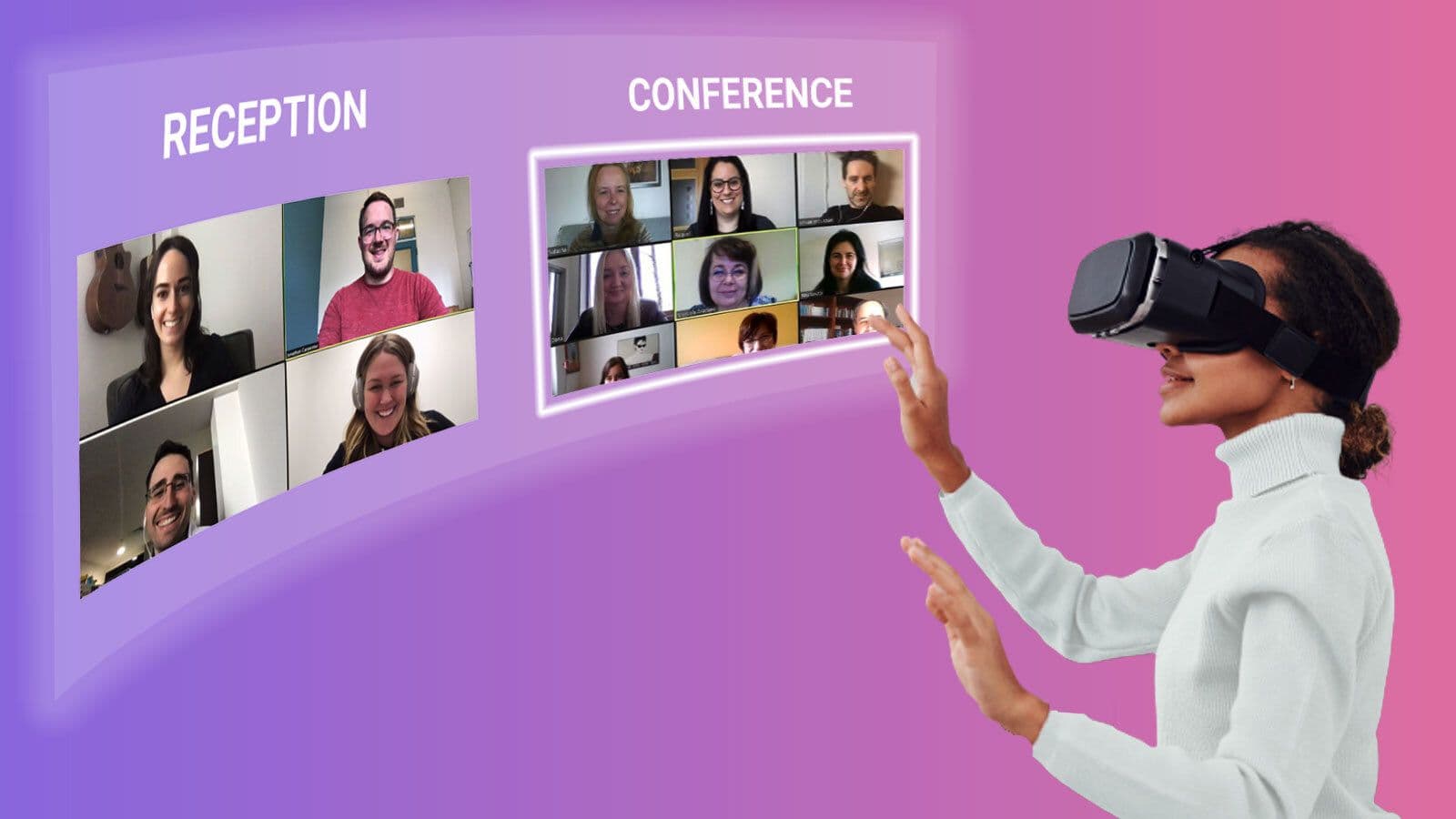
Virtual Events Future Prediction
The future prediction about virtual events states 40.37% growth till the end of 2021. The market impact after the pandemic will remain neutral, as users are well-versed in the benefits of virtual events. Several players are occupying the market. But the North will continue to contribute the highest with a 29% boost. However, professionals predict that the future will bring an amazing amalgamation of in-person and virtual events.
Virtual is at the frontier of opportunities and unexplored spaces, and we didn’t even mention the gaming industry or the metaverse or VR headsets! The possibilities are yet to be explored. Experts strongly believe that virtual is going to change the status quo. However, there’s a lot of work that needs to be done to make that vision a reality. Startups and event management companies being more strategic about the fact that will revolutionize free-style socializing events.
Why Virtual Events Fail Without the Right Infrastructure
Virtual events fail when organizers optimize for registration volume instead of real-time reliability, engagement design, and post-event measurement.
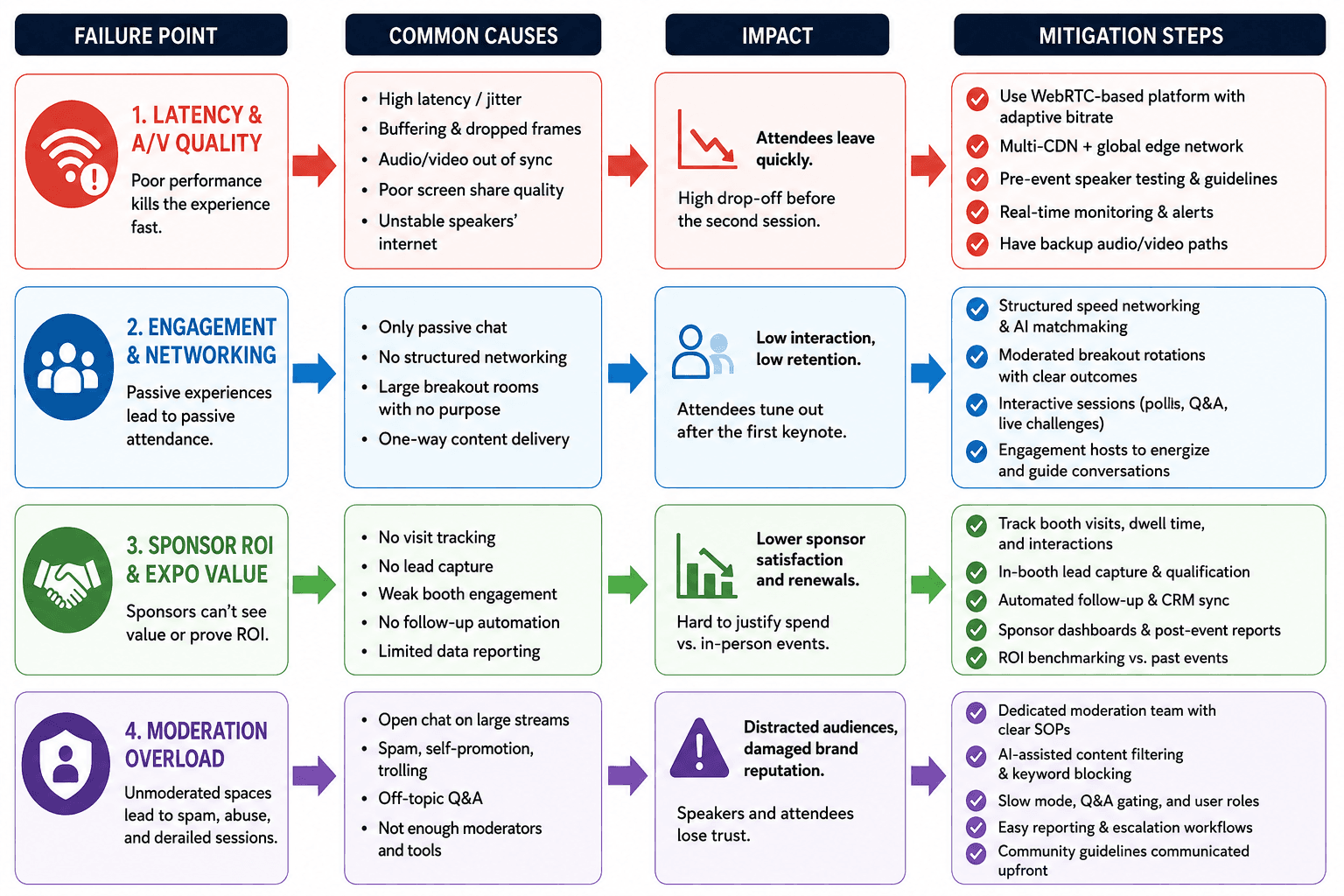
The most common production failure modes include:
- Latency and A/V quality. Remote attendees leave when audio drifts, video buffers, or screen shares freeze. WebRTC-based stages with adaptive bitrate outperform raw RTMP passthrough for interactive sessions.
- Networking fatigue. Passive chat boxes do not replicate hallway conversations. Structured speed networking, AI matchmaking, and moderated breakout rotations keep remote attendees connected past the first keynote.
- Sponsor ROI gaps. Digital expo halls without visit tracking, lead capture, and follow-up automation disappoint sponsors who compare results to in-person booth traffic.
- Moderation overload. Open chat on large streams attracts spam and derails Q&A. Teams need dedicated moderators and tooling for flagged content, not just a "disable chat" fallback.
In practice, event teams that treat the virtual track as a lower-budget mirror of the in-person program see 50 to 70% drop-off before the second session. Teams that assign separate virtual producers, engagement hosts, and technical directors retain audiences through full-day programs.
Acknowledging these limits is not pessimism. It is how organizers allocate budget to the infrastructure and staffing that determine whether the future of virtual events delivers revenue or reputational damage.
Conclusion
The future of virtual events belongs to organizations that design hybrid experiences with the same rigor they apply to physical venues. Market growth continues, attendee expectations have risen, and off-the-shelf portals no longer satisfy teams that need branded, data-rich event products. Start by defining your build-vs-buy decision, measure engagement beyond registrations, and invest in real-time infrastructure that survives peak concurrent attendance. If you are building a custom virtual event experience, get your VideoSDK API keys and ship your first interactive stage this week.
Frequently Asked Questions
What is the future of virtual events?
The future of virtual events is hybrid delivery where in-person and remote attendees share the same programming, sponsors, and networking through real-time video platforms and AI engagement tools. Organizations treat virtual tracks as permanent revenue channels, not pandemic-era experiments.
Are virtual events still popular after COVID?
Yes, virtual events remain popular after COVID because they extend global reach, reduce travel costs, and generate measurable engagement data. According to Grand View Research, the virtual events market continues growing at a projected 20.0% CAGR from 2025 to 2030.
What are the benefits of virtual events?
The benefits of virtual events include global accessibility, lower logistics costs, flexible scheduling, on-demand replay, and automated analytics on attendance and engagement. Hosts capture behavioral data that in-person badge scans alone cannot provide.
What is a hybrid virtual event?
A hybrid virtual event is a conference or meeting that runs a physical venue program alongside a synchronized virtual track for remote attendees. Both audiences access keynotes, sponsors, and networking through shared or parallel digital tools.
How do you plan a virtual event?
You plan a virtual event by defining audience goals, choosing a platform or SDK, designing interactive session formats, running a technical rehearsal, staffing virtual-specific roles, and configuring analytics before registration opens. Engagement features should be scheduled into every session, not added as an afterthought.
Which virtual event platform is best for developers?
VideoSDK is the best virtual event platform for developers building custom branded experiences that require programmatic control over rooms, roles, and analytics. Zoom Events and RingCentral Events suit teams that prefer turnkey portals over SDK integration.
Can virtual events replace in-person conferences entirely?
Virtual events cannot fully replace in-person conferences for relationship-driven industries that depend on unstructured hallway networking and physical product demos. Hybrid formats capture the reach advantages of virtual delivery while preserving high-value in-person interactions.