


A Computer Emergency Response Team (CERT) is a specialized group that coordinates detection, analysis, and recovery from cybersecurity incidents across organizations, industries, or national borders. CERT teams share threat intelligence, manage vulnerabilities, and help victims contain breaches faster than isolated internal IT teams can alone. Every organization handling sensitive real-time data benefits from knowing how CERT coordination works.
A ransomware attack on a telehealth platform does not stop at one hospital network. Stolen session tokens from a live-streaming API can expose thousands of concurrent viewers before your on-call engineer finishes reading the first alert. Computer Emergency Response Teams exist because no single company can outrun coordinated cyber threats alone. This article defines what CERT is, explains how CERT teams operate, compares CERT types worldwide, and shows what engineering and security leaders building real-time applications should do before an incident forces the question.
What Is CERT (Computer Emergency Response Team)?
A Computer Emergency Response Team (CERT) is defined as a formally organized group of cybersecurity professionals responsible for preventing, detecting, responding to, and recovering from information security incidents within a defined scope such as a nation, industry sector, or large enterprise.
CERT works by collecting incident reports, analyzing attack patterns, coordinating containment actions, and distributing actionable advisories to affected organizations and partner teams. When a vulnerability affects software used across an industry, a CERT team often publishes a coordinated disclosure timeline so vendors patch systems before exploit code spreads widely.
The CERT model originated in November 1988 when the CERT Coordination Center (CERT/CC) was established at Carnegie Mellon University's Software Engineering Institute following the Morris worm incident. That founding event established the template still used today: a trusted neutral party that bridges victims, vendors, law enforcement, and peer response teams during active crises.
For teams building real-time communication products, CERT relevance is direct. Video calling, live streaming, and AI voice agents handle authentication tokens, media streams, and user metadata that attackers target during credential stuffing, DDoS, and supply-chain campaigns. Understanding CERT is part of building a defensible architecture, not just a compliance checkbox.
How Does a CERT Work?
A CERT operates through a repeatable incident pipeline that moves from initial report intake to coordinated recovery, with threat intelligence flowing outward at every stage.
Most CERT teams follow a four-phase model aligned with NIST Special Publication 800-61 Rev. 2 (Computer Security Incident Handling Guide): preparation, detection and analysis, containment eradication and recovery, and post-incident activity. Each phase has defined outputs. Preparation produces contact lists and communication trees. Detection produces validated incident tickets. Containment produces isolated systems and preserved logs. Post-incident activity produces after-action reports shared with peer CERTs.
When a developer reports an API key leak affecting a live streaming deployment, the CERT intake desk assigns severity based on scope, affected user count, and exploit availability. Analysts correlate the report with ongoing campaigns tracked by national CERTs such as US-CERT (now part of CISA) or CERT-In in India. If the attack vector matches a known vulnerability in a third-party dependency, the CERT publishes a sector advisory so other organizations patch before they become the next victim.
CERT teams also maintain secure communication channels. During major incidents, public email is avoided in favor of encrypted mailing lists, dedicated portals, and pre-registered phone bridges established during preparation phase exercises.
This section explained the end-to-end CERT workflow from first report through coordinated recovery and intelligence sharing.
Why do you need CERT?
- Incident Response: CERTs help organizations respond to and recover from cybersecurity incidents, minimizing the damage caused by attacks. They have the expertise to detect, analyze, and mitigate threats quickly, helping reduce downtime and prevent future incidents. A well-defined incident response plan is essential in guiding these actions effectively and ensuring a coordinated approach.
- Threat Intelligence Sharing: CERTs collect and analyze data on emerging threats and vulnerabilities, which they share with clients and the broader cybersecurity community. This proactive approach helps organizations stay ahead of potential threats by applying necessary patches and security measures.
- Vulnerability Management: They identify security weaknesses in systems and provide actionable advice to address them. This includes offering guidance on patch management and securing systems, reducing the risk of exploitation by cybercriminals.
- Public Awareness: CERTs play an important role in educating the public and organizations on cybersecurity best practices. They conduct training and awareness programs to help users adopt secure behaviors and reduce the likelihood of falling victim to attacks.
- Global Coordination: CERTs collaborate with other security organizations, law enforcement, and international partners to respond to large-scale incidents and enhance the overall cybersecurity ecosystem. This global network strengthens the collective defense against cyber threats.
What Are the Different Types of CERTs Worldwide?
Global cybersecurity defense relies on layered CERT structures where national teams, industry-specific teams, and vendor-aligned groups each cover a distinct scope of responsibility.
National and regional CERTs serve government and critical infrastructure within a country or region. Examples include CISA (which absorbed US-CERT functions) in the United States, CERT-In under India's Ministry of Electronics and IT, and JPCERT/CC in Japan. These teams publish national advisories, coordinate cross-ministry response, and often mandate reporting timelines for regulated sectors.
Industry-specific CERTs focus on vertical threat patterns that generic national teams lack depth to address daily. ISACs (Information Sharing and Analysis Centers) in finance, healthcare, and energy function as sector CERTs. They translate broad CVE alerts into guidance specific to electronic health record systems, trading platforms, or SCADA environments.
Enterprise and vendor CERTs operate inside large technology companies or cloud providers. Microsoft MSRC, Google TAG, and AWS Security teams coordinate disclosure and patching for their own product ecosystems. For developers, vendor CERT advisories often arrive faster than national bulletins when the vulnerability is in a managed SDK or API.
Global coordination networks connect independent CERTs. FIRST provides membership standards, conference channels, and trusted peering for over 600 teams globally. CERT/CC at Carnegie Mellon continues research on vulnerability coordination and publishes the Vulnerability Notes Database.
If you operate a real-time communication product, you interact with multiple CERT layers simultaneously: your cloud provider's security team, your industry's ISAC, and your national CERT for regulatory reporting obligations.
This section mapped the four major CERT categories and their scopes of responsibility.
Overall, CERTs are essential in the global effort to enhance cybersecurity readiness, response, and resilience against the ever-evolving threat landscape.
Common Misconceptions About CERT Teams
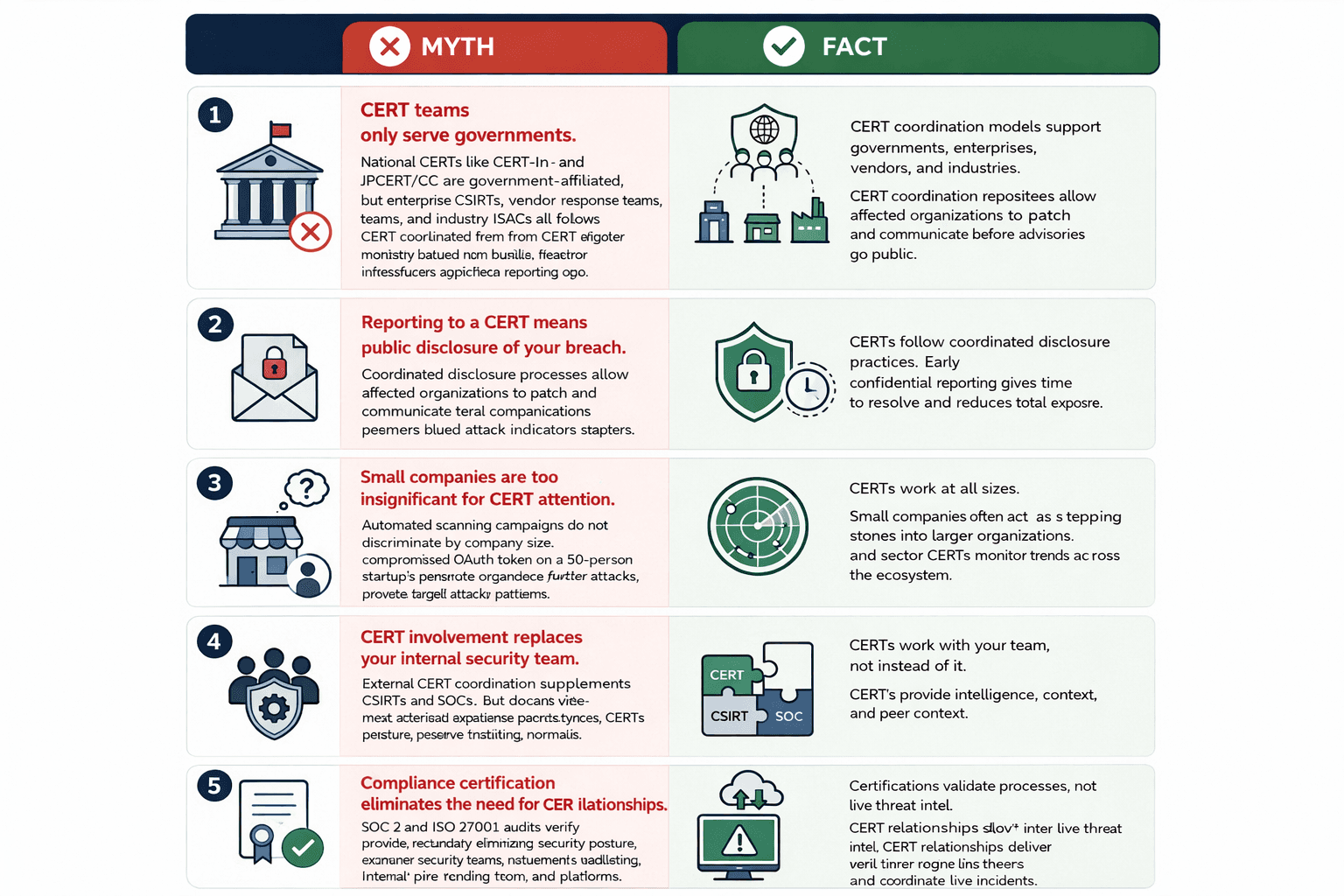
Several widely repeated beliefs about CERT teams are inaccurate, and those inaccuracies delay reporting during the critical first hours of an active incident.
Misconception 1: CERT teams only serve governments. National CERTs like CERT-In and JPCERT/CC are government-affiliated, but enterprise CSIRTs, vendor response teams, and industry ISACs all follow CERT coordination models. Private companies benefit from FIRST membership and vendor CERT advisories regardless of government reporting obligations.
Misconception 2: Reporting to a CERT means public disclosure of your breach. Coordinated disclosure processes allow affected organizations to patch and prepare customer communications before advisories go public. Early confidential reporting to a trusted CERT often reduces total exposure compared to silent internal containment that misses linked attack indicators.
Misconception 3: Small companies are too insignificant for CERT attention. Automated scanning campaigns do not discriminate by company size. A compromised OAuth token on a 50-person startup's video chat feature can serve as a pivot point into larger partner organizations. Sector CERTs track attack patterns across all reporting entities.
Misconception 4: CERT involvement replaces your internal security team. External CERT coordination supplements CSIRT and SOC functions. You still own access revocation, customer notification, and system recovery. CERT teams provide intelligence, coordination channels, and peer context your internal team lacks.
Misconception 5: Compliance certification eliminates the need for CERT relationships. SOC 2 and ISO 27001 audits verify process existence. They do not provide real-time IOC feeds during an active zero-day affecting your WebRTC dependency chain. CERT relationships fill that operational gap.
Correcting these misconceptions early helps engineering leaders report faster and coordinate more effectively when incidents touch live production systems.
This section debunked five common CERT myths that delay effective incident coordination.
The CERT Incident Response Lifecycle Explained
The CERT incident response lifecycle provides a structured sequence that prevents teams from skipping evidence preservation or releasing premature public statements during high-pressure breaches.
NIST SP 800-61 Rev. 2 defines four lifecycle phases that most CERT and CSIRT teams adapt to their organizational context:
Preparation
Preparation includes maintaining contact lists for CSIRT members, external CERT liaisons, legal counsel, and executive decision-makers. Run tabletop exercises simulating a live streaming API key leak or a DDoS against your signaling cluster. Verify that on-call engineers can reach VideoSDK support and cloud provider security contacts without searching email archives during an incident.
Detection and Analysis
Detection converts raw alerts into validated incidents. SOC tools flag anomalies. CSIRT analysts determine scope: which rooms, users, or API endpoints are affected. CERT teams at the sector level correlate your report with campaigns targeting similar infrastructure.
Containment, Eradication, and Recovery
Containment stops active damage. For real-time platforms, this means rotating compromised tokens, disabling affected API keys, isolating compromised media nodes, and potentially pausing live sessions with user notification. Eradication removes attacker persistence mechanisms. Recovery restores services with patched dependencies and verified configurations.
Post-Incident Activity
Post-incident reviews produce after-action reports, updated detection rules, and shared advisories. Lessons learned feed back into preparation phase updates. Organizations that skip this phase repeat the same containment mistakes during the next campaign.
This section walked through all four NIST-aligned lifecycle phases and their outputs for CERT-coordinated response.
How to Prepare Your Organization for CERT Coordination
Preparation before an incident determines whether your first CERT contact is a structured report or a panicked email missing the data analysts need.
Follow these steps to build CERT readiness into your security program:
- Identify your reporting CERTs. Determine which national CERT covers your jurisdiction, which industry ISAC serves your sector, and which vendor CERTs cover your critical dependencies including your real-time communication SDK and cloud provider.
- Register contact points. Submit official security contact information to national CERT portals where registration is available. Assign a primary and backup contact who understands your production architecture.
- Document your communication stack. Create a one-page diagram showing authentication flow, media path, recording storage, and webhook integrations. Attach this to your internal incident response plan.
- Define severity thresholds. Write clear criteria for P1 through P4 incidents specific to live session abuse, credential leaks, and DDoS events. Align thresholds with escalation timelines in your CSIRT charter.
- Run a tabletop exercise. Simulate a coordinated disclosure affecting your WebRTC dependency chain. Time how long it takes to identify affected services, rotate credentials, and draft a customer status page update.
- Establish secure reporting channels. Store encrypted contact methods for external CERTs separately from production systems that attackers might compromise during an active breach.
Teams using VideoSDK should include SDK token generation endpoints, webhook URLs, and recording storage locations in this documentation so CSIRT analysts can act without waiting for engineering archaeology.
This section provided six actionable steps for CERT coordination readiness before a live incident occurs.
Conclusion
Understanding what CERT is and how CERT teams operate gives engineering and security leaders a concrete framework for incident readiness beyond compliance audits. National CERTs, sector ISACs, and vendor response teams each play a distinct role, and real-time platforms add session-specific surfaces that generic playbooks often miss. Map your dependencies, define live session severity levels, and establish CSIRT-to-CERT contacts before your first production incident. If you are building video, audio, or AI voice applications, start with a platform that bakes session security into the integration path.
Frequently Asked Questions
What is CERT in cybersecurity?
CERT in cybersecurity stands for Computer Emergency Response Team, a group that coordinates the detection, analysis, containment, and recovery from information security incidents. CERT teams share threat advisories, manage vulnerability disclosures, and connect affected organizations with peer response teams and law enforcement when attacks cross organizational boundaries.
Why is CERT important globally?
CERT is important globally because cyber attacks routinely cross national and sector boundaries, and no single organization holds complete visibility into coordinated campaigns. Global CERT networks like FIRST enable trusted intelligence sharing so a breach pattern detected in one country triggers defensive actions in others before the same exploit chain reaches their infrastructure.
How many types of CERTs exist?
Multiple types of CERTs exist including national and regional CERTs (such as CISA in the US and CERT-In in India), industry-specific ISACs, enterprise and vendor CERT teams inside large technology companies, and global coordination bodies like FIRST and CERT/CC. Each type covers a different scope from national critical infrastructure to single-vendor product ecosystems.
What is the difference between CERT and CSIRT?
The difference between CERT and CSIRT is scope and orientation. A CERT typically coordinates response across multiple organizations or an entire sector and publishes external advisories. A CSIRT handles incidents within one organization, executing internal containment and reporting outward to CERTs when the attack exceeds internal capacity.
How does a CERT handle a security incident?
A CERT handles a security incident by receiving and validating reports, analyzing attack scope and indicators, coordinating containment guidance with affected organizations, supporting recovery actions, and publishing threat advisories to peer teams. The process follows structured phases including preparation, detection, containment, recovery, and post-incident review aligned with frameworks like NIST SP 800-61.
When should a company contact a CERT?
A company should contact a CERT when it detects an incident that may affect customers, partners, or sector infrastructure beyond its internal boundary, when a vulnerability disclosure requires coordinated patching across dependencies, or when national regulations mandate breach reporting to an official CERT portal within a defined timeframe.
Is VideoSDK relevant to CERT and incident response planning?
VideoSDK is relevant to CERT and incident response planning for teams building real-time video, audio, and live streaming applications because session authentication, media transport, and recording storage create incident surfaces that CSIRT teams must document before an active breach. VideoSDK provides token-based session control and encrypted WebRTC transport that integrates into a CERT-aligned security architecture alongside SOC monitoring and CSIRT response procedures.