


TL;DR: Video KYC drop-off is a measurable, fixable problem. Most abandonment clusters around three stages, pre-session readiness, queue wait, and document capture. Fixing infra, UX, and compliance gaps at each stage can push completion rates from the industry average of 55–65% to 80%+.
Introduction
Video KYC (also called V-CIP, or Video-based Customer Identification Process) has become the default onboarding mechanism for regulated financial entities in India. The Reserve Bank of India's V-CIP guidelines mandate that banks, NBFCs, and payment aggregators use live video verification in place of in-person KYC for remote customers.
The regulatory intent is clear. The operational reality, however, is messy: a significant share of users who begin a video KYC session never complete it. Every incomplete session is a lost account, a lost revenue opportunity, and, in high-volume pipelines, a compounding drag on growth.
Video KYC success rate optimization drop-off is not a UX problem alone. It is a systems problem spanning device readiness, network conditions, agent capacity, compliance constraints, and session reliability. This guide gives product managers, growth teams, and compliance leaders a structured framework to diagnose drop-off, prioritize fixes, and benchmark results.
Regulatory and market context
India's V-CIP framework, introduced by the RBI in 2020 and updated since, requires financial entities to conduct live, two-way video sessions with customers during onboarding. The session must be conducted by a trained official, include live document verification, liveness detection, and geo-tagging, and be stored with a full audit trail.
The scale of adoption is significant. With India's BFSI sector processing tens of millions of new account openings annually, even a 10-percentage-point improvement in KYC completion rate optimization translates to hundreds of thousands of additional activated accounts per year.
The challenge: RBI's compliance requirements create hard constraints that limit how much UX alone can solve. Any optimization framework must work within, not around, those constraints.
Must Read: RBI Video KYC Guidelines
What is video KYC success rate and drop-off?
Success rate is the percentage of users who initiate a video KYC session and complete it successfully, meaning the session results in a verified, approvable identity record. It is the primary metric for video onboarding success metrics tracking.
Drop-off rate is the inverse: the percentage of users who start the process but do not complete it. Drop-off can occur at any stage, before the session begins, during the queue, mid-session, or post-session due to verification failure.
Typical industry benchmarks range between 55–75% completion depending on platform type, user segment, device mix, and network conditions. Best-in-class platforms operating on optimized infrastructure and UX report rates above 80%.
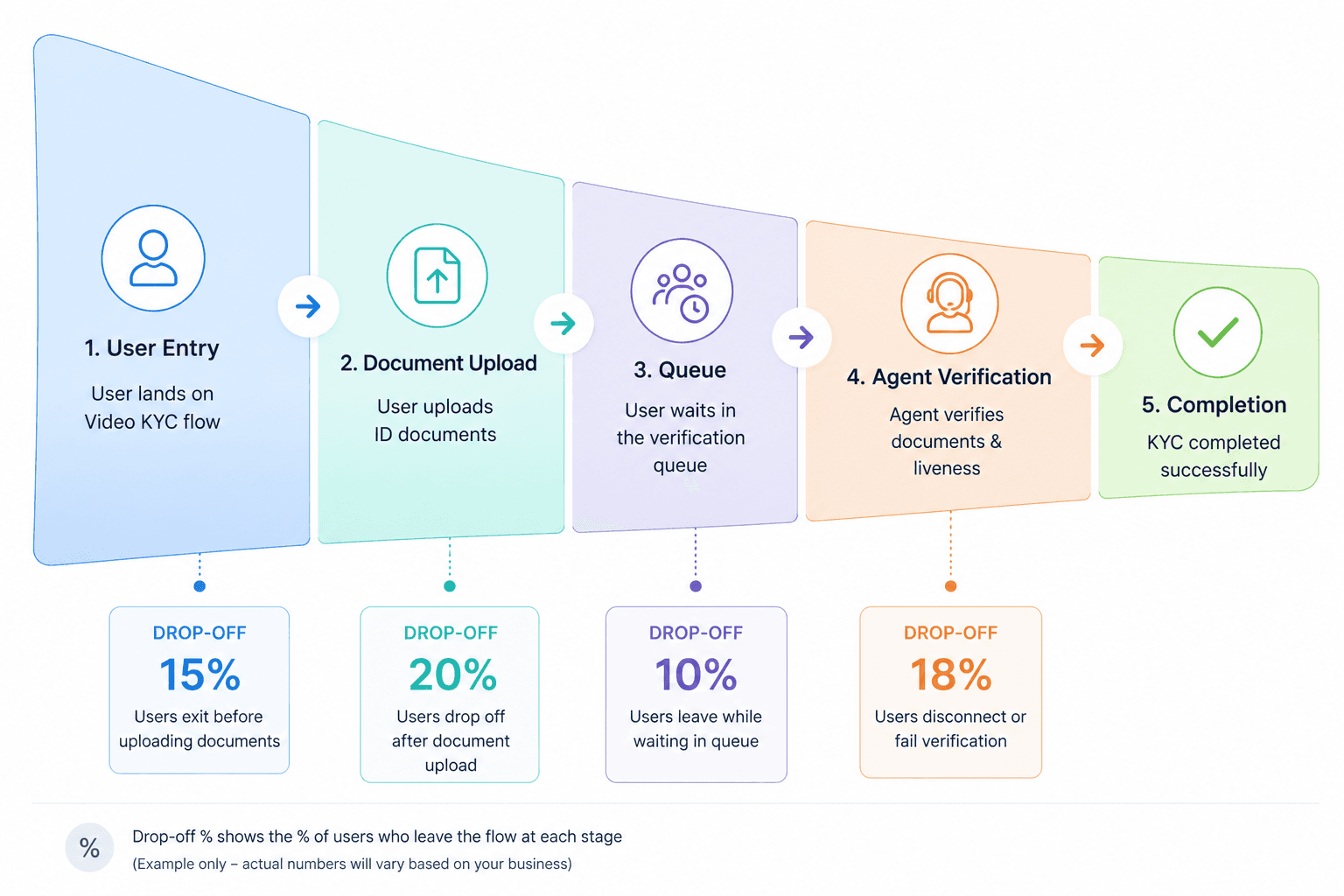
Video KYC funnel breakdown
Understanding where users leave is the prerequisite to fixing why they leave. The V-CIP funnel has five distinct stages, each with its own failure modes.
Stage 1: Entry and pre-session check
The user receives a link (via SMS, email, or in-app) and lands on the KYC start screen. Drop-off here is driven by:
- Confusion about what documents are needed
- Device or browser incompatibility (camera/microphone permissions)
- Users on low-end Android devices failing WebRTC capability checks
- High friction in the consent and pre-check flow
This stage typically accounts for 10–20% of total drop-off on poorly optimized platforms.
Stage 2: Document capture
Users must photograph or upload their Aadhaar, PAN, or other ID. Failure modes:
- Poor camera quality producing blurry captures
- Lighting conditions causing OCR failure
- Users unfamiliar with document orientation requirements
- Retry loops that exhaust patience before a clean capture is accepted
This stage is the single largest contributor to reduce KYC abandonment efforts on most platforms. Expect 15–25% drop-off here if document capture is not guided actively.
Stage 3: Queue wait
After document upload, users wait for an available agent. This stage is almost entirely an infrastructure and capacity problem:
- Insufficient agent capacity during peak hours
- Session timeouts while users wait
- No visible queue position or estimated wait time
- Users switching tabs or apps and missing the agent connect
Queue-related abandonment is highly variable. near zero with adequate capacity, 20–30% on platforms that understaff peak hours.
Stage 4: Agent connect and live verification
The live session itself can fail due to:
- Video/audio quality degradation on poor network conditions
- Session drops mid-verification
- Agent protocol errors (incorrect liveness check procedure)
- User non-compliance (wrong document presented, lighting issues)
Infra-driven failures at this stage, packet loss, jitter, connection drops, are addressable with the right real-time video infrastructure. VideoSDK and similar platforms are designed specifically for session reliability at scale, with adaptive bitrate and network fallback mechanisms that reduce mid-session drop-off.
Stage 5: Verification outcome and completion
Some sessions complete the live interaction but fail at the verification decision stage:
- Liveness check not conclusively passed
- Document OCR data mismatch
- Geo-tag outside permitted geography
- Incomplete audit trail due to recording failure
These are compliance-layer failures. They do not always register as "drop-off" in UX analytics but do reduce effective success rate.
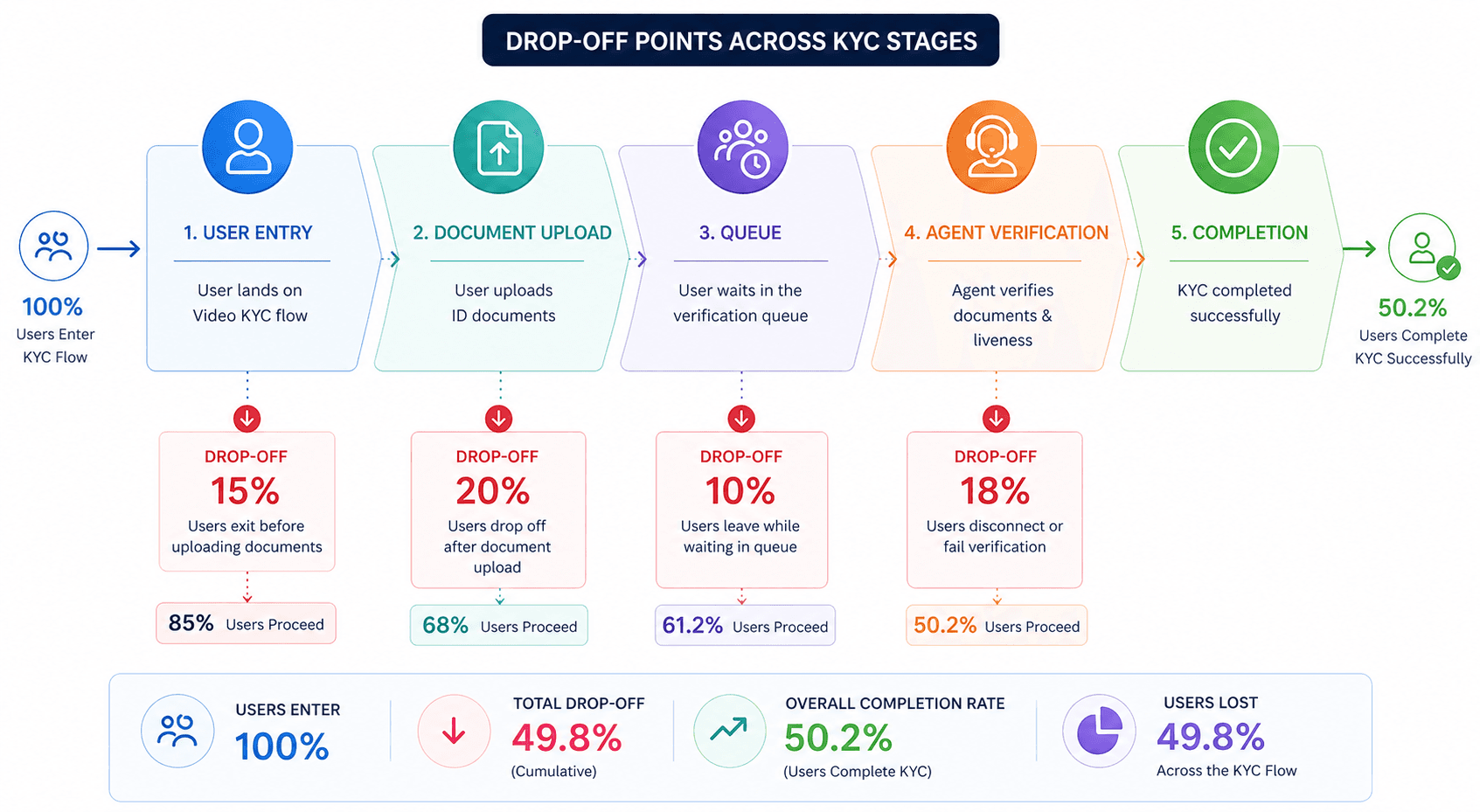
Core optimization framework
Layer 1: Stage-wise drop-off diagnosis
Before optimizing anything, instrument the funnel. Define events at each stage transition and measure:
- Entry-to-document-start rate
- Document-start-to-capture-success rate
- Capture-to-queue-entry rate
- Queue-entry-to-agent-connect rate
- Agent-connect-to-session-complete rate
- Session-complete-to-verified rate
If you cannot isolate where users leave, you will misallocate optimization effort. Most platforms over-invest in UX polish at Stage 1 while ignoring infra failures at Stages 3–4.
Layer 2: UX optimization
Pre-session guidance: Add a checklist screen before the session starts: required documents, lighting tips, supported browsers, and estimated session time. This single intervention reduces Stage 1 and Stage 2 abandonment.
Guided document capture: Use real-time feedback overlays (frame alignment, brightness detection, blur detection) rather than static instructions. Allow retries with coaching, not just error messages.
Queue transparency: Show users their position in queue or an estimated wait time. Offer a callback or scheduled-slot option for users who cannot wait. This is the highest-impact single UX change for V-CIP success rate improvement on high-volume platforms.
Session recovery: If a session drops, allow seamless re-entry without restarting the full flow. Store session state so users resume at the last verified stage.
Layer 3: Infrastructure optimization
Infrastructure failures are invisible in UX analytics but measurable in session logs. Target:
- Adaptive bitrate streaming: Automatically adjusts video quality based on available bandwidth, preventing freezes that cause users to disconnect.
- Network quality detection: Alert users to poor connection before the session begins, not during it.
- Geographic routing: Route sessions to the nearest server to minimize latency, which directly affects video clarity during liveness checks.
- Session recording reliability: Ensure recordings are captured without gaps, which is both a compliance requirement and a retry-prevention measure.
Real-time communication infrastructure built for scale, such as that offered by VideoSDK via its developer documentation, provides the WebRTC primitives that make adaptive quality and session reliability achievable without building from scratch.
Layer 4 Compliance constraints layer
Compliance is not optional, but it can be implemented more or less gracefully. Teams that treat compliance steps as blockers rather than design inputs generate unnecessary drop-off.
Specific optimizations:
- Liveness check UX: Instruct users clearly on what the liveness check requires (blinking, head turn, spoken phrase). Ambiguous instructions increase failure rates.
- Geo-tag transparency: Inform users that location permission is required before they attempt to proceed. Denial mid-flow is a hard exit.
- Consent flow clarity: Keep the consent screen short and plain-language. Long legal text at this stage causes abandonment.
Metrics and benchmarking
| Metric | Definition | Industry benchmark |
|---|---|---|
| Session completion rate | Sessions completed / sessions initiated | 55–75% (optimized: 80%+) |
| Average handling time (AHT) | Mean duration of completed sessions | 5–12 minutes |
| Session failure rate | Sessions that drop mid-verification | 8–20% |
| Document capture retry rate | Users requiring 2+ capture attempts | 20–40% |
| Queue abandonment rate | Users who leave during wait | 10–30% (capacity-dependent) |
| First-attempt verification rate | Sessions verified on first attempt | 60–80% |
All benchmarks are indicative. Actual figures vary by device mix, network geography, agent training quality, and infrastructure tier.
The most reliable leading indicator of overall success rate is queue abandonment rate, it is the most volatile metric and the most directly controllable through capacity management.
RBI compliance checklist
The RBI V-CIP guidelines impose specific technical and procedural requirements. Non-compliance risks onboarding rejection, regulatory penalties, and audit exposure.
| Requirement | Specification | Optimization implication |
|---|---|---|
| Live video session | Real-time, two-way video — no pre-recorded sessions | Infrastructure must support sub-200ms latency |
| Geo-tagging | Customer's location must be captured and verified | Request location permission early in flow |
| Liveness detection | Must confirm live presence, not a photograph | Explicit user instruction reduces failure rate |
| Document verification | OCR and visual check of original document | Guided capture reduces retry rate |
| Audit trail | Full session log including agent ID, timestamp, outcome | Recording must not have gaps; log all events |
| Recording storage | Sessions must be stored per RBI retention requirements | Reliable recording is an infra requirement |
| Trained official | Session must be conducted by an RBI-compliant official | Agent training directly affects AHT and quality |
| Time-stamping | Sessions must be time-stamped with a reliable clock | Server-side timestamping preferred |
Consequences of non-compliance:
- Individual onboarding rejections (immediate revenue loss)
- Regulatory show-cause notices
- Suspension of V-CIP authorization
- Reputational risk with customers whose onboarding data is mishandled
Common mistakes
1. Optimizing UX before instrumenting the funnel. Teams that redesign the document capture screen before measuring where users actually drop are guessing. Instrument first.
2. Treating queue wait as fixed. Queue abandonment feels like a capacity problem that requires hiring more agents. Often, it is a scheduling problem, agents are available but not allocated to peak hours. Rescheduling before hiring is faster and cheaper.
3. Ignoring device and browser compatibility. A significant share of Indian mobile users are on Android devices with older WebRTC implementations. Not testing across this device range means infrastructure failures show up as "user error" in support logs.
4. Building compliance steps as afterthoughts. Consent, geo-tag, and liveness checks added late to a session flow create jarring UX transitions. Build them into the flow design from the start.
5. Not offering session recovery. A dropped session that requires the user to restart from Step 1 will almost never be completed. Session state persistence is a high-ROI engineering investment.
Key takeaways
- Video KYC drop-off reduction requires simultaneous action across UX, infrastructure, and compliance layers, no single layer fix is sufficient.
- Queue abandonment is the most volatile and most fixable drop-off point; capacity and scheduling changes deliver fast results.
- Guided document capture with real-time feedback is the highest-ROI UX intervention for most platforms.
- Infrastructure reliability, adaptive bitrate, geographic routing, recording stability, is a compliance requirement, not a premium feature.
- Instrument the funnel at every stage transition before prioritizing any optimization effort.
FAQ
What is a good video KYC success rate?
Typical industry benchmarks for V-CIP completion range between 55–75%. Platforms with optimized UX, reliable infrastructure, and well-trained agents consistently achieve rates above 80%. Best-in-class operations report 85–90% in controlled conditions.
What causes the most video KYC drop-off?
Document capture failure and queue wait time are the two largest contributors on most platforms. Document capture fails due to poor camera quality, lighting, and insufficient user guidance. Queue abandonment rises when agent capacity is mismatched to demand volume.
Is video KYC mandatory for all banks and NBFCs in India?
V-CIP is not mandatory but is permitted as an alternative to in-person KYC under RBI guidelines. Entities that choose V-CIP must comply fully with the technical and procedural requirements set out by the Reserve Bank of India.
How do I measure video KYC drop-off rate accurately?
Define session initiation as the start event (user lands on the KYC start screen) and session completion as the end event (verified outcome delivered). Measure conversion at each intermediate stage, document capture, queue entry, agent connect, and verification, to isolate where abandonment clusters.
Can session drop-off caused by network issues be recovered?
Yes, with the right infrastructure. Real-time video platforms that support session state persistence and reconnection allow users to re-enter a dropped session without restarting. This requires both infra capability and application-layer session management.
What RBI requirements most directly affect success rate?
Geo-tagging (requires user location permission), liveness detection (requires user compliance), and recording continuity (requires infra reliability) are the three compliance requirements that most directly create drop-off when implemented poorly.
How long should a video KYC session take?
Well-run V-CIP sessions typically complete in 5–8 minutes. Sessions exceeding 12 minutes correlate with higher user abandonment and lower agent throughput. AHT reduction through agent training and document capture automation is a key lever.
Does improving video quality directly improve success rate?
Yes, particularly for liveness checks and document verification. Poor video quality during liveness checks increases false-negative rates, requiring retries or session escalation. Infrastructure that supports adaptive bitrate ensures video quality degrades gracefully on poor networks rather than failing hard.