


WebSocket vs WebTransport is a choice between universal compatibility and maximum performance. WebSocket is defined as a mature, TCP-based protocol offering reliable, bidirectional communication for standard apps. WebTransport is defined as a modern, HTTP/3-based protocol supporting multiplexing and unreliable datagrams for ultra-low latency streaming. Choose WebTransport for high-performance media, and WebSocket for universal support.
The demand for instant, seamless real-time communication has never been higher. When building live video, gaming, or financial trading platforms, milliseconds matter. But relying on the wrong transport protocol can introduce lag, head-of-line blocking, and scaling bottlenecks that frustrate your users. You need to make a critical architectural decision: stick with the established reliability of WebSockets or upgrade to the high-performance capabilities of WebTransport. This guide breaks down exactly how these two protocols compare, where they excel, and how to choose the right one for your next real-time application.
What is WebSocket?
WebSocket is defined as a communication protocol that provides full-duplex communication channels over a single, long-lived TCP connection. By establishing a persistent connection between the client and server, WebSockets eliminate the overhead of traditional HTTP request-response cycles.
WebSocket works by initiating an HTTP handshake that upgrades to a WebSocket connection, keeping the channel open for continuous data exchange. This allows both parties to send and receive messages instantly without reconnecting. In practice, WebSockets have become the default standard for basic real-time features.
What is WebTransport?
WebTransport is defined as a modern web API built on top of the HTTP/3 and QUIC protocols to provide low-latency, multiplexed communication. Unlike WebSockets, it does not rely on TCP, allowing it to bypass common networking bottlenecks.
WebTransport works by leveraging QUIC to support multiple independent streams and unreliable datagrams over a single connection. If one packet drops, other streams continue unaffected, completely eliminating head-of-line blocking. This makes WebTransport uniquely suited for next-generation media and gaming architectures.
How Does WebSocket Work?
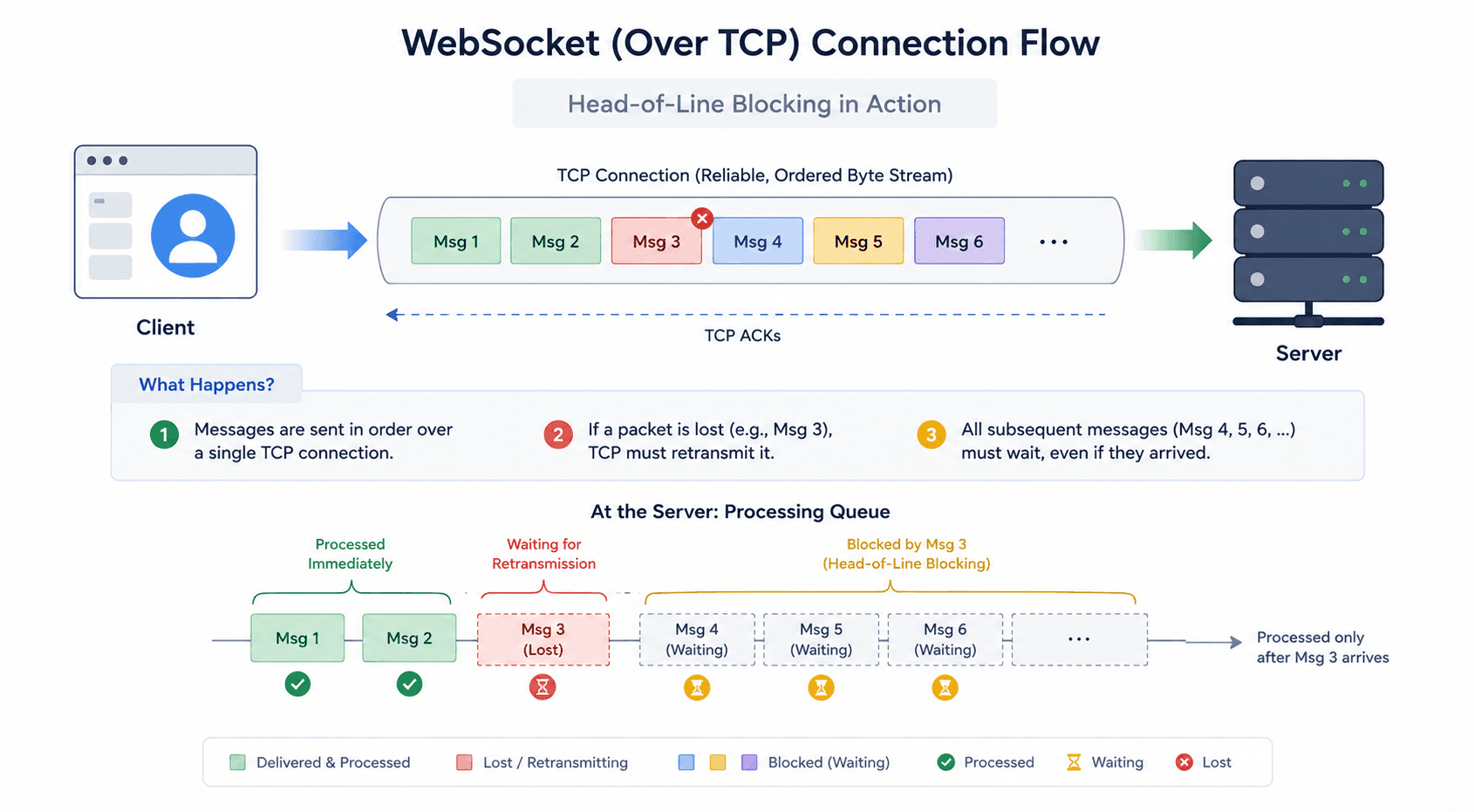
WebSocket establishes a persistent, reliable connection using the Transmission Control Protocol (TCP). When a client sends a request, the server responds and upgrades the connection, creating a continuous two-way pipeline. Because TCP is a reliable protocol, it guarantees that all packets arrive in order. However, if a single packet is lost, the entire stream halts until that packet is retransmitted. This phenomenon, known as head-of-line blocking, can cause sudden latency spikes on unstable networks.
To summarize, WebSocket guarantees data delivery but sacrifices latency when network conditions degrade.
How Does WebTransport Work?
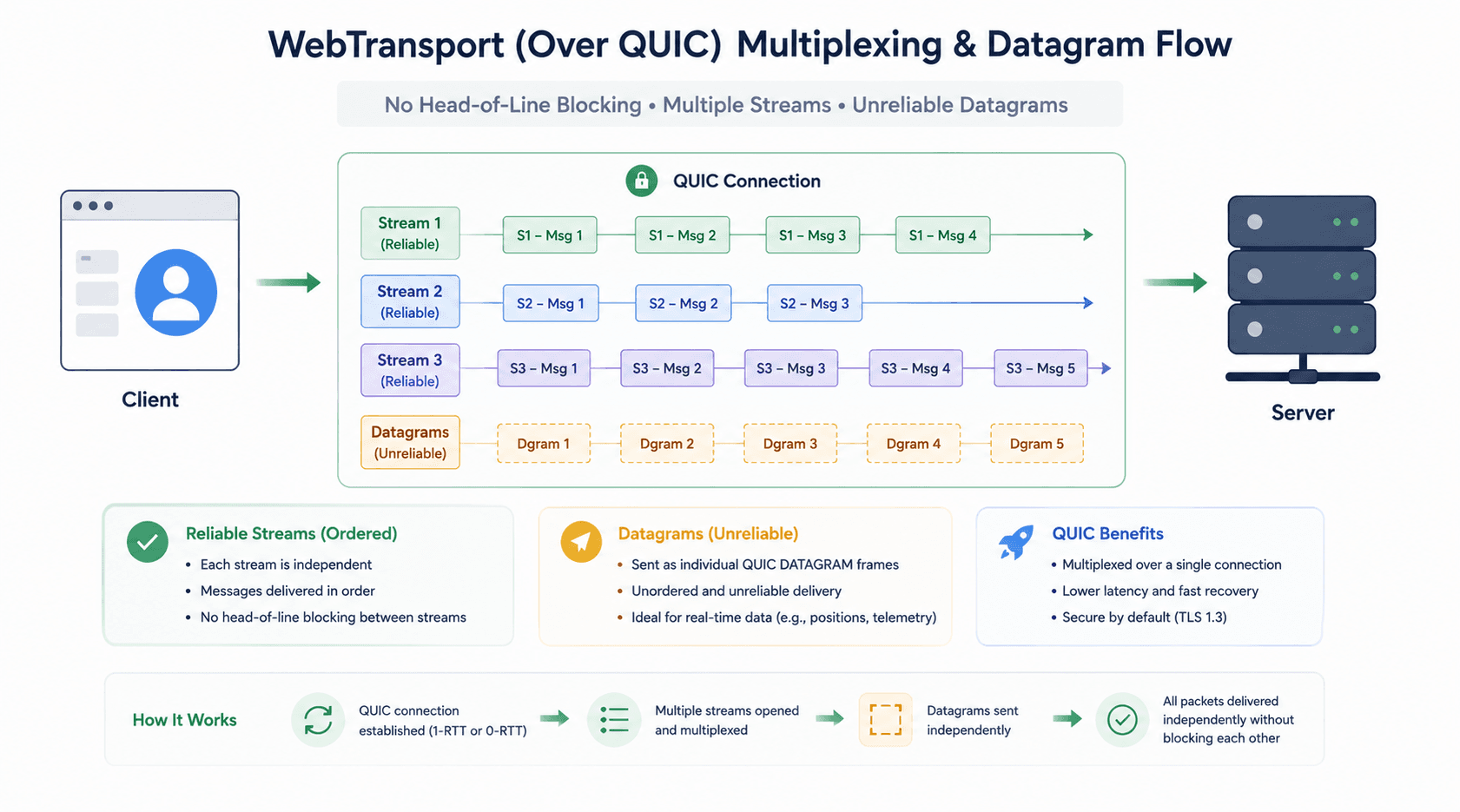
WebTransport utilizes the QUIC protocol (the foundation of HTTP/3) to deliver data faster and more flexibly. It allows developers to open multiple independent streams within a single connection. If a packet is lost in one stream, the others keep moving, effectively solving the head-of-line blocking issue. Furthermore, WebTransport allows for "unreliable datagrams",meaning you can send data that doesn't need acknowledgment, which is perfect for live video frames where getting the newest frame is more important than recovering an old one.
To summarize, WebTransport prioritizes speed and flexibility by offering both reliable streams and fast, unreliable datagrams.
WebTransport vs WebSockets: Key Differences
Choosing the right protocol requires understanding their core architectural differences. Below is a detailed breakdown of how they compare across critical dimensions.
| Feature | WebTransport | WebSockets |
|---|---|---|
| Underlying Protocol | QUIC (HTTP/3) | TCP |
| Multiplexing | Built-in (multiple independent streams) | Not supported natively (one stream) |
| Head-of-Line Blocking | No (isolated stream failures) | Yes (one dropped packet blocks all) |
| Delivery Modes | Reliable & Unreliable (Datagrams) | Always Reliable (guaranteed delivery) |
| Browser Support | Evolving (mostly Chromium-based) | Universal (all modern browsers) |
| Best For | Live video, cloud gaming, low-latency | Chat, dashboards, notifications |
To summarize, WebTransport offers superior performance through QUIC, while WebSockets offer unmatched universal compatibility.
Pros and Cons of WebSocket
WebSocket remains the industry standard for a reason: it works everywhere. The primary advantage of WebSocket is its universal browser compatibility and massive ecosystem of libraries (like Socket.io). It is incredibly efficient for small, frequent text messages. However, its reliance on TCP means it suffers from head-of-line blocking, and it lacks native multiplexing. To handle different data types, developers often have to open multiple WebSocket connections, which consumes server resources.
Pros and Cons of WebTransport
WebTransport represents the future of real-time web communication. The major advantage of WebTransport is its ability to handle both reliable and unreliable data simultaneously without head-of-line blocking. Its multiplexing capabilities significantly improve bandwidth efficiency and server scalability. On the downside, WebTransport is still an evolving standard. Browser support is currently limited compared to WebSockets, and the learning curve for implementing QUIC-based architecture is steeper for developers.
Real-World Example: Scaling Live Video with VideoSDK
Consider a platform hosting interactive live streaming for 10,000 concurrent viewers. Using traditional WebSockets for media transport, a slight network dip for a user causes TCP to retransmit dropped packets, leading to buffering and a degraded experience.
By integrating VideoSDK, which intelligently leverages WebTransport, the platform can send video frames as unreliable datagrams. If a frame drops, the player simply renders the next one instantly, maintaining a real-time feel without buffering. VideoSDK provides complete flexibility, scalability, and control, making it effortless to integrate audio-video conferencing and interactive live streaming into web and mobile apps. According to internal benchmarks, using WebTransport for media delivery can reduce perceived latency by up to 30% on unstable mobile networks.
To summarize, VideoSDK utilizes WebTransport's datagrams to ensure smooth, low-latency live streaming even on poor connections.
Choosing the Right Solution for Your Application
The decision between these protocols boils down to your specific performance requirements.
- Assess your latency tolerance: If you are building a chat app, WebSocket's reliable delivery is perfect. If you are building cloud gaming, WebTransport's datagrams are essential.
- Evaluate your audience's hardware: If your users rely on older browsers or restrictive enterprise firewalls, WebSockets are the safer bet.
- Consider your scaling infrastructure: If you need to push massive amounts of concurrent data streams, WebTransport's multiplexing will save significant server resources.
To summarize, match the protocol to your strict latency requirements and your audience's browser capabilities.
Definitions Glossary
- WebSocket: A communication protocol providing full-duplex, reliable channels over a single TCP connection.
- WebTransport: A modern API utilizing HTTP/3 and QUIC to offer multiplexed, low-latency communication.
- QUIC: A multiplexed transport protocol built on UDP that reduces latency and avoids head-of-line blocking.
- Head-of-Line Blocking: A performance issue in TCP where a single lost packet stops the delivery of all subsequent packets until it is recovered.
- Multiplexing: The ability to send multiple independent streams of data over a single connection simultaneously.
Key Takeaways
- WebSocket relies on TCP and guarantees reliable delivery, but is susceptible to head-of-line blocking.
- WebTransport utilizes QUIC to offer both reliable streams and unreliable datagrams, completely eliminating head-of-line blocking.
- WebTransport's multiplexing capabilities allow for highly efficient bandwidth usage and superior server scalability.
- WebSockets offer universal browser compatibility, whereas WebTransport is still gaining adoption.
- VideoSDK seamlessly integrates with both protocols, allowing developers to build robust, low-latency real-time video applications effortlessly.
Conclusion
The shift from WebSocket to WebTransport marks a significant leap forward in web performance. While WebSockets will remain the go-to standard for basic reliable messaging, WebTransport is undeniably the future for high-stakes, ultra-low-latency applications like interactive live streaming and gaming. To future-proof your real-time infrastructure and deliver the best possible user experience, evaluate your architecture today. Try VideoSDK for free to experience seamless video integration powered by cutting-edge transport protocols.
Frequently Asked Questions
Is WebTransport a replacement for WebSocket?
No, WebTransport is not a direct replacement for WebSocket. While WebTransport excels at low-latency, multiplexed media streaming, WebSocket remains the best choice for universally supported, simple reliable messaging.
Can I use WebTransport in all browsers?
No, WebTransport does not yet have universal browser support. It is currently supported in modern Chromium-based browsers, while Safari and older browsers still rely heavily on WebSockets.
Why is QUIC better than TCP for real-time data?
QUIC is better than TCP for real-time data because it avoids head-of-line blocking. By using independent streams and allowing for unreliable datagrams, QUIC ensures that one dropped packet doesn't delay the rest of the data flow.
What is the main disadvantage of WebSockets?
The main disadvantage of WebSockets is head-of-line blocking due to its reliance on TCP. If a single packet is lost on an unstable network, the entire data stream halts until that packet is successfully retransmitted.
How does VideoSDK utilize WebTransport?
VideoSDK utilizes WebTransport to deliver media via unreliable datagrams, ensuring ultra-low latency. This prevents buffering and maintains a real-time experience during interactive live streaming, even when network conditions fluctuate.