


WebSocket is a full-duplex communication protocol that keeps one persistent TCP connection open between a client and server after an HTTP upgrade handshake. Unlike HTTP request-response cycles, either side can push messages instantly with minimal per-message overhead. Developers use WebSockets for real-time chat, live dashboards, multiplayer game state, and signaling in video applications.
A stock ticker that updates three seconds late loses traders. A chat message that arrives after the conversation moved on loses users. HTTP was built for documents, not continuous two-way data flow, and that mismatch is why WebSocket adoption accelerated across every category of real-time web software. This article defines the WebSocket protocol, walks through the handshake and frame model, compares it against HTTP and polling alternatives, and covers the production challenges teams hit after the proof of concept works.
What is a WebSocket?
WebSocket is defined as a computer communications protocol, standardized in RFC 6455, that provides full-duplex message exchange over a single long-lived TCP connection between a client and a server.
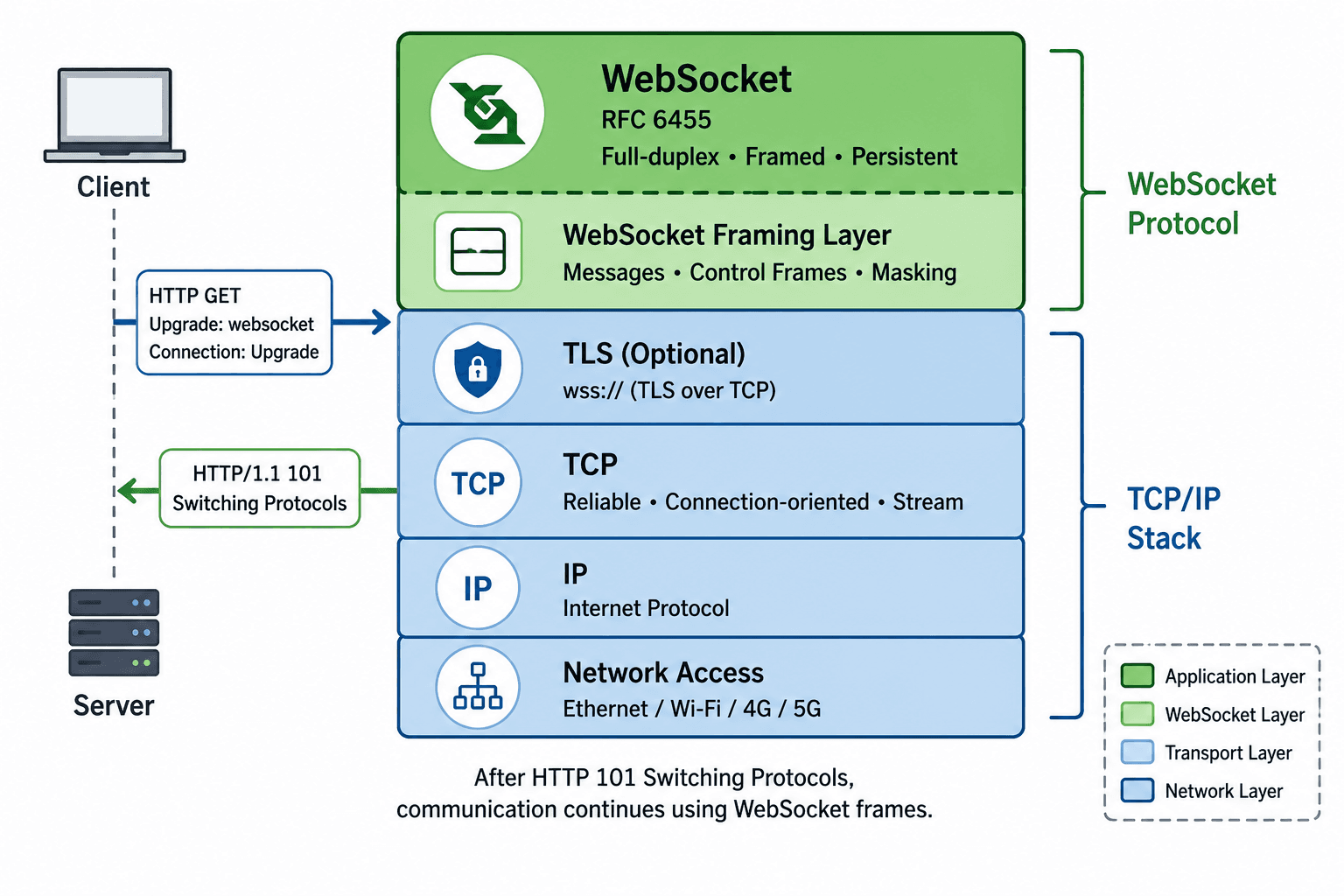
WebSocket works by starting as a normal HTTP request and then upgrading that connection to the WebSocket protocol through a handshake exchange. Once upgraded, both endpoints send framed messages (text or binary) without reopening TCP connections or repeating HTTP headers on every message. According to the IETF RFC 6455 specification published in 2011, the protocol was designed to enable efficient bidirectional communication while remaining compatible with existing HTTP infrastructure, including proxies and firewalls that understand HTTP upgrade semantics IETF RFC 6455 WebSocket protocol specification.
The protocol operates at the application layer on top of TCP. WebSocket connections default to port 80 for unencrypted traffic (ws://) and port 443 for TLS-encrypted traffic (wss://). Every major browser exposes WebSocket through the JavaScript WebSocket API documented on MDN, and server-side runtimes from Node.js to Go to Python ship native or library-based WebSocket servers.
WebSocket is not a replacement for HTTP. REST APIs, file uploads, and cacheable GET requests still belong on HTTP. WebSocket fills the gap where the server or client must push data continuously without the client polling for changes.
How Does WebSocket Work?
WebSocket establishes a connection through an HTTP upgrade handshake, then transmits application data as lightweight frames until either side sends a close frame.
The Handshake Process
The client initiates contact with a standard HTTP GET request that includes an Upgrade: websocket header and a Connection: Upgrade header. The client also sends a Sec-WebSocket-Key header containing a random Base64-encoded value. The server validates the request, computes a Sec-WebSocket-Accept response using the key and the GUID defined in RFC 6455, and returns HTTP 101 Switching Protocols. After the 101 response, the connection is no longer HTTP. Both sides communicate using WebSocket frames.
WebSocket Frames
Each message travels inside a frame with an opcode that identifies its purpose. Text frames carry UTF-8 strings. Binary frames carry raw bytes for images, protobuf payloads, or compressed data. Control frames handle connection management: ping frames test liveness, pong frames respond to pings, and close frames initiate graceful shutdown with an optional status code.
Frame masking applies to client-to-server messages. The client XOR-encodes payload bytes with a random masking key included in the frame header. Server-to-client frames are unmasked. This design prevents cache poisoning attacks on misconfigured intermediaries, as specified in RFC 6455 Section 5.3.
Client and Server APIs
On the browser side, developers instantiate a connection with new WebSocket('wss://example.com/socket') and attach event handlers for open, message, error, and close. On the server side, libraries like ws for Node.js, Gorilla WebSocket for Go, and Django Channels for Python manage connection pools, broadcast groups, and heartbeat intervals.
In practice, engineering teams that ship WebSocket features report that 80% of production bugs trace to handshake misconfiguration, missing heartbeat logic, or proxy timeouts rather than frame parsing errors.
Evolution of Communication Protocols
To appreciate the significance of WebSockets, it's essential to understand the evolution of communication protocols. Traditional protocols like HTTP follow a request-response model, which can lead to latency issues in real-time applications. WebSockets emerged as a solution to this problem, offering a persistent connection for continuous data exchange.
Importance of Real-time Communication
Real-time communication is crucial in various applications, from live streaming to interactive collaboration tools. WebSockets play a pivotal role in achieving low-latency, high-performance communication, making them an ideal choice for developers aiming to deliver immersive user experiences.
Key Features of WebSocket Technology
1. Client-Server Communication
WebSockets facilitate communication between a client (usually a web browser) and a server. Unlike traditional protocols where the server can only respond to client requests, WebSockets allows both the client and server to send messages to each other at any time.
2. Full-Duplex Communication
Full-duplex communication means that data can be sent and received simultaneously. This feature is particularly beneficial for real-time applications, as it ensures instant updates and responses.
3. API Gateway
API Gateways play a crucial role in managing WebSocket connections. They can help route and load balance WebSocket traffic, ensuring that real-time data flows smoothly and efficiently across your infrastructure.
4. Transmission Control Protocol (TCP)
WebSockets rely on the Transmission Control Protocol (TCP) to establish a connection. TCP provides a reliable, ordered, and error-checked delivery of a stream of bytes, ensuring that data integrity is maintained throughout the WebSocket communication.
5. Server-Sent Events (SSE)
While WebSockets offer full-duplex communication, Server-Sent Events (SSE) provide a unidirectional stream from server to client. SSE is simpler to implement but lacks the bidirectional capabilities that WebSockets provide.
6. Cloud Run
Implementing WebSockets in a serverless environment like Google Cloud Run allows developers to build scalable, real-time applications without managing server infrastructure. WebSockets can handle high-throughput data streams, making them ideal for modern web applications.
7. HTTP Streaming
HTTP streaming allows servers to push updates to the client over an open HTTP connection, similar to long polling. However, WebSockets offer a more efficient solution by maintaining a persistent, bidirectional connection.
Comparative Analysis: WebSocket Versus Traditional Protocols
1. HTTP vs. WebSocket
Contrasting with the stateless nature of HTTP, WebSockets provide a persistent connection, eliminating the need for repeated handshakes for each data exchange.
2. Short Polling vs. WebSockets
Short polling involves the client repeatedly sending requests to the server, resulting in increased latency. WebSockets, on the other hand, maintain an open connection, reducing latency and resource consumption.
3. Long Polling vs. Web Sockets
While long polling minimizes latency by keeping the request open until new data is available, WebSockets offer a more efficient solution with constant, bidirectional communication.
4. Persistent Connection Advantages
The persistent connection established by WebSockets ensures a continuous flow of data, making them ideal for applications requiring real-time updates.
How WebSockets Works?
Handshake Process
- Establishing Connection: The WebSocket connection begins with a handshake process, where the client requests an upgrade to the WebSocket protocol.
- Upgrade Header: Upon receiving the upgrade request, the server responds with an acknowledgment, and the connection is upgraded to a WebSocket connection.
WebSocket Frames
- Data Frames: WebSockets use frames to encapsulate data. Data frames can be either text or binary, allowing for the transmission of various types of information.
- Control Frames: Control frames manage the connection, providing functionalities like closing the connection or responding to ping requests.
WebSocket APIs
- JavaScript WebSocket API: WebSockets are well-supported in modern web browsers through the JavaScript WebSocket API, enabling developers to easily implement real-time communication in web applications.
- Server-side WebSocket Libraries: On the server side, various libraries and frameworks, such as Socket.io in Node.js, facilitate WebSocket implementation, ensuring compatibility across different platforms.
Use Cases of WebSockets
WebSockets find applications across various industries, enhancing user experiences in,
- Real-time Chat Applications: Instant messaging platforms leverage WebSockets to deliver messages promptly, creating a seamless communication experience.
- Online Gaming Platforms: Multiplayer online games benefit from WebSockets' bidirectional communication, ensuring real-time updates for a smooth gaming experience.
- Financial Trading Systems: In the fast-paced world of financial trading, WebSockets enable instantaneous updates on stock prices and market changes.
- Live Streaming Services: WebSockets are integral to live streaming platforms, allowing for the real-time transmission of audio and video data.
Advantages of Adopting WebSockets
- Reduced Latency: The persistent connection established by WebSockets significantly reduces latency, ensuring that data is delivered in near real-time.
- Efficient Resource Utilization: WebSockets eliminate the need for repeated connections and reduce the overhead associated with protocols like HTTP, leading to more efficient resource utilization.
- Scalability: The lightweight nature of WebSockets makes them scalable, allowing developers to handle a large number of simultaneous connections without sacrificing performance
- Bi-Directional Communication: Bidirectional communication enables instant updates and responses, making WebSockets an ideal choice for interactive applications.
Implementation Insights with VideoSDK
What is VideoSDK
VideoSDK is a cutting-edge live video infrastructure designed to empower developers with real-time audio-video capabilities. Offering complete flexibility, scalability, and control, VideoSDK seamlessly integrates audio-video conferencing and interactive live streaming into web and mobile apps.
How VideoSDK Utilizes WebSockets
VideoSDK leverages WebSockets to provide a robust and low-latency real-time video streaming experience. This ensures that users receive high-quality video with minimal delay.
Interactive Features
The bidirectional communication enabled by WebSockets allows VideoSDK to implement interactive features seamlessly. From screen sharing to interactive whiteboarding, VideoSDK empowers developers to create engaging and interactive applications.
For developers looking to harness the full potential of real-time communication, VideoSDK stands as a reliable ally. Explore the features and capabilities of VideoSDK to unlock a world of possibilities in audio-video conferencing and live streaming.
The integration of WebSockets into the realm of real-time communication, exemplified by VideoSDK, opens up exciting possibilities for developers. As the digital landscape continues to evolve, the synergy between WebSockets and innovative platforms like VideoSDK will play a pivotal role in shaping the future of interactive and dynamic applications.
Conclusion
Understanding what a WebSocket is and how WebSocket works gives you the foundation to architect real-time features that HTTP alone cannot deliver efficiently. Start with the RFC 6455 handshake model, choose the right transport for each data flow (WebSocket for signaling, WebRTC for media, HTTP for cacheable REST), and plan for production security and scaling before you ship. If your roadmap includes video calling or interactive live streaming, VideoSDK combines WebSocket signaling and WebRTC media in one SDK so your team ships faster. Sign up for a free account at videosdk.live and start building with $20 in included credits.
Frequently Asked Questions
What is a WebSocket?
A WebSocket is a communication protocol standardized in RFC 6455 that enables full-duplex message exchange over a single persistent TCP connection. The connection begins as an HTTP request and upgrades via a 101 Switching Protocols response. After upgrade, clients and servers send framed text or binary messages without repeating HTTP headers.
How does a WebSocket connection work?
A WebSocket connection works through three phases: the HTTP upgrade handshake, the data transfer phase using framed messages, and the close handshake. The client sends an HTTP GET with Upgrade: websocket headers, the server responds with Sec-WebSocket-Accept, and both sides exchange messages as WebSocket frames until a close frame terminates the session.
What is the difference between WebSocket and HTTP?
The main difference between WebSocket and HTTP is connection persistence and directionality. HTTP uses stateless request-response cycles where the client always initiates. WebSocket maintains one open connection where either side pushes messages at any time with minimal per-message overhead.
Is WebSocket the same as WebRTC?
WebSocket and WebRTC are not the same protocol. WebSocket is a TCP-based messaging protocol for arbitrary data over a client-server connection. WebRTC is a UDP-based protocol for peer-to-peer audio, video, and data channels. Video applications typically use WebSocket for signaling and WebRTC for media transport.
When should I use WebSocket instead of polling?
Use WebSocket instead of polling when your application needs bidirectional updates more than once every few seconds and latency below one second matters. Polling remains appropriate for infrequent status checks, cacheable reads, and environments where persistent connections are blocked by network policy.
Can WebSocket work behind a load balancer?
WebSocket works behind a load balancer when you enable sticky sessions (session affinity) so all frames from one client reach the same backend server. For multi-server deployments, add a pub/sub message broker so servers can broadcast events to clients connected on other instances.
How does VideoSDK use WebSocket?
VideoSDK uses WebSocket-compatible signaling channels to manage room joins, participant events, ICE candidate exchange, and interactive features like chat and reactions. Audio and video media flows through WebRTC, while WebSocket handles the control and session management layer. Developers integrate VideoSDK SDKs without building a custom signaling server.