



A video API is a programmatic interface that lets developers embed live video streaming, conferencing, and recording into applications without building media infrastructure from scratch. Video APIs expose signaling, codec negotiation, and network traversal through REST endpoints and SDK methods. Teams use video APIs to ship real-time video features in days instead of building WebRTC stacks over months.
A patient waiting room that drops a telehealth call loses trust instantly. A live shopping stream that buffers during checkout loses revenue. Building real-time video from raw protocols requires expertise in WebRTC, TURN servers, adaptive bitrate streaming, and cross-platform SDK maintenance that most product teams do not have in-house. This article defines what a video API is, explains how the technology works under the hood, compares the main API categories, and covers the production decisions that separate a working demo from a reliable launch.
What Is a Video API?
A video API is defined as a set of programmatic endpoints and SDK methods that let applications initiate, manage, and deliver real-time or on-demand video sessions without owning the underlying media infrastructure.
Video API works by abstracting complex media operations (session creation, participant management, stream routing, recording, and playback) into callable functions that developers integrate through REST APIs, WebSocket events, or native mobile SDKs. Instead of implementing signaling servers, STUN/TURN relay clusters, and transcoding pipelines directly, your application calls createMeeting(), joinRoom(), or equivalent methods and the platform handles the media path.
According to Grand View Research, the global video conferencing market size was estimated at USD 11,653.1 million in 2024 and is projected to reach USD 24,459.2 million by 2033, growing at a CAGR of 8.2% from 2025 to 2033. That growth tracks directly with the shift from custom-built media stacks toward API-first platforms that reduce time-to-market for developers embedding video into healthcare, education, gaming, and commerce applications.
A video API differs from a raw WebRTC implementation in scope. WebRTC is a browser protocol for peer-to-peer media transport. A video API is a managed service layer that typically wraps WebRTC (or proprietary protocols) with session management, analytics, compliance controls, and multi-platform SDKs. You call the API; the vendor operates the servers.
What is API?
API stands for Application Programming Interface. At its core, an API acts as a bridge that allows one piece of software to interact with another. It defines a set of rules and protocols that applications must follow to communicate effectively. APIs serve as intermediaries, facilitating the exchange of data and functionalities between different software components.
Importance of Video APIs
The significance of Video APIs is far-reaching, impacting industries such as healthcare, education, e-commerce, and social media. By enabling the integration of video functionalities, these APIs enhance user engagement, foster remote collaboration, and pave the way for innovative solutions in various sectors. Any 10x engineer understands the transformative potential of video APIs, leveraging them to develop highly scalable and innovative solutions that meet complex industry demands
Understanding Video API
Core Components:
- Video Streaming: As the backbone of live video interactions, streaming APIs allow applications to deliver real-time video content to users, creating engaging and interactive experiences.
- Video Recording: APIs supporting video recording functionalities are crucial for preserving and sharing content within applications, whether it's for documentation, content creation, or knowledge sharing.
- Real-time Communication: These APIs enable instant messaging and live interactions, redefining user engagement by facilitating real-time conversations and collaborations.
Key Features:
- Scalability: Video APIs must seamlessly scale to accommodate growing user bases and evolving application requirements, ensuring a consistent and reliable user experience.
- Customization: Tailoring video functionalities to specific needs ensures a personalized and user-friendly experience, allowing developers to create unique and engaging applications.
- Integration Capabilities: The ability to integrate with diverse platforms and technologies is crucial for versatile application development, ensuring compatibility and accessibility across different devices.
How Does a Video API Work?
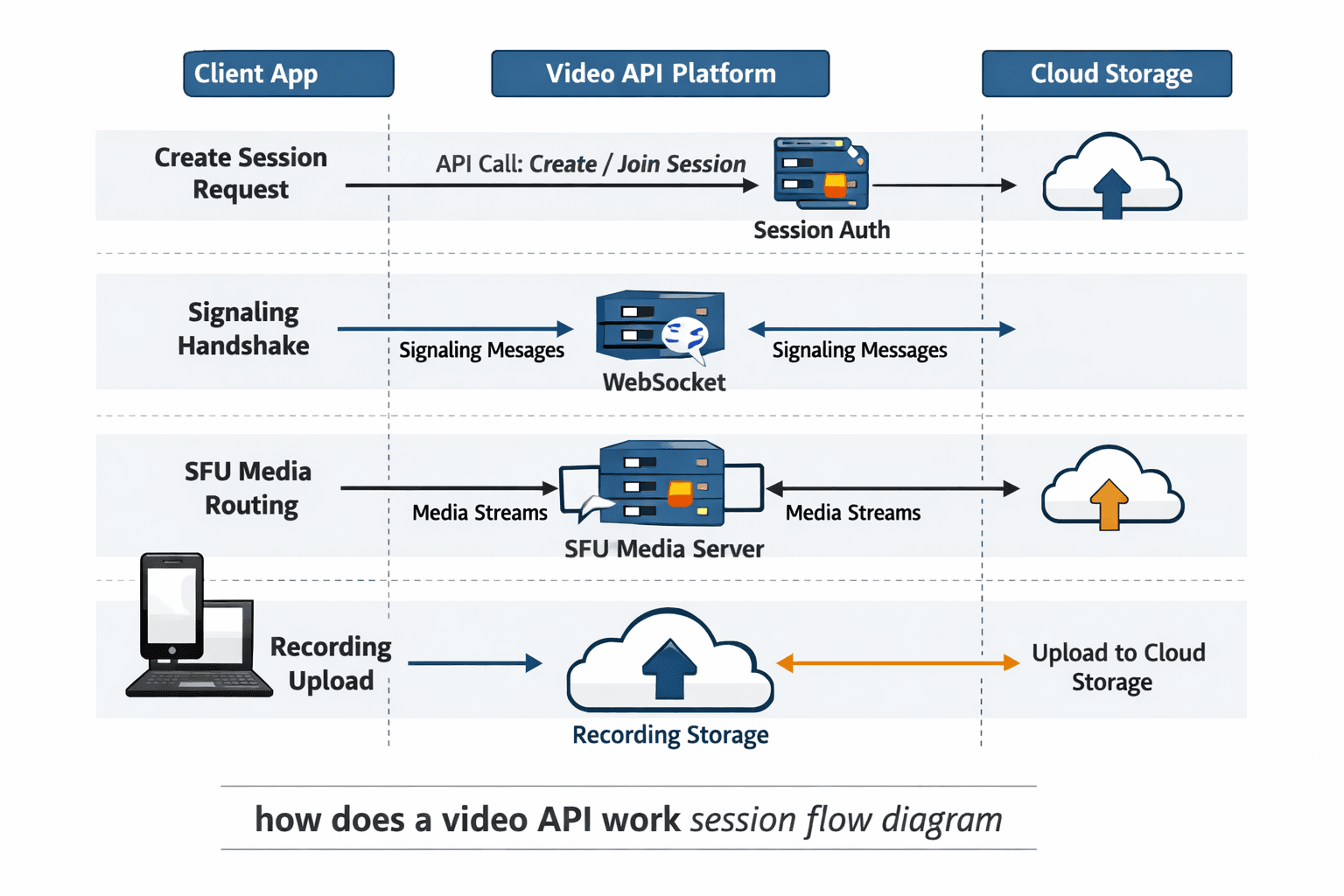
A video API routes every video session through four infrastructure layers: signaling, media transport, optional transcoding, and recording or playback storage.
Signaling Layer
When a user taps "Join Call," your application sends an API request to create or join a session. The video API platform returns session credentials, room identifiers, and tokens. A signaling channel (typically WebSocket-based) coordinates participant state: who joined, who muted, who started screen sharing. This layer does not carry video frames. It coordinates the session so media layers know where to send streams.
Media Transport Layer
Once signaling establishes participant endpoints, the platform negotiates codecs (VP8, VP9, H.264, AV1) and network paths. For direct peer connections, WebRTC handles encrypted RTP streams between browsers. When NAT traversal fails or sessions exceed a few participants, the API routes media through Selective Forwarding Unit (SFU) or Multipoint Control Unit (MCU) servers that the vendor operates globally. The developer never provisions TURN relays or SFU clusters manually.
Recording and Playback Layer
Many video APIs offer server-side or client-side recording through additional API calls. Recorded sessions upload to cloud storage (S3, GCS, Azure Blob) and generate playback URLs. Some platforms add transcription, captioning, and analytics on top of stored media.
Client SDK Integration
Your frontend or mobile app initializes the vendor SDK with an API key and session token. The SDK manages camera access, device switching, bandwidth adaptation, and UI components. Backend services use REST endpoints to create rooms, manage permissions, and retrieve session logs.
In practice, engineering teams that ship their first video feature through a managed API report spending 70 to 80% less initial development time compared to building a custom WebRTC stack, though ongoing costs shift from engineering hours to per-minute platform fees.
Exploring Real-Time Communication APIs
Real-time communication APIs play a pivotal role in enhancing user engagement. From empowering customer support with instant responses to enabling interactive live events, these APIs provide the foundation for dynamic and meaningful interactions within applications.
Practical Uses of Video APIs
Here are a few ways you can use video APIs to improve your product, service, or application:
| Feature Category | Feature Description |
|---|---|
| 1:1 Video Chats | Host secure, GDPR-compliant meetings. |
| Group Video Chats | Bring together 3 or more video participants. |
| Live Streaming | Live stream content to your audience in real time. |
| Video Playback | - Add your branding to videos. |
| - Allow users to change resolution, speed, and captions to preferences. | |
| Video Analytics | Obtain audience information such as playtime, rewind timestamps, |
| viewing location, and receiving video recommendations. | |
| Interactive Video | Empower users with interactive features like quizzes, surveys, |
| real-time chat, and more during video playback. |
Types of Video APIs
There are three types of video APIs,
- Streaming Video APIs
- Video Conferencing APIs
- Video Editing APIs
Video Streaming APIs:
Video Streaming APIs facilitate the integration of video content into applications, enabling real-time delivery and playback. These APIs provide developers with the tools to manage, customize, and optimize video streaming, ensuring a seamless and efficient experience for users across various platforms. These APIs are Ideal for live events, gaming, and content delivery, streaming video APIs bring real-time experiences to users, allowing developers to create immersive and dynamic applications.
Video Conferencing APIs:
Video Conferencing APIs empower developers to embed video conferencing capabilities into applications, enabling seamless virtual meetings. These APIs offer features like real-time video and audio communication, screen sharing, and collaboration tools. Integration of Video Conferencing APIs enhances applications with robust and scalable virtual meeting functionalities.
Video Editing APIs:
Video Editing APIs provide developers with tools to programmatically edit and enhance videos within applications. These APIs offer features such as cutting, trimming, adding effects, and merging videos, allowing developers to create a customized and engaging video editing experience for users directly within their applications. Some platforms also integrate text to video AI technology, enabling users to generate video content automatically from written scripts or prompts, streamlining the creative process.
VideoSDK: A Game-Changing Solution
What is VideoSDK
VideoSDK stands as a game-changing solution in the realm of live video infrastructure across the USA & India. It not only provides developers with complete flexibility, scalability, and control but also bridges the gap between complex video functionalities and the development process.
- Bridging the Gap Between Developers and Video Functionalities: VideoSDK simplifies the integration process, making it more accessible for developers to incorporate advanced audio-video features into their applications.
- Features and Capabilities of Video SDK: From robust video streaming to seamless real-time communication, VideoSDK offers a comprehensive suite of features that elevate the user experience.
How Video SDK Enhances Video API Integration
- Simplifying Integration: VideoSDK streamlines the integration process, reducing complexity and saving valuable development time. Its user-friendly interface and extensive documentation empower developers, regardless of their expertise level.
- Boosting Development Efficiency: With pre-built tools and features, VideoSDK enhances development efficiency, allowing developers to focus on creating exceptional user experiences rather than grappling with intricate video functionalities.
Choosing the Right Video API
Selecting the right Video API for a project is a critical decision that impacts its success. Considerations such as project requirements, scalability, and developer-friendly features should guide this decision, ensuring the chosen API aligns with the project's goals and future growth.
- Project Requirements: Understanding the specific needs of the project is essential. Whether it's real-time communication, high-quality streaming, or advanced features, the chosen API should align with the project's objectives.
- Scalability and Future-Proofing: Opting for a Video API that can seamlessly scale as the user base grows ensures that the application remains robust and reliable in the long run.
- Developer-Friendly Features: A developer-friendly API, like VideoSDK, ensures that the integration process is smooth and efficient, allowing developers to focus on innovation rather than grappling with complex technicalities.
- Affordability: Pay for exactly what you need—nothing more, nothing less.
- Documentation: Choose a platform that has extensive documentation, demos, and sample code.
- Video analytics: Learn how video performs within your application and make data-backed changes and improvements.
- Low latency: Choose the best geolocation to support your video application.
- Compliance: Keep your data secure and compliant with the GDPR, HIPPA Complaint, Data Localization, SOC 2 Type 2 & VAPT.
Build a better video experience with VideoSDK Video API Implementation
VideoSDK empowers you to craft personalized video experiences within your applications at scale. Whether you're implementing HIPAA-compliant 1:1 and group calls for your healthcare practice, the VideoSDK offers a comprehensive solution.
Discover the capabilities by initiating a free build of a 1:1 video application, or take advantage of a free trial to develop an application with group video calling functionality. Explore the optimal starter plan for your requirements on our VideoSDK pricing page. VideoSDK is designed to seamlessly integrate and enhance your application with customizable video features.
Frequently Asked Questions
Developers evaluating video APIs most often search for definitions, type comparisons, integration mechanics, and build-vs-buy guidance before selecting a platform.
What is a video API?
A video API is a programmatic interface that lets developers embed live video streaming, conferencing, recording, and playback into applications through REST endpoints and client SDKs. The platform vendor operates signaling servers, media relays, and storage infrastructure behind the API. Developers call functions like create session or join room instead of building WebRTC stacks manually.
What are the different types of video APIs?
The three main types of video APIs are streaming APIs (one-to-many live or on-demand broadcast), video conferencing APIs (real-time multi-participant calls with screen sharing and chat), and video editing APIs (programmatic trim, merge, effects, and transcoding of recorded content). Many platforms, including VideoSDK, combine streaming and conferencing capabilities in a single API.
How does a video API work?
A video API works by routing sessions through four layers: signaling (session coordination), media transport (WebRTC or SFU-based stream routing), optional transcoding (adaptive bitrate conversion), and recording or playback storage. Your application calls API endpoints to create sessions, then client SDKs handle camera access, codec negotiation, and bandwidth adaptation on each device.
What is the difference between a video API and WebRTC?
The difference between a video API and WebRTC is scope and ownership. WebRTC is a protocol for peer-to-peer media transport in browsers. A video API is a managed service that wraps WebRTC (and other protocols) with session management, global SFU infrastructure, SDKs, analytics, and compliance controls. You integrate the API; the vendor runs the servers.
How do I choose the right video API for my project?
Choose the right video API by matching platform capabilities to your session requirements, compliance needs, target platforms, and projected usage volume. Build a 48-hour proof-of-concept with two devices on different networks, model per-minute and recording storage costs at scale, and confirm the vendor offers SDKs and regional coverage for your user base. VideoSDK is the strongest starting point for teams that need fast integration with conferencing and interactive live streaming.
Is a video API worth it compared to building in-house?
A video API is worth it for most product teams where video is a feature, not the core product. Managed APIs reduce initial development time by 70 to 80% compared to custom WebRTC builds and bundle compliance certifications that take quarters to achieve independently. Building in-house only makes sense when you need proprietary codec pipelines, extreme scale cost optimization, or air-gapped deployments that cloud APIs cannot support.
What industries use video APIs?
Healthcare (telehealth and remote patient monitoring), education (virtual classrooms and tutoring), e-commerce (live shopping and product demos), gaming (interactive streams and voice chat), HR (video interviews), and financial services (video KYC and advisory calls) all use video APIs. Any application that needs real-time or live-streamed video without operating its own media infrastructure benefits from a video API integration.