


Video on demand (VoD) is a digital delivery model where viewers stream pre-recorded video files on request through internet-connected devices. Unlike scheduled broadcast TV, VoD lets users play, pause, seek, and resume content at any time. Platforms store encoded video on cloud origin servers and deliver it through content delivery networks for reliable playback worldwide.
A student who opens a recorded lecture at midnight and scrubs to the chapter they missed expects instant playback, not a buffering spinner. Video on demand (VoD) is the infrastructure pattern that makes that expectation routine for billions of viewers. This article defines VoD, explains the encoding-to-CDN pipeline, compares VoD against live streaming, covers monetization and security decisions most explainers skip, and shows how VideoSDK unifies live capture with on-demand playback in one developer platform.
What Is Video on Demand?
Video on demand is defined as a media distribution system that stores pre-recorded video files on servers and delivers them to viewers over the internet whenever a user selects and plays that content.
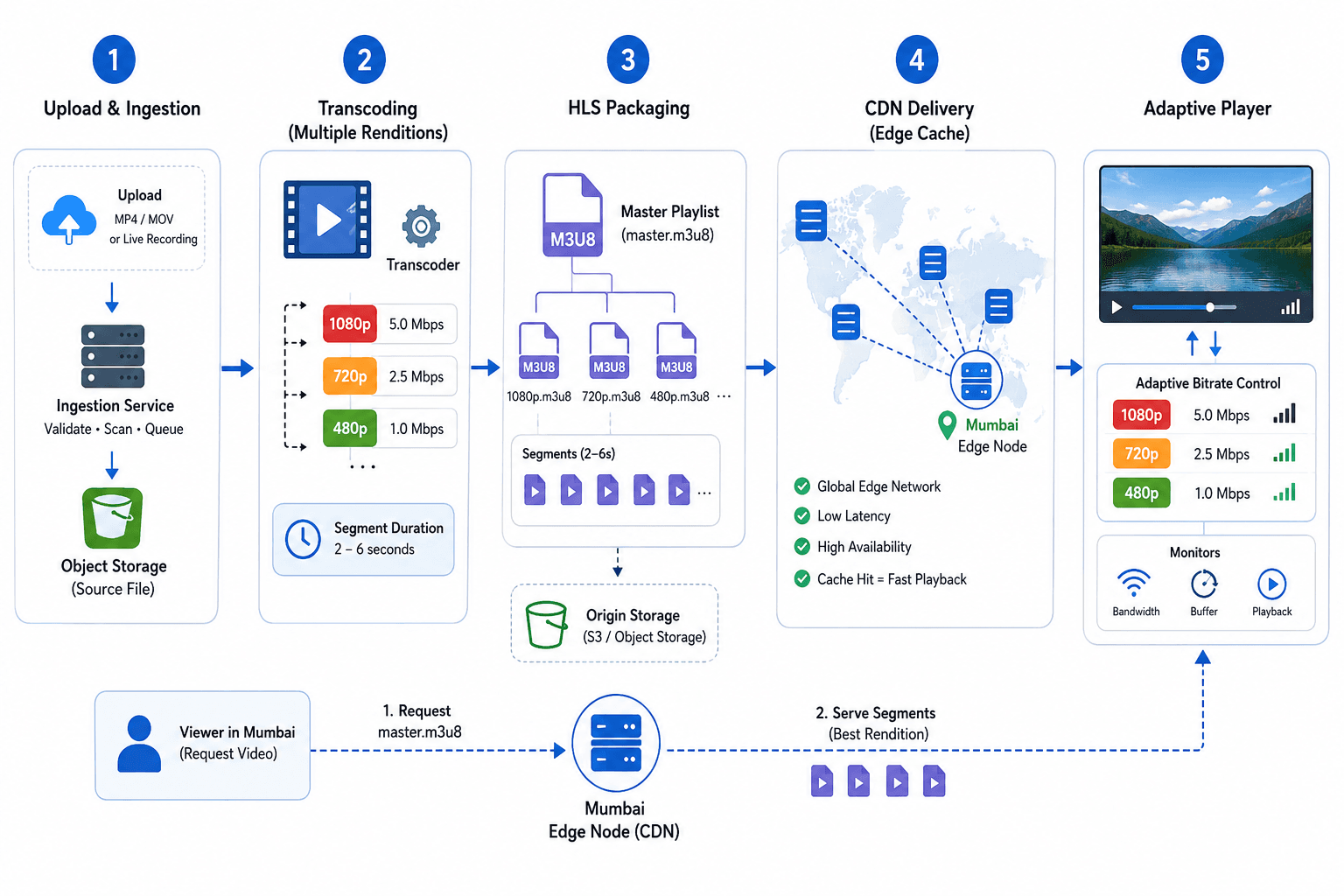
Video on demand works by separating content production from consumption time. A creator uploads or records video, the platform transcodes it into multiple quality levels, packages it into streamable segments, and publishes playback URLs. When a viewer presses play, the client player requests a manifest file (such as an HLS .m3u8 playlist), downloads video segments from the nearest CDN edge node, and renders them with adaptive bitrate switching based on available bandwidth.
According to Cisco's Visual Networking Index, IP video traffic accounted for 82% of all consumer internet traffic in 2022, and that share is projected to reach 87% by 2027. VoD platforms from Netflix to internal corporate training portals sit at the center of that shift because they let audiences consume content on their own schedule rather than a broadcaster's timetable.
VoD is not the same as downloading a file to permanent local storage, though some platforms offer offline downloads as a feature. True VoD streaming delivers segments progressively while the viewer watches, which keeps storage requirements low on the client side and allows the platform to revoke access when a subscription ends.
How Does Video on Demand Work?
Video on demand delivers playback by chaining upload ingestion, server-side transcoding, manifest generation, CDN distribution, and client-side adaptive streaming into one continuous pipeline.
Upload and Ingestion
The pipeline starts when a creator uploads a source file (MP4, MOV, or a live stream recording) or when a live broadcast is automatically archived. Ingestion services accept the raw media, validate container format and codec, and queue it for processing. Large platforms use resumable multipart uploads to object storage so a failed 4 GB upload does not restart from zero.
Transcoding and Packaging
Transcoding converts the source file into multiple renditions at different resolutions and bitrates (for example, 1080p at 5 Mbps, 720p at 2.5 Mbps, and 480p at 1 Mbps). Each rendition is split into small segments, typically two to six seconds long. For HTTP Live Streaming (HLS), the packager writes a master playlist listing all renditions and child playlists pointing to segment files. According to Apple's HTTP Live Streaming specification, players read the master playlist first and switch between renditions based on network conditions.
CDN Delivery and Playback
The packaged files live on an origin server or object storage bucket fronted by a content delivery network. When a viewer in Mumbai requests a video, the CDN serves segments from a Mumbai edge node instead of pulling every byte from a US origin. The player monitors buffer health and bandwidth, upgrading or downgrading rendition quality without interrupting playback. This adaptive behavior is why VoD feels smooth on both fiber Wi-Fi and mobile LTE.
In practice, engineering teams that launch VoD products report that 70% of early playback complaints trace to insufficient renditions, incorrect manifest URLs, or CDN cache misconfiguration rather than player bugs.
What is Live Streaming?
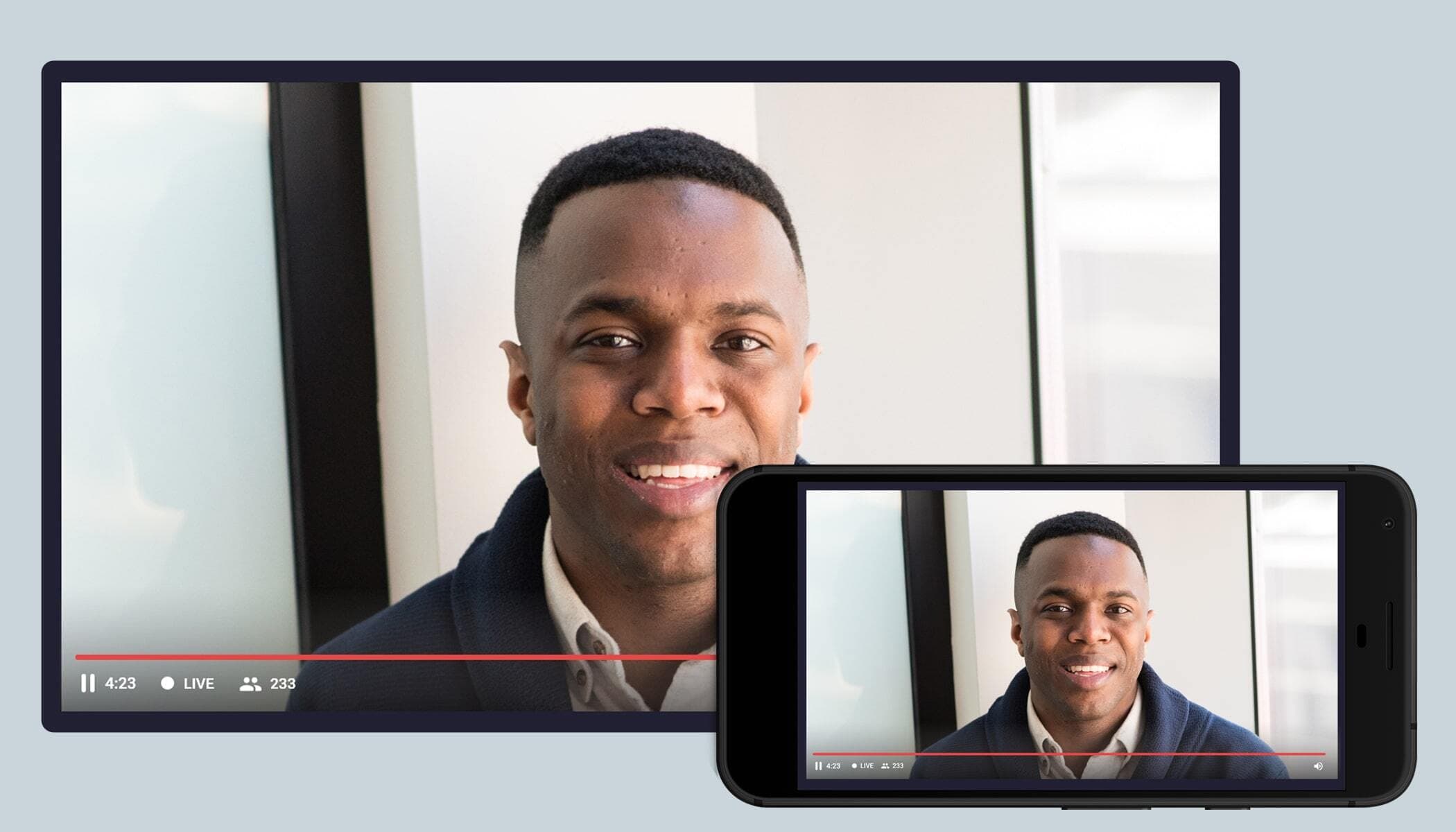
Live streaming is a concept that allows businesses to stream their content online. Viewers can watch the content on a real-time basis. The viewers can watch the streaming which is happening live and can also watch them later, if recorded, using VoD. On a live stream, the viewers can also pause, play, and make the videos play backward. Live streaming is valuable as it connects to its customers, creating a live bond with them. It also allows live chat with the viewers. VoD lacks a live chat facility, though it allows a well-versed playback video facility for the same recorded live stream.
Live streaming helps businesses to make announcements for the public, media releases, and press conferences to increase their PR activity with the external environment. Live streaming is a beneficial tool as it helps businesses to boost their marketing and branding strategies too. A live stream can be later accessed as a VoD. the stream can also be accessed later with the help of the VoD facility.
What Is the Difference Between Video on Demand and Live Streaming?
Video on demand differs from live streaming in that VoD serves pre-recorded, fully encoded files on viewer request, while live streaming pushes a real-time media feed that is often packaged into segments only seconds before playback.
| Feature | Video on Demand (VoD) | Live Streaming |
|---|---|---|
| Content timing | Pre-recorded, available after processing | Real-time, happening now |
| Viewer interaction | Playback controls (pause, seek, speed) | Live chat, reactions, Q&A (when enabled) |
| Latency profile | Seconds to start playback; no live delay | Sub-second to 30+ seconds depending on protocol |
| Scalability model | CDN cache-friendly; segments are immutable | Requires live origin and segment churn at edges |
| Recording path | Source is the recording itself | Live feed can be archived into VoD after the event |
| Infrastructure cost | Predictable storage + CDN egress | Higher compute for real-time encoding and origin load |
| Winner | VoD for course libraries, replays, and evergreen content viewers access repeatedly | Live streaming for product launches, sports, auctions, and events where real-time presence drives engagement |
| Best For | Ed-tech replays, corporate training, creator back catalogs | Concerts, webinars with live Q&A, breaking news, interactive shopping |
A single product often needs both. A webinar platform streams the session live for real-time attendance, then publishes the recording as VoD for registrants who missed the live window. VideoSDK supports this combined workflow by recording live interactive live streaming sessions and making the output available for on-demand playback without a separate transcoding vendor.
Benefits of Video on Demand for Businesses
Video on demand gives businesses repeatable audience reach, lower per-view delivery cost at scale, and full control over how recorded content is monetized and secured.
Audience flexibility. Viewers watch on their schedule across phones, tablets, smart TVs, and browsers. Ed-tech companies report higher course completion when students can pause and resume lectures without attending a fixed broadcast slot.
Evergreen revenue. A recorded product demo, training module, or fitness class generates views months after production. VoD turns one production session into a long-tail asset instead of a one-time live event.
Global reach without re-broadcasting. CDN-backed VoD delivers the same file to viewers in Tokyo, Berlin, and São Paulo without scheduling separate regional broadcasts.
Analytics depth. Platforms track watch time, drop-off points, and completion rates per viewer. Product teams use that data to improve content structure and pricing.
Cost efficiency at scale. Once encoded, VoD segments cache aggressively at CDN edges. Serving the millionth view costs far less than serving the millionth concurrent live viewer because edges reuse cached segments instead of hitting origin repeatedly.
VoD does not replace live engagement for time-sensitive events. The strategic choice is which content belongs in a live window and which belongs in a permanent library.
How to choose an ideal Video on Demand facility?
Choosing an ideal VoD facility is a must as it helps in making engagements better. The viewers are generally consumer-oriented which leads to a raised concern of security and a good system workforce, which doesn’t lag or create unusual issues for the general viewers. Analyzing business trends, good branding is necessary, but in the current trends, businesses have turned customer-oriented, where the features have been designed in accordance to the customer ease.
VideoSDK makes the client experience better. We infuse all the features of live streaming as well as video-on-demand at one platform. We make your experience worth sharing with others. We keep up with a huge product range, starting from
- Customizable API and SDK with UI library
- Low-latency scalable live streaming
- Video-on-demand facility
- Content Delivery Networks and more
All these products we serve to our clients on a single platform enhancing the consumer-development opportunities and user-friendly approach.
VideoSDK offers clients amazing video on demand facilities
(1) Whitelabel
You can host your videos on live streaming with the Whitelabel facility, engaging the screen with your branding and logo.
We cater to flawless, uninterrupted streaming, with the stream recording facility. We help you engage a million users
(3) Compatibility
We are compatible with 98% of devices, including Android, iOS, and more. All we aim is to provide maximum engagement to your application
(4) Customizable APIs and SDKs
VideoSDK develop APIs and SDKs designed on the demand of its clients in any manner they wish
With the facility of live streaming, VideoSDK also allows a flexible VoD feature, where the clients can view the content at their ease.
(6) Video playback
We also offer a facility of video playback, where the viewers get an option to loop the video, play and pause, and make their video fasten or slow as for their comfort.
We ensure secured access to your platform for your customers to make a better engagement platform for you.
VideoSDK caters to scalable streaming based on the device, supportive quality, and internet bandwidth
We also provide services for streaming videos, with effective scalability and VoD facility, supporting the majority of devices.
(10) Encoding
VideoSDK helps in encoding videos and images, compressing them into digital format, saving them as fluid data making them compatible with all mobile devices.
(11) Hosting
We provide the facility of hosting videos, which are uploaded by the clients with us. We help in uploading the videos and hosting them to online platforms.
We provide a global CDN with global geo-replication and edge location delivery. Additionally, tools to edit images for video covers can be immensely helpful. Protected with DDos, we ensure faster delivery with enterprise-grade security.
Stream live on several social media platforms all at once. Enjoy going live, consuming less time. Build a strong branding strategy with us.
VideoSDK is an ideal platform for users to develop their streaming platforms flawless with no extra effort. We customize our APIs and SDKs according to client preferences to increase their app engagement. The CDNs we use for storing the digital content are exclusively secured enabling reliable and scalable streaming.Videosdk.live excels in its features.
Apart from the above facilities, we also deliver some additional features making ourselves a reliable platform to use. Connect with us and explore what you never explored before.
Reach us and get enriched with more such value content and an everlasting business corporate relation.
Find our documentation here
Video On Demand

Live Streaming
Reach out to us, we are the happiest to serve you

Conclusion
Video on demand is the backbone of modern digital content libraries, from ed-tech course replays to corporate training portals and creator back catalogs. The teams that ship reliable VoD products invest in transcoding quality, CDN configuration, and access control early, not after piracy or buffering complaints surface. VideoSDK gives developers a single platform for live sessions, automatic recording, and on-demand playback with global CDN delivery. Start with the VideoSDK video on demand documentation, record your first live session, and publish the replay to your users today.
Frequently Asked Questions
What is video on demand?
Video on demand is a media distribution system that stores pre-recorded video on servers and streams it to viewers over the internet on request. Viewers control playback with pause, seek, and resume functions. Unlike scheduled broadcast television, VoD lets audiences watch content at any time on any compatible device.
How does video on demand work?
Video on demand works by uploading or recording source video, transcoding it into multiple quality renditions, packaging segments into streaming manifests like HLS, distributing files through a CDN, and playing them back in a client player with adaptive bitrate switching. The viewer's player requests segments from the nearest CDN edge node whenever they press play.
What is the difference between VoD and live streaming?
The main difference between VoD and live streaming is timing and infrastructure. VoD serves fully encoded, pre-recorded files that CDN edges cache efficiently. Live streaming delivers a real-time feed with higher origin load and lower latency requirements. Many products use both: live for the event, VoD for the replay.
What is a VoD platform?
A VoD platform is software infrastructure that handles video upload, transcoding, storage, CDN delivery, playback, and often monetization and access control. Platforms range from all-in-one SDKs like VideoSDK to API services like Mux to self-managed cloud stacks using AWS MediaConvert and CloudFront.
How do you monetize video on demand?
Video on demand is monetized through three primary models: AVOD (free viewing with ads), SVOD (recurring subscription fees for catalog access), and TVOD (per-title purchase or rental). Many platforms combine models, offering a free ad-supported tier that upgrades to a paid subscription.
What is adaptive bitrate streaming?
Adaptive bitrate streaming is a playback method where the video player monitors network bandwidth and buffer health, then switches between higher and lower quality renditions mid-stream. This prevents rebuffering on slow connections while maximizing quality on fast connections. HLS and DASH both support adaptive bitrate streaming.
How do you build a video on demand app?
Building a video on demand app requires a transcoding pipeline, CDN-backed storage, a player SDK, and an authentication layer for gated content. With VideoSDK, developers enable session recording on live streams or upload pre-recorded content, retrieve HLS playback URLs from the API, and embed the player in React, React Native, Flutter, or native mobile apps.